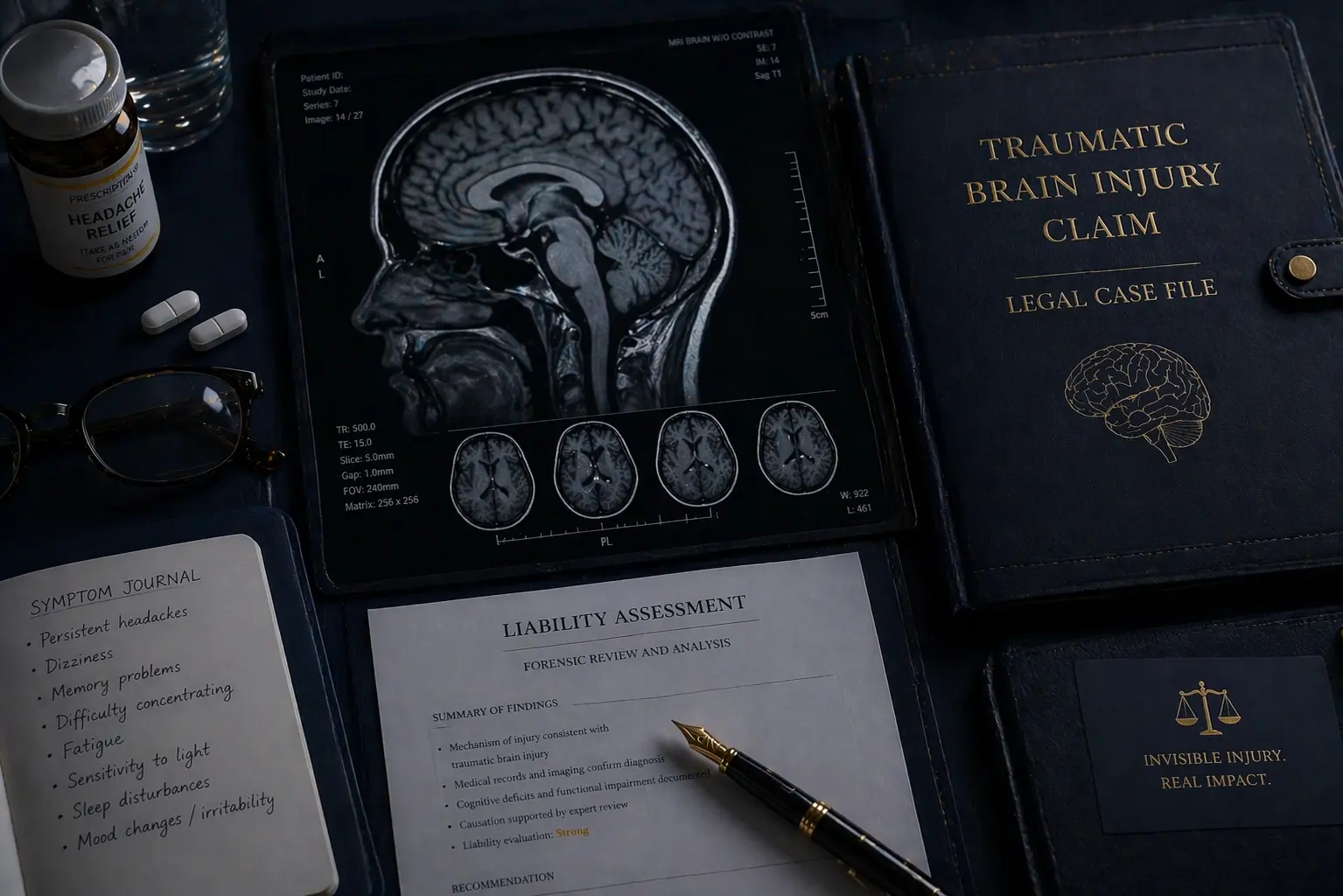
The gap between a brain injury claim that is documented and argued effectively and one that is not can be hundreds of thousands of dollars.
Types of TBI and How Ontario Courts Treat Them
Concussion (Mild TBI)
Concussions are the most common and most frequently minimized brain injuries in car accident claims. Insurance companies often use the word “mild” to suggest that the injury is temporary and insignificant. Ontario courts have rejected this framing repeatedly.
Post-concussion syndrome — persistent cognitive symptoms following a concussion that do not resolve within the expected timeframe — is a recognized, compensable condition. Headaches, light sensitivity, difficulty concentrating, memory problems, fatigue, and emotional dysregulation that persist for months or years after an accident can satisfy the threshold test and support significant pain and suffering awards.
The key is documentation. A concussion diagnosed immediately after an accident, followed by consistent specialist treatment, neuropsychological assessment, and ongoing symptoms documentation, builds a very different evidentiary record than one diagnosed weeks later without continuous treatment.
Moderate TBI
Moderate traumatic brain injury — defined by a period of loss of consciousness of 30 minutes to 24 hours, or a Glasgow Coma Scale score of 9 to 12 at presentation — typically produces more significant and longer-lasting cognitive impairment than concussion.
Victims of moderate TBI often experience permanent changes in memory, processing speed, executive function, and emotional regulation. These changes affect the ability to work, maintain relationships, and live independently in ways that are well-documented in the neuropsychological and neurological literature and well-established in Ontario courts.
Severe TBI and Catastrophic Designation
Severe traumatic brain injury — significant loss of consciousness, extended post-traumatic amnesia, Glasgow Coma Scale score below 9 — frequently produces impairment that qualifies for catastrophic designation under the SABS. A CAT designation triggers enhanced accident benefits of up to $1 million for medical and rehabilitation needs and up to $1 million for attendant care.
Beyond the SABS stream, severe TBI cases involve extensive tort claims for future care costs, lifetime income loss, and non-pecuniary damages that can reach into the millions of dollars in the most serious cases.
Proving Cognitive Damage: The Evidence That Matters
The central challenge in any brain injury claim is translating subjective cognitive and emotional experiences into objective, measurable evidence that courts and insurers can assess. The key tools are:
Neuropsychological assessment. A comprehensive neuropsychological evaluation conducted by a registered neuropsychologist measures cognitive function across multiple domains — memory, attention, processing speed, executive function, language. This assessment establishes a baseline of impairment and documents how the injury has affected the claimant’s cognitive profile relative to expected norms.
Neuroimaging. MRI and CT scans can document structural brain changes in moderate to severe TBI. More advanced imaging techniques — including functional MRI and diffusion tensor imaging — can identify white matter tract injuries and connectivity disruptions that standard imaging may miss.
Functional capacity evaluation. An FCE documents what the injured person can and cannot do in practical terms — sustained cognitive work, multi-tasking, response to stress — providing a functional picture of impairment’s real-world impact.
Expert testimony. Neurologists, neuropsychologists, and brain injury rehabilitation specialists can provide expert evidence at trial or in settlement negotiations about the nature, permanence, and future trajectory of the injury.
Psychological Injuries as Standalone Compensable Damages
Post-traumatic stress disorder, major depressive disorder, and anxiety disorders that follow a serious accident are independently compensable in Ontario personal injury law. They do not need to accompany a physical injury to be actionable — though they often do.
In brain injury cases, the co-occurrence of cognitive impairment and psychological injury is extremely common. The accident that caused the TBI may also produce PTSD from the trauma of the collision itself. The resulting cognitive limitations may cause profound depression. The disruption to relationships, career, and identity that follows a serious brain injury may trigger anxiety and grief responses that require long-term psychological treatment.
All of these conditions, when medically documented and supported by expert evidence, contribute to both pain and suffering awards and future care cost projections.
What Drives Settlement Value in Brain Injury Cases
The factors that most significantly affect the settlement value of an Ontario brain injury claim are:
Permanence. Injuries that medical evidence establishes as permanent — or with a poor prognosis for meaningful recovery — attract significantly higher awards than those with an uncertain or potentially positive prognosis.
Impact on employment. Lost future earning capacity is often the largest single component of a serious brain injury claim. The difference between a claimant who can return to modified work and one who cannot work at all represents potentially decades of income loss quantified at present value.
Age at injury. Younger claimants have longer periods of productive working life ahead of them, resulting in larger future income loss projections.
Future care costs. Long-term rehabilitation, attendant care, assistive technology, and home modifications for catastrophically impaired claimants are calculated by life care planners whose evidence can add millions to a claim.
Quality of the evidentiary record. Cases with thorough neuropsychological documentation, consistent specialist treatment, and well-qualified expert witnesses settle for more and fare better at trial.
Cambria Law’s Results
At Cambria Law Firm, we have recovered over one million dollars in brain injury settlements for clients in Mississauga, Toronto, and the GTA. These results reflect our commitment to building complete evidentiary records, working with the right experts, and pursuing maximum recovery across both the SABS and tort streams.
Call 416-840-7545 or contact us online for a free consultation. No fees unless we win.