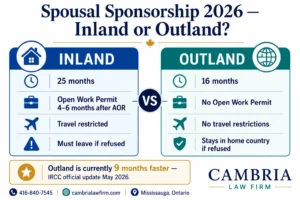
Spousal sponsorship takes 16 months for outland applications and 25 months for inland applications in 2026, based on IRCC’s official figures as of May 2026. A single missing document or expired police certificate returns the file to you — and the clock resets to zero.
At Cambria Law, we build spousal sponsorship files the way an IAD appeal panel would need to see them — anticipating every refusal ground before the application is submitted, not after it is refused.
Inland vs Outland — The Decision That Shapes Your Entire Application
| Inland | Outland | |
|---|---|---|
| Who applies | Spouse already in Canada | Spouse outside Canada |
| 2026 processing time | ~25 months | ~16 months |
| Open Work Permit | Available ~4–6 months after AOR | Not available |
| Travel outside Canada | Restricted — ATA required from IRCC | No restrictions |
| If refused | Must leave Canada | Remains in home country |
What IRCC Is Actually Evaluating
Every sponsorship file is assessed on three dimensions. Sponsor eligibility establishes that the Canadian citizen or permanent resident is legally entitled to sponsor — meaning they are 18 or older, not receiving social assistance, have not defaulted on a previous undertaking, and have no disqualifying criminal convictions.
Applicant admissibility establishes that the sponsored spouse has no criminal, health, or security inadmissibility that would prevent permanent residence. Police certificates and medical examinations address this dimension.
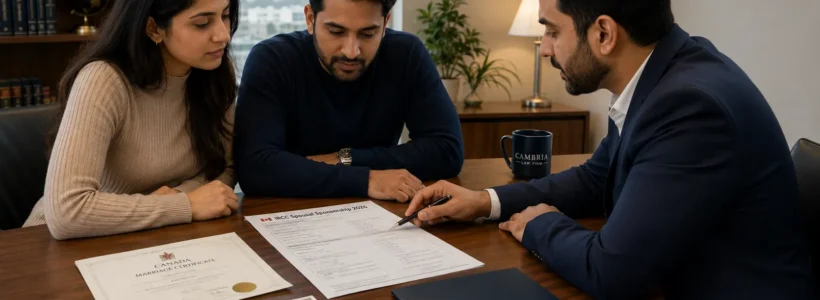
Genuineness of relationship is where most refusals originate. IRCC officers are specifically trained to identify relationships entered primarily for immigration purposes. An officer reviewing your file has never met you and is making a determination based entirely on the documents, photographs, and declarations in your package. A thin relationship evidence package — a marriage certificate and five photographs — is not sufficient for high-refusal-rate applicant profiles. The relationship narrative must be built deliberately.
The Four Most Common Refusal Grounds
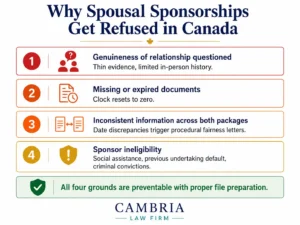
1. Genuineness of relationship questioned. The most frequent ground. Officers assess total relationship history — how and when you met, time spent together in person, shared financial history, family awareness, community knowledge of the marriage. A short acquaintance, limited in-person contact, or a timeline that raises officer questions creates refusal risk regardless of how genuine the marriage is.
2. Missing or expired documents. IRCC returns incomplete applications without processing them. Police certificates must be under six months old at the time of submission — not when you ordered them. If IRCC processing is slow and your certificate expires before your file is complete, you must obtain a new one. Cambria Law tracks every document expiry date for every client file throughout the application.
3. Inconsistent information across packages. The sponsor submits one package. The applicant submits another. IRCC compares them for consistency. Dates, addresses, employment history, and relationship timelines must match precisely across both. A date discrepancy between the sponsor’s forms and the applicant’s travel history is enough to generate a procedural fairness letter — which adds months to the processing timeline.
4. Sponsor ineligibility. A sponsor who has received social assistance in the past, defaulted on a previous immigration undertaking, or has certain criminal convictions cannot sponsor regardless of how strong the relationship evidence is.
How We Can Help With Your Spousal Sponsorship
- We assess both inland and outland options and tell you which gives you the best outcome for your specific situation — not just the faster one.
- We build the complete relationship evidence package — photographs, communication records, shared financial history, affidavits from family and friends.
- We track every document expiry date throughout the application so a lapsed police certificate never resets your clock.
- We apply for the Spousal Open Work Permit simultaneously for inland applicants so your spouse can work while you wait.
- We file IAD appeals within the 30-day window if the sponsorship is refused — call us the day you receive the decision.
- Free assessment for all spousal and common-law sponsorship situations.
What Happens if Your Sponsorship Is Refused
A refusal triggers the 30-day IAD appeal window. You have exactly 30 days from the date you receive the refusal letter to file an Immigration Appeal Division appeal. There are no extensions. Missing this deadline permanently forfeits your right to appeal this decision.
At the IAD, you have the opportunity to present additional evidence that was not in the original application, including new photographs, updated communication records, sworn affidavits, and witness testimony. Many refusals based on genuineness of relationship are overturned at the IAD when a comprehensive evidence package is properly organised and presented.
Call Cambria Law the day you receive a refusal. Not the next day.
Key 2026 Timelines and Figures
| Item | 2026 Figure |
|---|---|
| Outland processing time | ~16 months (IRCC official, May 2026) |
| Inland processing time | ~25 months (IRCC official, May 2026) |
| Spousal Open Work Permit | ~4 to 6 months after AOR (inland only) |
| Police certificate validity | Under 6 months at submission |
| IAD appeal deadline if refused | 30 days — no extensions |
| Government fees | ~$1,315 CAD (2026) |
| 2026 Family Class admission target | 69,000 |
Frequently Asked Questions
Is there a minimum income requirement for spousal sponsorship?
No fixed income threshold applies to most spousal and common-law partner sponsorships. The sponsor must demonstrate they are not receiving social assistance — but there is no minimum dollar amount required. The exception is if the sponsored spouse has dependent children, in which case the Low Income Cut-Off threshold applies based on total family size. Cambria Law confirms your financial eligibility at your first consultation before any application work begins.
Can my spouse work in Canada while the sponsorship is processed?
Only for inland applications. If your spouse is already in Canada and you file inland, they can simultaneously apply for a Spousal Open Work Permit. The SOWP processes in approximately 4 to 6 months after IRCC’s Acknowledgment of Receipt and is an open permit — any employer, no LMIA required. For outland applications, the sponsored spouse has no Canadian work authorisation until PR is approved.
Our sponsorship was refused. What are the realistic chances of success at the IAD?
Success at the IAD depends heavily on the specific refusal ground and the quality of the additional evidence presented. Refusals based on genuineness of relationship — the most common ground — are frequently overturned when the appeal file includes a comprehensive relationship timeline, additional photographs and communication records, sworn affidavits from family and friends, and clear explanations for any timeline gaps the officer identified. Cambria Law reviews every refusal letter and identifies exactly what additional evidence is required for the appeal.