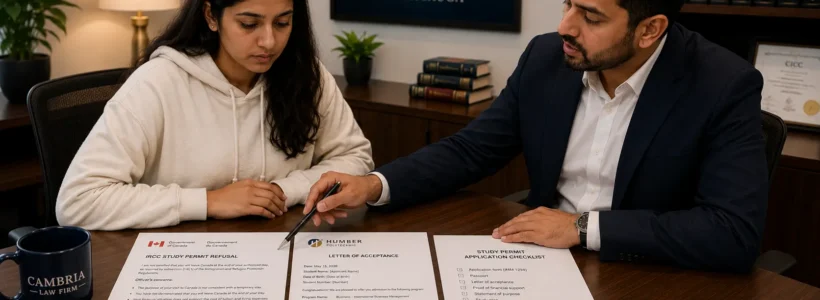
IRCC officers are required to record their refusal reasons. When a study permit is refused, the refusal notes obtained through an Access to Information request identify the officer’s exact concern.
The most common grounds are insufficient ties to the home country, an unclear purpose of study, and inadequate financial documentation. Cambria Law Firm rebuilds the application around those specific concerns instead of resubmitting the same file with a new fee.
Study Permit Requirements — What Every Application Must Include
A study permit application is not just a school acceptance letter. IRCC needs to see that the program is legitimate, the money is available, the purpose of study makes sense, and the student has a reason to leave Canada when authorized status ends.
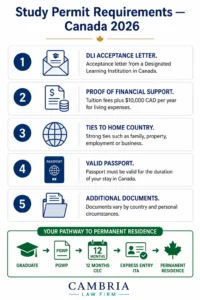
Letter of acceptance from a Designated Learning Institution. Canada’s DLI list includes provincially approved educational institutions. Acceptance from a non-DLI institution is not enough. The acceptance letter must be current and must clearly identify the program, start date, and expected duration.
Proof of financial support. The applicant must demonstrate sufficient funds to cover tuition for the full program plus living costs. IRCC accepts bank statements, investment account statements, proof of scholarship, and letters of financial support from a sponsor. The funds must be accessible. A letter promising future support without accompanying account documentation is usually not sufficient.
Ties to the home country. This is one of the most frequently cited refusal grounds. The officer must be satisfied that the student will leave Canada after completing their studies. Evidence can include employment in the home country, family obligations, property ownership, and other commitments that demonstrate a reason to return.
Valid passport and identity documents. The passport should remain valid for the expected duration of the studies plus a buffer period. If the passport expires during the study period, it should be renewed before the study permit application is submitted.
How We Can Help With Your Study Permit
- We build first-time applications with the ties evidence and financial documentation officers expect from high-refusal-rate countries.
- We obtain the officer’s refusal notes through an ATIP request and identify the specific concern before reapplying.
- We plan your full study-to-PR pathway from day one: study permit, PGWP, CEC eligibility, and Express Entry ITA.
- We advise on program changes, DLI transfers, and permit amendments before you make a move that creates a compliance issue.
- We apply for your PGWP within the 180-day window after graduation — open permit, any employer, no LMIA required.
- Free assessment for all international students and prospective applicants in Ontario.
The PGWP Pathway — What Every Study Permit Applicant Should Plan For
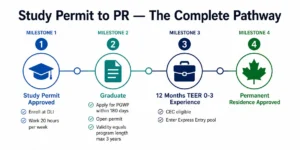
For many international students in Ontario, the study permit is not the final goal. It is the first step in a longer pathway: study permit, Post-Graduation Work Permit, Canadian work experience, Canadian Experience Class, and then permanent residence.
International students who complete eligible programs at Designated Learning Institutions may apply for a Post-Graduation Work Permit within 180 days of receiving their final marks or transcript. The PGWP is an open permit. That means any employer in Canada, with no LMIA required.
The length of the PGWP usually depends on the length of the completed program, up to a maximum of three years. Work experience gained on a PGWP in a TEER 0, 1, 2, or 3 occupation can build directly toward Canadian Experience Class eligibility for Express Entry.
Cambria Law Firm plans the full pathway from the initial consultation. Understanding the destination changes how the first application is built. A study plan that makes sense for school admission may not be enough for IRCC. The officer needs to understand why this program, why Canada, why now, and what happens after graduation.
Key Study Permit and PGWP Figures — 2026
| Item | Requirement or Figure |
|---|---|
| School requirement | Acceptance from a Designated Learning Institution |
| Financial proof | Tuition plus living costs and accessible supporting funds |
| Most common refusal issues | Home country ties, purpose of study, and financial documentation |
| PGWP application window | Within 180 days of final marks or transcript |
| PGWP work authorization | Open work permit — any employer, no LMIA required |
| CEC work experience target | 12 months in a TEER 0, 1, 2, or 3 occupation |
Frequently Asked Questions
My study permit was refused twice. Can I apply a third time?
Yes. There is no fixed limit on the number of study permit applications. But a third application that does not meaningfully address the refusal grounds will likely be refused on the same basis.
Before applying again, Cambria Law Firm obtains the officer’s refusal notes through an ATIP request, identifies the specific concerns, and builds the reapplication to address each one. In many cases, that means new financial documentation, a restructured purpose of study letter, or stronger ties evidence.
Can I work while studying in Canada on a study permit?
Yes. Full-time students at Designated Learning Institutions can usually work part-time off campus during academic sessions and full-time during scheduled breaks, if they meet the eligibility rules. No separate work permit is required for eligible off-campus work.
After graduation, eligible students can apply for a PGWP, which provides open work authorization for any employer in Canada.
I received my study permit, but my program changed. Do I need a new permit?
Not necessarily. But you may need to notify IRCC of significant changes to your study program or institution. Transferring to a different DLI, extending your program beyond the permit’s expiry date, or changing to a program category not covered by your current permit may require an amendment or a new application.
Contact Cambria Law Firm before making any program change so the IRCC notification or application requirement can be confirmed before the move is made.