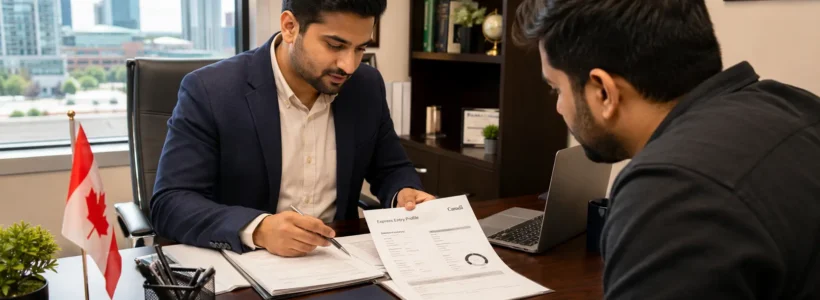
Most immigration applications fail not because the applicant does not qualify — but because the file was not built the way an IRCC officer expects to see it.
At Cambria Law Firm, we review every immigration file the way a refusal officer would — before it is submitted. A missing document, an inconsistent date, or a narrative that does not connect your personal history to a recognized legal ground is enough to close your file. We find those gaps before IRCC does.
What Most People Do Not Realize About Immigration Applications
Canadian immigration is not a form-filling exercise. It is a legal process where IRCC officers make discretionary decisions based on the totality of your file. Two people with similar qualifications can receive completely different outcomes because one file was clear, complete, and officer-ready — and the other was not.
The difference between an approval and a refusal is rarely the applicant’s eligibility. It is almost always the completeness, consistency, and strategic presentation of the file. This is what Cambria Law Firm does before submission — when the file can still be strengthened, corrected, and positioned properly.
Immigration Services Every Pathway We Handle
Express Entry and CEC
CRS strategy, draw category positioning, profile optimization, and 60-day ITA submission management.
OINP and Provincial Nominees
Ontario streams closed May 30, 2026. Federal draw alternatives and new stream monitoring.
Spousal Sponsorship
Complete file preparation, relationship evidence, Open Work Permit, and IAD appeal strategy for refusals.
Work Permits and LMIA
Employer-specific and open work permits, LMIA applications, maintained status, and BOWP for PR applicants.
Visitor and Super Visa
Targeted reapplications after refusals, Super Visa files for parents and grandparents, and $100,000 insurance guidance.
Study Permits
First applications and refused reapplications. Post-study PGWP planning and CEC pathway strategy.
Refugee Claims
Basis of Claim preparation, RPD hearing preparation, RAD appeal deadlines, and PRRA planning when removal approaches.
Humanitarian and Compassionate
Section 25 IRPA applications, establishment evidence, best interests of children, and country conditions analysis.
Removal Order Appeals
IAD appeal planning within the strict 30-day window. Departure, exclusion, and deportation order strategy.
Denied Entry and Inadmissibility
Criminal inadmissibility, DUI offences, Temporary Resident Permits, deemed rehabilitation, and individual rehabilitation.
Pre-Removal Risk Assessment
15-day PRRA confirmation window, evidence preparation, and urgent Federal Court stay strategy from Day 1.
Why Most Immigration Refusals Are Preventable
Most immigration refusals come down to two things. Documentation — a missing certificate, an expired result, something that did not match — or narrative, which is the more frustrating one. The evidence was there. The legal connection was never drawn.
Genuine ineligibility does happen. But it is not the reason behind every refusal. Many people who are refused had a file that could have been stronger before submission. The problem was not always the person. It was the way the file was built.
At Cambria Law Firm, we build every file to reduce both risks before IRCC makes a decision. If a refusal has already happened, we identify what caused it and then decide whether the correct next step is a targeted reapplication, appeal, reconsideration request, judicial review, or urgent stay strategy.
How Cambria Law Firm Can Help With Your Immigration File
- We review your file the way a refusal officer would before you submit, not after you are refused.
- We identify documentation gaps, expired certificates, and narrative inconsistencies that IRCC uses to close files.
- We build your strategy around the specific draw, stream, remedy, or program that gives you the strongest realistic path.
- We manage every deadline — ITA windows, appeal periods, permit renewals, PRRA timelines, and removal-related dates — so nothing falls through.
- We prepare first-time applications, refused reapplications, appeal files, and urgent escalation matters based on what your situation actually requires.
- We offer a free consultation where you speak directly with Vick Sidhu, RCIC R705820, not a call centre or generic intake process.
Your File Is Reviewed by the Right Professional From the Start
Immigration files do not all need the same strategy.
A first-time Express Entry, work permit, study permit, visitor visa, or spousal sponsorship application needs careful eligibility review, complete documents, clean timelines, and a file narrative that makes sense to an IRCC officer.
A refused application, removal order, Federal Court deadline, or appeal needs a different level of legal strategy. That is where timing matters. So does choosing the correct remedy. A rushed reapplication can waste months if the real issue was something that should have gone to appeal or judicial review.
At Cambria Law Firm, your file is reviewed based on what is actually at stake — not pushed into a generic process.
Vick Sidhu, Regulated Canadian Immigration Consultant, RCIC R705820, handles immigration applications, file preparation, strategy review, and IRCC submissions. If your matter involves a refusal, appeal, removal order, or Federal Court issue, our legal team reviews the next step before deadlines are missed.
That means your file is assessed based on the remedy you actually need — application, reapplication, appeal, judicial review, or urgent stay strategy.
The goal is simple: build the strongest file before IRCC decides, and if IRCC has already refused, choose the correct remedy before the clock runs out.
Critical Immigration Deadlines — Know These Before You Need Them
| Situation | Deadline | Consequence if missed |
|---|---|---|
| Work permit expires | Apply before the expiry date | Maintained status never triggers — your right to work can end immediately |
| Removal order received | 30 days to file IAD appeal where appeal rights exist | Appeal right may be permanently forfeited |
| Spousal sponsorship refused | 30 days to file IAD appeal | The appeal route can close |
| CBSA PRRA notice received | 15 days to confirm intent | PRRA option can be lost while removal continues |
| Express Entry ITA received | 60 days to submit PR file | ITA expires — you return to the pool |
| Refugee claim refused | 15 days for RAD appeal where eligible | RAD appeal right may be forfeited |
Frequently Asked Questions
Do I speak with Vick Sidhu directly about my immigration file?
Yes. For immigration files, your consultation is with Vick Sidhu, Regulated Canadian Immigration Consultant, RCIC R705820. That matters because the person reviewing your documents needs to understand the actual legal risk in the file — not just collect forms and send you a checklist.
What is the most common reason immigration applications get refused?
Documentation failures and narrative gaps. A police certificate expires. An employment letter is missing one required detail. Dates do not match between forms. Or the evidence is technically included, but the application never explains why it satisfies the legal test. IRCC officers do not fix that for you. They decide based on the file in front of them.
Can a refused application be fixed?
Often, yes. But the next step depends on the refusal. Sometimes the right move is a targeted reapplication. Sometimes it is an IAD appeal, reconsideration request, Federal Court judicial review, or urgent stay strategy. Guessing is expensive. The deadline may already be running, so the first step is identifying the correct remedy.
How long do most immigration applications take in 2026?
Express Entry after ITA can take 4 to 12 months. Spousal sponsorship outland is approximately 16 months, while inland sponsorship is approximately 25 months. Work permit extensions in Canada are taking approximately 241 days. H&C applications often take 24 to 36 months. These timelines are why a complete file matters from the beginning.
Does Cambria Law Firm serve clients outside Mississauga?
Yes. Cambria Law Firm serves clients across Mississauga, Brampton, Oakville, Burlington, Etobicoke, Scarborough, and the Greater Toronto Area. Most consultations can be handled by phone or video call. Call (416) 840-7545 to arrange a free consultation.