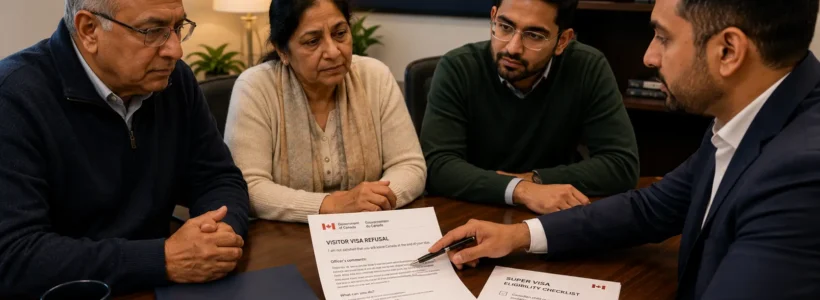
Visitor visa refusals from India, the Philippines, Nigeria, and Pakistan most commonly cite one concern: the officer was not satisfied the applicant would return home after the visit.
Reapplying with the same documents and a new application fee usually produces the same outcome. Cambria Law Firm reads the refusal letter, identifies the officer’s exact concern, and builds the reapplication around documented evidence — not general reassurances.
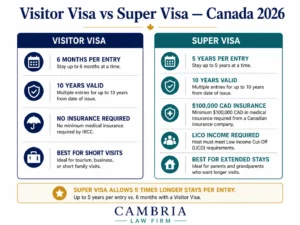
Visitor Visa vs. Super Visa — Which Applies to Your Situation?
| Item | Visitor Visa (TRV) | Super Visa |
|---|---|---|
| Who can apply | Anyone eligible from a visa-required country | Parents and grandparents of Canadian citizens or permanent residents only |
| Stay per entry | Up to 6 months | Up to 5 years |
| Multiple entry | Yes | Yes |
| Valid for | Up to 10 years | Up to 10 years |
| Medical insurance | Not required | Minimum $100,000 CAD coverage required |
| Income requirement | Not specified | Canadian child must meet the minimum income threshold |
Why Visitor Visa Applications Get Refused
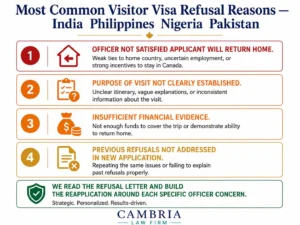
IRCC officers assessing visitor visa applications make one central determination: will this person leave Canada when their authorized stay ends? Everything else — employment status, financial situation, family ties, travel history, and the stated purpose of the visit — is evidence bearing on that single question.
The most common refusal grounds from high-refusal-rate countries are insufficient ties to the home country, an unclear purpose of visit, and insufficient evidence of financial means to support the trip.
Reapplying without directly addressing the specific ground cited in the refusal letter repeats the same error. An officer reviewing a new application will see the prior refusal. A new application that does not explain and address the previous concern is highly likely to be refused again.
Cambria Law Firm builds every reapplication around the specific language of the prior refusal letter. If the officer cited insufficient ties, we build the ties evidence. If the officer cited an unclear purpose, we construct a detailed and consistent visit itinerary. If finances were questioned, we document the financial picture comprehensively.
How We Can Help With Your Visitor Visa or Super Visa
- We read the refusal letter carefully, identify the officer’s exact concern, and build the reapplication to address that concern directly.
- We build the ties evidence package for high-refusal-rate applicant profiles from India, the Philippines, Nigeria, and Pakistan.
- We structure the Super Visa application around the $100,000 insurance requirement and the Canadian child’s income verification.
- We prepare a detailed visit itinerary and financial documentation package that answers the officer’s concerns with evidence.
- We give you an honest assessment of whether another application is viable before you pay another government fee.
- Free refusal assessment — we review the letter and tell you clearly whether the concern is addressable.
Super Visa — What the Sponsoring Child Must Provide
The Super Visa requires the Canadian citizen or permanent resident child to provide proof that their income meets or exceeds the minimum income threshold based on family size. This income threshold changes annually.
The Canadian child must also provide a letter of invitation confirming that the parents or grandparents will be residing with them and that the Canadian child is responsible for their care and expenses during the visit.
The applicant parent or grandparent must obtain Canadian medical insurance with minimum coverage of $100,000 CAD. The policy must be valid for at least one year from the date of entry. This insurance must be in place before the Super Visa is issued.
Key Visitor Visa and Super Visa Figures — 2026
| Item | Requirement or Figure |
|---|---|
| Visitor visa stay per entry | Usually up to 6 months |
| Super Visa stay per entry | Up to 5 years |
| Super Visa validity | Up to 10 years |
| Super Visa insurance | Minimum $100,000 CAD coverage |
| Super Visa insurance validity | At least 1 year from the date of entry |
| Visitor visa validity | Up to 10 years, depending on passport validity and officer decision |
Frequently Asked Questions
My parents’ visitor visa was refused three times. Is there any point in applying again?
Yes — but only with a fundamentally different file. Three refusals on the same grounds with the same documentation will likely produce a fourth refusal. The question is whether the refusal grounds cited in those decisions can be substantively addressed with new evidence.
Cambria Law Firm reviews all prior refusal letters and identifies whether the concern is addressable. If it is, we build the evidence package. If it is not addressable — for example, if the applicant genuinely has no ties to their home country — we provide an honest assessment instead of submitting a weak application.
Can my parents work in Canada on a Super Visa or visitor visa?
No. Both Super Visas and standard visitor visas authorize temporary stays only. They do not authorize employment. Working without authorization while on a visitor visa is a serious violation that can affect future immigration applications. If your parents wish to work in Canada, a separate work authorization pathway is required.
Does a previous refusal automatically lead to another refusal?
Not automatically — but it does create heightened scrutiny. IRCC’s system records all prior applications and decisions. A new application that ignores the prior refusal is highly likely to be refused on the same grounds. Addressing the prior refusal grounds directly and demonstrably in the new application is essential, not optional.