The Canadian Experience Class exists for one reason: to give people already contributing to Canada’s economy a direct route to permanent residence.
If you have 12 months of full-time skilled work experience in Canada in a TEER 0, 1, 2, or 3 occupation, you may be eligible. The question is not only whether you qualify — it is whether your Express Entry profile is positioned for the next draw.
CEC Eligibility — The Four Requirements
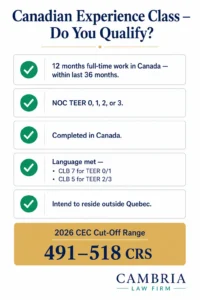
The Canadian Experience Class has four mandatory criteria. All four must be met when you receive your ITA and submit your application.
1. Work experience in Canada. You must have at least 12 months of full-time skilled work experience — or an equivalent amount of part-time experience — in Canada within the 36 months before you submit your application. The experience must be in a TEER 0, 1, 2, or 3 occupation under Canada’s National Occupational Classification system.
2. NOC code accuracy. Your work experience must be accurately described under the correct NOC code. A mismatch between your actual job duties and your claimed NOC code is one of the most common causes of CEC refusal. Vick Sidhu reviews every client’s employment documentation against the NOC descriptor before submission.
3. Language requirements. You must meet the minimum Canadian Language Benchmark for your NOC TEER level. TEER 0 and 1 occupations require CLB 7 in all four abilities. TEER 2 and 3 occupations require CLB 5. Language tests must be under two years old at the time of submission.
4. Intention to reside outside Quebec. CEC is for applicants who intend to live and work in any province or territory except Quebec, which manages its own immigration system separately.
How We Can Help With Your CEC Application
- We confirm your NOC code against your actual job duties — the most common and most preventable cause of CEC refusal.
- We calculate your CRS score and identify every draw category you qualify for beyond standard CEC, including French and category-based draws.
- We manage your work permit renewal alongside your CEC strategy so your right to work is not interrupted.
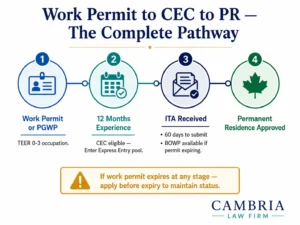
- We apply for a Bridging Open Work Permit if your permit is expiring during PR processing.
- We build and submit your complete Express Entry application within the 60-day ITA window.
- Free assessment for all work permit holders and PGWP graduates in Mississauga and the GTA.
How Work Permit Holders and PGWP Graduates Build CEC Eligibility
Most CEC applicants in the GTA fall into one of two groups: workers on employer-specific closed work permits and recent graduates on Post-Graduation Work Permits.
For work permit holders, every month of employment in a TEER 0–3 occupation with your current Canadian employer counts toward the 12-month CEC requirement. If you have been working in Canada for over a year and your NOC code falls under TEER 0, 1, 2, or 3, you may already be eligible for CEC.
For PGWP graduates, the PGWP provides an open work permit that allows you to work for any employer in Canada. Work experience gained on a PGWP counts fully toward CEC eligibility. Many graduates in Mississauga and Brampton who completed their studies at Ontario colleges and universities become CEC-eligible within 12 months of graduation.
The critical issue for both groups: if your work permit or PGWP expires before you receive an ITA, or while your PR application is being processed, your right to work in Canada may be interrupted. Cambria Law Firm manages work permit renewals and BOWP applications alongside Express Entry strategy to help ensure continuous work authorization throughout the process.
Key CEC Figures — 2026
| Item | Requirement or Figure |
|---|---|
| Minimum work experience | 12 months full-time in the 36 months before application |
| Eligible NOC levels | TEER 0, 1, 2, or 3 |
| Language — TEER 0/1 | CLB 7 in all four abilities |
| Language — TEER 2/3 | CLB 5 in all four abilities |
| CEC draw cut-off range 2026 | 491 to 518 CRS |
| ITA submission window | 60 days — no extensions |
| IRCC processing after submission | 4 to 12 months |
Frequently Asked Questions
Does self-employed work in Canada count toward CEC?
No. Self-employment in Canada does not count toward the 12-month CEC work experience requirement. The work must be authorized under a valid work permit and must be employment, meaning you work for an employer who pays you a wage and deducts CPP and EI. If you have been self-employed in Canada, other Express Entry pathways under the Federal Skilled Worker Program may still apply, depending on your overall profile.
Can I apply for CEC if my current work permit is a closed permit tied to one employer?
Yes. Work experience on a closed employer-specific work permit counts fully toward CEC eligibility as long as the work is authorized, the occupation falls under TEER 0–3, and you have accumulated 12 months of eligible experience. You do not need an open work permit to qualify for CEC. However, if you plan to change employers before your ITA arrives, you need a new work permit. Working for an unauthorized employer invalidates your status and can damage your PR application.
My CRS score is 475 — am I too far below the CEC cut-off?
Not necessarily. At 475, you are within range of French category draws, which have cut off as low as 379 in 2026. If you have any French proficiency, a TEF Canada test is worth pursuing before you conclude that your CRS is too low. Any score improvement through language retesting or a job offer could also help close the gap toward the standard CEC cut-off. Vick Sidhu reviews every available pathway for clients below the current CEC cut-off range.