
A refugee claim is not evaluated only on the severity of what you experienced. It is evaluated on whether your written Basis of Claim narrative establishes a well-founded fear of persecution based on one of the five Convention grounds recognized under Canadian law.
A weak BOC — vague dates, gaps in the chronology, or a narrative that does not clearly connect your personal history to a Convention ground — is one of the most common reasons refugee claims fail at the Refugee Protection Division hearing. Cambria Law Firm builds this document with the legal precision that a hearing panel expects.
Who Can Claim Refugee Protection in Canada
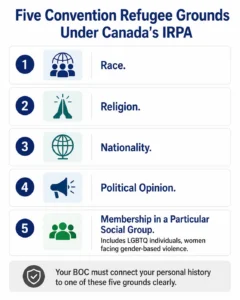
You may be eligible to claim refugee protection in Canada if you face a risk of persecution in your country of citizenship or habitual residence based on one of five grounds recognized under the 1951 Refugee Convention and Canada’s Immigration and Refugee Protection Act: race, religion, nationality, political opinion, or membership in a particular social group.
Membership in a particular social group can include LGBTQ+ individuals, women facing gender-based violence, and other groups defined by an innate or unchangeable characteristic. The scope of this ground has evolved significantly through Canadian case law. Accurately framing a claim under the correct ground — or multiple grounds — is a legal task that requires familiarity with RPD jurisprudence.
Claims can be made at a Canadian port of entry when you arrive or at an IRCC inland office if you are already in Canada. Once your claim is referred to the Refugee Protection Division, you may apply for a work permit while the claim is being processed.
How We Can Help With Your Refugee Claim
- We build your Basis of Claim narrative with the legal precision an RPD panel requires, connecting your personal history to the correct Convention grounds.
- We identify credibility gaps in your story before the hearing — the same gaps an RPD Member may use to reject the claim — and help address them.
- We prepare you for the RPD hearing by reviewing your chronology, evidence, testimony, and likely credibility issues.
- We file RAD appeals within the 15-day window if the RPD decision goes against you.
- We apply for a PRRA and Federal Court stay strategy when removal is approaching, with both tracks assessed from Day 1.
- Free confidential consultation. Your information is never shared with your country of origin.
The BOC Form — What It Must Contain and Why It Is Critical
The Basis of Claim form is the central document of every refugee hearing. It contains your personal narrative: what happened to you, who was responsible, why it happened based on a Convention ground, and why you cannot safely return to your country of origin.
The BOC must be internally consistent. Dates, places, names, and events described in the BOC must match the documentary evidence you submit and the oral testimony you give at your hearing.
Inconsistencies between the BOC and hearing testimony are a primary credibility ground that RPD Members may rely on to reject claims. Not always because the events did not happen. Often because the inconsistency undermines the Member’s confidence in the account.
The BOC must also connect your personal history to the legal standard. It is not enough to describe serious harm. The harm must be linked to one of the five Convention grounds in a way that reflects Canadian refugee law and RPD jurisprudence. A narrative that describes persecution without explaining the Convention nexus may fail to establish a Convention refugee claim even when the underlying facts are true.
What Happens If Your Refugee Claim Is Refused
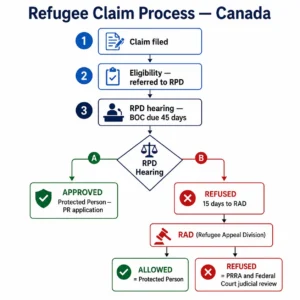
A refused refugee claim at the RPD can trigger a short deadline to file an appeal at the Refugee Appeal Division. The RAD appeal window is 15 days. That deadline matters. Missing it can permanently limit your options.
The RAD reviews the RPD decision for errors of fact, law, or mixed fact and law. If the RAD appeal is also unsuccessful, other options may include a Pre-Removal Risk Assessment when removal is imminent, a Humanitarian and Compassionate application, and Federal Court judicial review of the RAD decision.
These processes can sometimes run simultaneously or in parallel. Cambria Law Firm assesses all available options immediately after any refugee claim refusal and pursues the combination that provides the strongest available protection against removal.
Key Refugee Claim Figures and Deadlines — 2026
| Item | Requirement or Deadline |
|---|---|
| Convention grounds | Race, religion, nationality, political opinion, or membership in a particular social group |
| Core refugee claim document | Basis of Claim form |
| Main hearing body | Refugee Protection Division |
| Appeal body after RPD refusal | Refugee Appeal Division |
| RAD appeal window | 15 days |
| PRRA timing | When removal is approaching |
| Work permit | Available after the claim is referred to the RPD, subject to eligibility |
Frequently Asked Questions
Can I work while my refugee claim is being processed?
Yes. Once your claim is referred to the RPD, you can usually apply for an open work permit that allows you to work for any employer in Canada while the hearing is pending. The work permit remains valid according to the dates on the permit and may need to be renewed if the claim is still in process.
What is the difference between a Convention refugee claim and a PRRA?
A Convention refugee claim is made before the RPD. It determines whether you qualify for protection based on persecution connected to one of the five Convention grounds.
A PRRA is different. It is usually considered when removal from Canada is approaching. It assesses the risk you would face if returned, but it is not the same process as a full refugee hearing before the RPD. Cambria Law Firm advises on which process applies and whether more than one remedy should be pursued at the same time.
I am afraid to file a claim because of what happened in my country. Is the process confidential?
RPD hearings are generally closed to the public. Your claim information is not shared with your country of origin or its officials. IRCC and the IRB have confidentiality obligations regarding refugee claimant information.
The process is designed to protect claimants from the people or authorities they are fleeing. Cambria Law Firm can address specific confidentiality concerns in a private consultation at 416-840-7545.