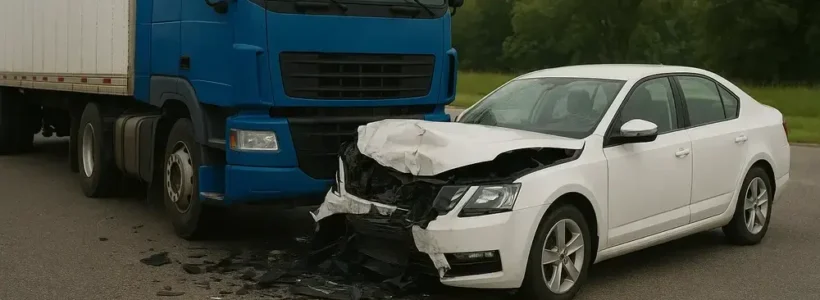
A collision with a commercial truck is not a car accident. The forces involved are catastrophic, the injuries are severe, and most critically the legal battle is completely different.
You are not fighting an individual driver. You are fighting a trucking company, their corporate insurer, and a legal team that has handled thousands of claims just like yours. At Cambria Law Firm, we move on the day we take your case. The most important evidence in a truck accident is the Event Data Recorder (EDR) and the Electronic Logging Device (ELD) which can legally disappear within days if not preserved. We know how to stop that from happening.
Free consultation. Call 416-840-7545. No fee unless we win.
Why Trucking Accidents Require a Specialist
Commercial vehicle collisions involve a complex web of federal and provincial regulations that standard car accident lawyers rarely encounter:
- Hours of Service (HOS): Federal regulations strictly limit how many consecutive hours a driver can operate before mandatory rest periods.
- Electronic Logging Devices (ELD): Mandatory digital records that track movement and can definitively prove if a driver was fatigued or operating illegally.
- Massive Insurance Policies: Commercial insurers carry $2 million to $5 million or more in coverage — and fight proportionally harder to protect it.
- Multiple Liable Parties: Liability often extends beyond the driver to include the carrier, the cargo loader, the broker, and the vehicle maintenance company.
The Evidence We Secure on Day 1
The Event Data Recorder (EDR) – The Truck’s Black Box
The EDR records speed, RPM, brake application, cruise control status, and clutch usage in the seconds before impact. This data is stored on a loop — if the truck continues to be driven after the crash, the new data can quickly overwrite the crash record. We send an immediate Spoliation Letter to the trucking company the day we take your case to legally prevent them from destroying this data.
Electronic Logging Device (ELD) Records
Canadian law requires commercial truck drivers to use an approved ELD that records driving time, engine hours, vehicle movement, and miles driven. If the driver was over their 13-hour limit, had falsified their logs, or was in violation of mandatory rest periods, this evidence can change the entire character of your case from standard negligence to gross recklessness.
Maintenance and Inspection Records
We subpoena the truck’s full maintenance history. Bald tires, defective brakes, and improperly maintained cargo tie-downs are common, preventable causes of truck accidents and create direct liability for the carrier — not just the driver.
Common Causes of Truck Accidents in Ontario
The physics of a fully loaded 80,000-pound commercial vehicle create unique accident scenarios. The most common catastrophic trucking collisions include:
- Jackknife accidents: Caused by improper braking, bald tires, or sudden evasive maneuver that cause the trailer to swing outward.
- Underride collisions: When a passenger vehicle slides under the rear or side of a trailer. These are frequently fatal.
- Wide-turn collisions: Accidents occurring when trucks making right turns sweep across multiple lanes, crushing vehicles caught in the blind spot.
- Tired driver rear-ends: Low-speed collisions that feel minor to the truck driver but cause severe spinal injuries to the occupants of the car ahead.
- Loose cargo: Catastrophic debris falling from improperly secured flatbed loads at highway speeds.
Frequently Asked Questions
Can I sue the trucking company directly?
Yes. Trucking companies are vicariously liable for their drivers’ negligence and may face additional direct liability for negligent hiring, inadequate training, or failure to maintain their vehicles to safety standards.
What if the truck was from the United States?
Cross-border trucking accidents add significant complexity. They involve US federal FMCSA regulations, cross-jurisdictional insurance policies, and potential litigation in multiple jurisdictions. Cambria Law has experience navigating the complexities of cross-border commercial vehicle claims across Ontario.
How long do I have to file a truck accident claim in Ontario?
You have exactly 2 years from the date of the accident to start a tort lawsuit against the at-fault parties. For your own accident benefits, you must notify your insurer within 7 days and submit your OCF-1 within 30 days. However, because EDR and ELD data can be legally overwritten or disappear within days, you should contact a lawyer on the very same day if possible.