
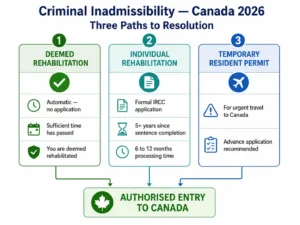
Criminal inadmissibility to Canada has three distinct legal options: deemed rehabilitation, individual rehabilitation, and Temporary Resident Permits.
The right pathway depends on the specific offence, when it happened, the Canadian equivalent offence, and the sentence imposed. Cambria Law Firm reviews the record first, then identifies the pathway that actually applies.
Common Grounds for Denied Entry to Canada
Criminal inadmissibility. A conviction for a foreign offence that has a Canadian equivalent under the Criminal Code is the most common inadmissibility ground. This includes DUI convictions from the United States, assault convictions, fraud, and drug offences. The severity of the inadmissibility depends on the maximum sentence the Canadian equivalent offence carries — not only the sentence imposed in the foreign country.
Health inadmissibility. A medical condition expected to cause excessive demand on Canadian health or social services can result in a finding of health inadmissibility. This ground has specific regulatory criteria and exemptions. Certain family members sponsored by spouses cannot be refused on excessive-demand grounds.
Misrepresentation. Providing false information or withholding material facts on a previous immigration application can result in a five-year inadmissibility finding. Misrepresentation can also arise from errors made by representatives acting on behalf of an applicant, which does not automatically exempt the applicant from the finding.
Security grounds. This is the most serious inadmissibility category. Findings under this ground are rare but carry severe consequences, including deportation orders and limited appeal rights.
How We Can Help With Denied Entry and Inadmissibility
- We review your specific criminal record against Canadian equivalent offences and identify which legal option applies.
- We assess deemed rehabilitation eligibility immediately — you may already qualify without filing an application.
- We prepare individual rehabilitation applications for offences that do not qualify for deemed rehabilitation.
- We apply for Temporary Resident Permits for urgent travel needs while a rehabilitation application is being processed.
- We advise on the effect of U.S. pardons on Canadian inadmissibility before you rely on one for travel.
- Free inadmissibility assessment before you attempt to enter Canada or submit any application.
The Three Possible Solutions for Criminal Inadmissibility
Deemed rehabilitation. For offences that occurred more than a specified number of years ago and that would carry a maximum sentence of under 10 years in Canada, a person may be deemed rehabilitated automatically. No application may be required.
That does not mean the border officer will always see it correctly. CBSA and visa officers make the determination based on the record presented. If the record is unclear, or if the Canadian offence equivalency is misunderstood, a person who may qualify can still face problems at the border or visa stage.
Individual rehabilitation. If you do not qualify for deemed rehabilitation, a formal individual rehabilitation application to IRCC may be available. This application shows that enough time has passed since the sentence was completed, that you are unlikely to reoffend, and that you have been rehabilitated.
Processing can take months. Once approved, individual rehabilitation resolves the criminal inadmissibility for the offence addressed in the application.
Temporary Resident Permit. A Temporary Resident Permit allows an otherwise inadmissible person to enter Canada for a specific, compelling purpose when the benefits of entry outweigh the risks. A TRP is time-limited and purpose-specific. It does not erase the underlying inadmissibility.
TRPs are often used for urgent family or business travel where a full rehabilitation application is not yet possible. Advance applications are strongly recommended. Waiting until the airport or land border usually leaves too much discretion in the hands of the officer on duty.
Key Inadmissibility Options— 2026
| Options or Issue | What It Means |
|---|---|
| Deemed rehabilitation | May apply automatically if the offence, timing, and Canadian equivalent offence meet the criteria |
| Individual rehabilitation | Formal IRCC application showing rehabilitation and low risk of reoffending |
| Temporary Resident Permit | Temporary entry for a specific compelling purpose despite inadmissibility |
| DUI and impaired driving | Requires careful Canadian offence equivalency review, especially after the 2018 Criminal Code changes |
| U.S. pardon | May help, but does not automatically erase Canadian inadmissibility |
| Border refusal | Creates a CBSA record that should be addressed before the next attempted entry |
Frequently Asked Questions
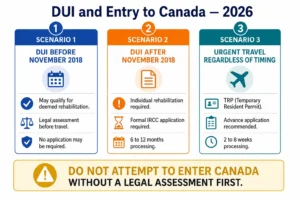
I have a DUI from the United States. Can I enter Canada?
It depends on when the DUI occurred and the specific charge. Before December 2018, impaired driving offences were treated differently for Canadian inadmissibility purposes. After the Criminal Code changes that took effect in December 2018, impaired driving became a more serious inadmissibility issue because the maximum sentence increased.
That change affects deemed rehabilitation analysis. Cambria Law Firm reviews your specific record and identifies which category applies: deemed rehabilitation, individual rehabilitation, or a Temporary Resident Permit. The correct answer depends on the offence date, sentence completion date, wording of the charge, and Canadian equivalency.
I was refused at the Canadian border. What should I do?
A border refusal creates a record in CBSA’s system. Future attempts to enter Canada without addressing the inadmissibility can trigger the same issue again.
Before attempting to re-enter, obtain advice on your specific inadmissibility ground and the appropriate legal option. Applying for a TRP or rehabilitation in advance of your next travel date is usually more effective than trying to explain the situation at the port of entry. Call 416-840-7545 and Cambria Law Firm will review your border refusal documentation.
Can a pardon from the United States resolve my Canadian inadmissibility?
A U.S. pardon may be recognized by IRCC when assessing admissibility, but it does not automatically resolve Canadian inadmissibility. The effect of a foreign pardon is assessed case by case.
It may support a deemed rehabilitation finding or strengthen an individual rehabilitation application, but it is not a standalone solution. Legal advice is needed before relying on a U.S. pardon for Canadian entry purposes.