Need help with your Canadian immigration matter?
Our immigration team can help with applications, refusals, appeals, and next steps. Contact us today for a no-obligation consultation.

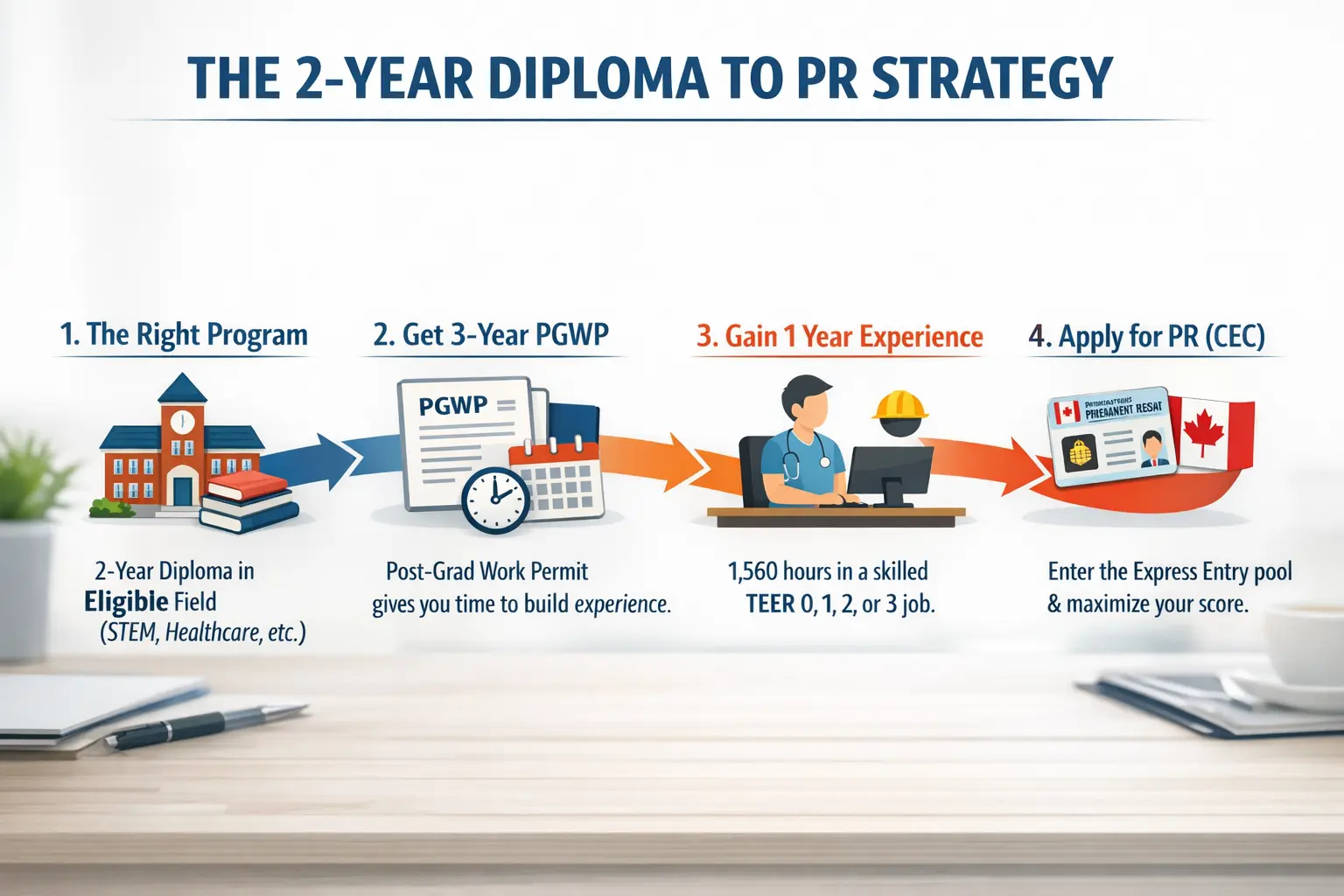
For years, the “gold standard” for international students was a university degree. But in 2026, the landscape has shifted. A two-year college diploma is now one of the most efficient, cost-effective pathways to Permanent Residence (PR)—if you follow the rules correctly.
With the right strategy, a two-year program doesn’t just give you an education; it grants you a three-year Post-Graduation Work Permit (PGWP), giving you ample time to build the skilled work experience needed to qualify for the Canadian Experience Class (CEC).
Here is the roadmap to turning that diploma into a PR card.
The rules for PGWPs have tightened. You can no longer study anything and expect a three-year work permit. To qualify for the PGWP after a college program, you generally must graduate from a program linked to in-demand occupations, such as:
STEM (Science, Technology, Engineering, Math)
Healthcare
Trade-related programs
Agriculture & Agri-food
Education
The Strategy: Before you enroll, verify that your specific program is on the government’s eligible list. If you graduate from a non-eligible general arts program, you may find yourself without a work permit, cutting your PR journey short before it begins.
If your program is at least two years long and in an eligible field, you are eligible for a three-year PGWP. This is your golden ticket.
Why 3 years? You only need one year of skilled work experience to qualify for the Canadian Experience Class (CEC).
The Buffer: A three-year permit gives you a “safety buffer.” If it takes you 6 months to find a job, or if you need to switch employers, you still have plenty of time to accumulate that crucial 1,560 hours of skilled work.
The most common federal route for college graduates is the CEC. To enter this pool, you need:
1 Year of Work: At least 1,560 hours of paid work.
Skilled Level: The job must be TEER 0, 1, 2, or 3.
Language Skills: CLB 7 for TEER 0/1 jobs, or CLB 5 for TEER 2/3 jobs.
Pro Tip: Work done while you are a full-time student (including Co-Op terms) does not count toward this requirement. Your PR clock starts the day you apply for your PGWP.
Qualifying for CEC is just the first hurdle. You still need a competitive Comprehensive Ranking System (CRS) score to get an invitation. A two-year diploma gives you fewer points than a Master’s degree, so you must make up the difference elsewhere:
Max Out Language: Scoring a CLB 9 or 10 in English (or NCLC 7 in French) can drastically boost your score through “Skill Transferability” points.
Foreign Experience: If you worked in a skilled job before coming to Canada, combine that with your Canadian experience for a massive point jump.
Category-Based Draws: If your diploma leads to a job in Healthcare or STEM, you might be invited with a much lower CRS score than the general cutoff.
If your CRS score isn’t high enough for federal Express Entry, look to the province where you studied.
Ontario (OINP): The Employer Job Offer: International Student Stream is designed specifically for graduates with a job offer.
Alberta (AAIP): Offers specific pathways for graduates who start businesses or work in tech.
Manitoba: Has a dedicated Career Employment Pathway for local graduates.
Choosing the wrong college program in 2026 can cost you your work permit and your future in Canada. We help students reverse-engineer their education path based on their PR goals.
Our Services Include:
Program Eligibility Audit: We verify if your chosen college program qualifies for the 3-year PGWP under the new field-of-study rules.
PR Pathway Mapping: We create a multi-year plan that transitions you from Student -> Worker -> Permanent Resident.
Express Entry Profile Management: Once you graduate, we manage your profile to ensure you claim every possible point, including education and sibling points.
PNP Representation: If federal draws are too high, we pivot your strategy to provincial streams like the OINP or AAIP.
Don’t guess with your future. Contact us today to ensure your two-year degree is a stepping stone to citizenship, not a dead end.
Disclaimer: Immigration rules, specifically regarding PGWP eligibility fields, change frequently. Always consult a professional before enrolling.
Our immigration team can help with applications, refusals, appeals, and next steps. Contact us today for a no-obligation consultation.