Injured in Ontario? Get clear legal guidance today.
Our personal injury team can help with accident, disability, and injury claims. Contact us today for a no-obligation consultation.

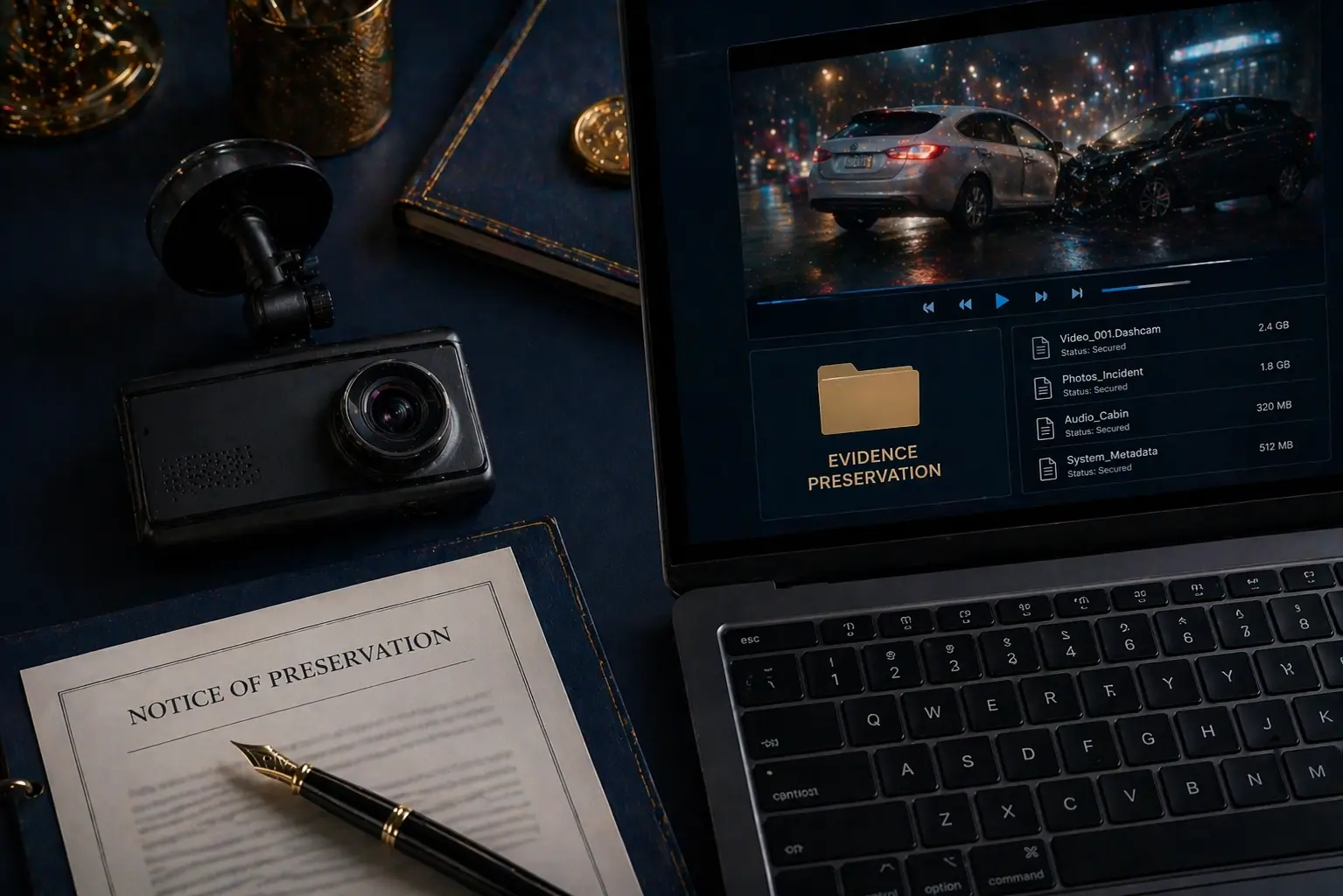
Dashcam footage can win a car accident case in 30 seconds of video. It can also be permanently overwritten in 72 hours if no one acts to preserve it.
As dashcam adoption continues to rise across Ontario — and as the evidentiary value of video footage becomes increasingly well understood in personal injury litigation — knowing what to do with dashcam footage immediately after an accident has become as important as knowing what to do at the scene.
Most dashcams use loop recording — they continuously overwrite old footage with new footage once the storage card reaches capacity. Depending on your camera’s resolution and card size, this cycle typically runs between 24 hours and 96 hours of driving time.
If you are involved in an accident and do not manually save the relevant footage before the loop overwrites it, that evidence is gone permanently.
Two types of dashcam storage:
Local storage (SD card): The most common type. Footage is stored on a memory card in the camera. It is vulnerable to loop overwriting unless the camera has an incident detection feature that automatically locks the current clip when a collision is detected.
Cloud storage: Some premium dashcam models continuously upload footage to cloud servers. Cloud-stored footage is not subject to the same overwriting risk, but you still need to log in and explicitly save or download the relevant clip before it rolls off the cloud retention window (typically 30 to 90 days, depending on subscription).
If you have a dashcam and were involved in an accident, take these steps immediately — ideally before you leave the scene:
1. Turn off the camera (if it has not already locked the clip automatically). This stops new footage from being recorded and prevents overwriting. 2. Remove the SD card if safe to do so and store it separately from the vehicle. The dashcam camera head itself is vulnerable to damage or theft if the vehicle is towed or left overnight. 3. Copy the relevant files to a separate device — a laptop, an external hard drive, or a cloud upload — as soon as possible. Label the files with the date, time, and a description. 4. Do not delete or edit anything. Courts accept unedited original footage. Edited or altered video is inadmissible and may constitute destruction of evidence. 5. Tell your lawyer you have footage at your very first contact. They can provide guidance on preservation and production obligations.
If the at-fault driver had a dashcam — or if there is reason to believe a third vehicle that caused the accident was also equipped — preserving that footage requires acting quickly.
Before litigation: Your lawyer can send a preservation demand letter to the other driver immediately after the accident, formally requesting that they preserve all dashcam footage related to the collision. This letter creates a legal obligation and documents that the demand was made. If the footage is subsequently deleted after receiving this demand, the deletion can give rise to a spoliation inference — meaning the court may assume the footage would have been unfavourable to the party who destroyed it.
After litigation commences: Dashcam footage in the other party’s possession is subject to documentary discovery. You can demand production of the relevant files through the litigation process. Insurance companies often have access to footage from their insured’s vehicle as part of their claims investigation.
Beyond dashcams, accidents on Ontario roads are frequently captured by stationary cameras:
Store and business CCTV: Many commercial properties along major roads have external security cameras that capture traffic. Footage retention periods vary — most systems overwrite within 7 to 30 days. Your lawyer can send a formal evidence preservation demand to businesses whose camera angles may have captured the accident.
City traffic cameras: The City of Toronto and other Ontario municipalities operate traffic management cameras at major intersections. These cameras typically do not retain footage automatically beyond 24 to 72 hours, but a formal legal request through your lawyer can sometimes secure preservation before the window closes.
TTC and transit cameras: Transit vehicles and stations throughout the GTA are equipped with cameras. If your accident involved a bus, streetcar, or occurred near a transit station, the TTC or GO Transit may have relevant footage. These organizations have formal processes for legal evidence preservation requests.
Dashcams of other vehicles: Bystander drivers who witnessed the accident may have dashcam footage. Witness names and contact information collected at the scene give your lawyer the ability to follow up.
Ontario courts treat dashcam footage as physical evidence subject to the standard authentication and disclosure requirements. To be admissible, the footage must:
When dashcam footage is authenticated and admitted, its persuasive power is significant. A clear video showing the at-fault driver running a red light, making an unsafe lane change, or rear-ending the plaintiff’s vehicle removes much of the contested factual uncertainty that makes personal injury trials costly and unpredictable.
Cambria Law sends evidence preservation demands the same day we are retained. We know the retention windows, we know who to contact at municipal authorities and transit bodies, and we know how to ensure dashcam evidence is preserved, authenticated, and used effectively in your claim.
Call 416-840-7545 or contact us online for a free consultation. No fees unless we win.
Our personal injury team can help with accident, disability, and injury claims. Contact us today for a no-obligation consultation.