Need help with your Canadian immigration matter?
Our immigration team can help with applications, refusals, appeals, and next steps. Contact us today for a no-obligation consultation.

Immigration, Refugees and Citizenship Canada (IRCC) issued 4,000 Invitations to Apply (ITAs) on April 29, 2026, targeting candidates with French-language proficiency. The minimum Comprehensive Ranking System (CRS) score was 400. This is the 26th Express Entry draw of 2026, firmly establishing French proficiency as the second-largest immigration category of the year, superseded only by the Canadian Experience Class.
Immigration, Refugees and Citizenship Canada (IRCC) capped off a busy week of selections by issuing 4,000 Invitations to Apply (ITAs) to French-speaking candidates. This April 29 draw marks the twenty-sixth Express Entry selection of the year and underscores a powerful legal and demographic shift in Canada’s immigration priorities.
For foreign nationals struggling against the hyper-competitive general Express Entry pool—where scores routinely exceed 500—this draw proves that bilingualism is currently the most strategic loophole in Canadian immigration law.
Here is what you need to know about this draw and the legal requirements for a successful French-Language proficiency application.
To understand why IRCC is issuing thousands of ITAs to candidates with a CRS score as low as 400, we have to look at the legislative mandate. Under the Official Languages Act, the Canadian government has strict statutory targets to increase francophone immigration outside the province of Quebec.
The numbers for 2026 speak for themselves:
Canadian Experience Class (CEC): 34,250 ITAs issued (Cut-off ~508-515)
French-Language Proficiency: 26,000 ITAs issued (Cut-off ~393-419)
By pursuing French proficiency, candidates are effectively accessing a parallel, lower-competition stream. A score of 400 is highly attainable for candidates with moderate education and work experience, bypassing the need for a highly coveted provincial nomination or a complex employer LMIA.
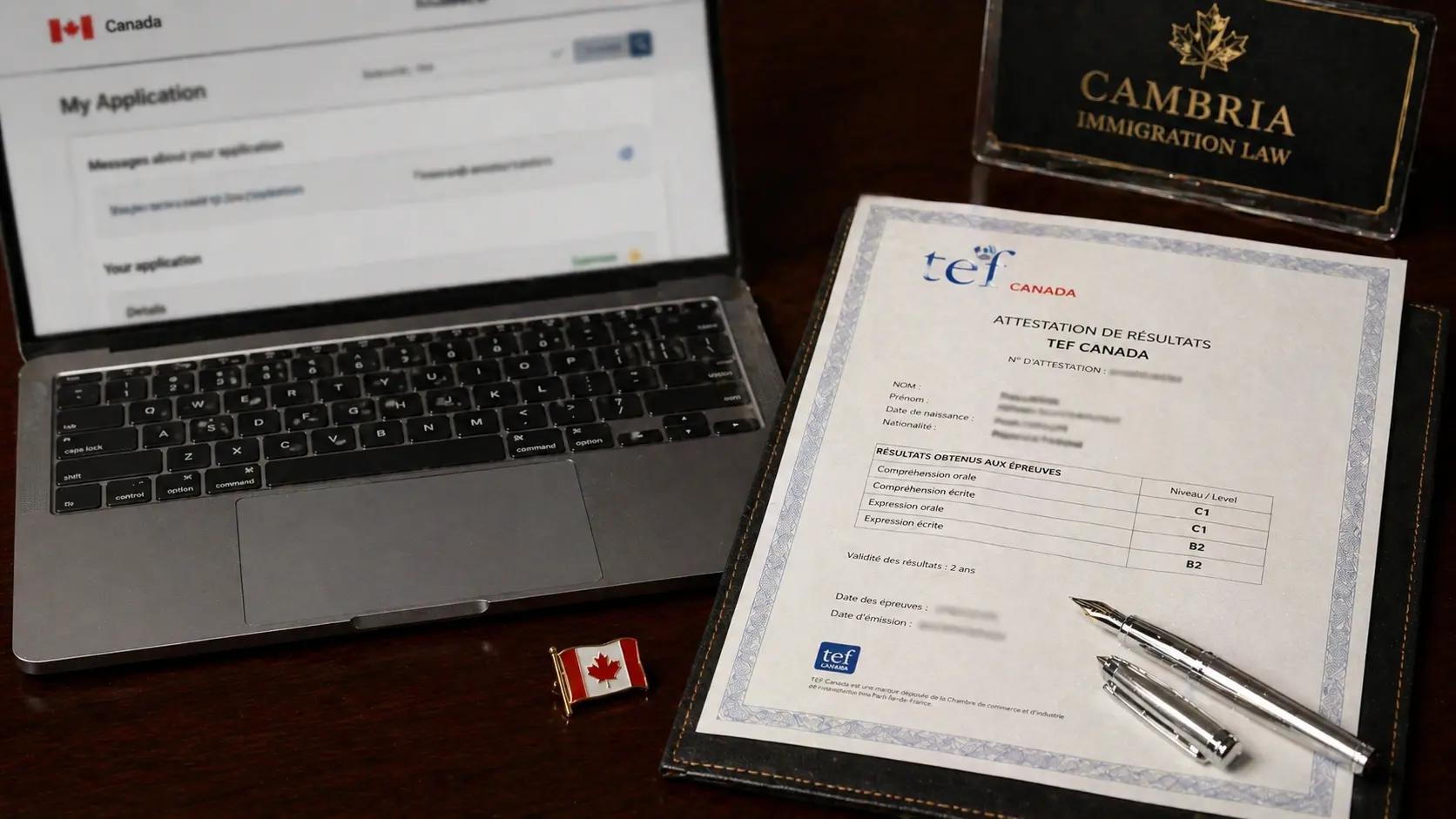
Under the strict guidelines of the Immigration and Refugee Protection Act (IRPA), claiming French proficiency requires objective, government-approved evidence. You cannot simply state that you are bilingual.
To qualify for this specific category-based draw, a candidate must:
Complete either the TEF Canada (Test d’évaluation de français) or the TCF Canada (Test de connaissance du français).
Achieve a minimum score of NCLC 7 (Niveaux de compétence linguistique canadiens) in all four language abilities: listening, speaking, reading, and writing.
Legal Risk Warning: Your language test results must be valid (less than two years old) both at the time you receive your ITA and on the exact day you submit your electronic Application for Permanent Residence (eAPR). Submitting an application with expired test results will result in an immediate refusal.
Candidates invited in this draw have a non-negotiable 60-day window to submit their eAPR.
While qualifying under the French-language category lowers the CRS requirement, it does not lower the evidentiary burden. IRCC officers will heavily scrutinize your police clearances, medical exams, and employment reference letters. Inconsistencies between your initial profile and your final submission can trigger an allegation of misrepresentation under section 40 of IRPA, resulting in a five-year ban from Canada.
Receiving an ITA is just the first step; navigating the 60-day application window requires absolute legal precision. At Cambria Law Firm, our immigration team meticulously prepares and audits every permanent residence application to ensure compliance with strict federal standards.
Protect your ITA and secure your Canadian future. Book an in-depth, strategic consultation with our immigration experts today. We will audit your profile, verify your evidentiary documents, and map your exact path to permanent residence.
Cambria Law Firm serves clients across Ontario, including Mississauga, Toronto, Brampton, Oakville, Hamilton, and the Greater Toronto Area. Law Society Number: 74895I.
The minimum Comprehensive Ranking System (CRS) score for the April 30, 2026 Canadian Experience Class (CEC) draw was 508.
To legally qualify for the CEC, candidates must have accumulated at least one year of full-time (or equivalent part-time) skilled work experience in Canada within the three years prior to their application. This experience must be in NOC TEER categories 0, 1, 2, or 3.
No, a valid employer job offer (or LMIA) is not strictly required to qualify for the Canadian Experience Class, provided you meet the core Canadian work experience and language requirements. However, having one can provide additional CRS points.
After receiving an Invitation to Apply (ITA), candidates have exactly 60 calendar days to submit a complete, error-free electronic Application for Permanent Residence (eAPR) to IRCC.
Our immigration team can help with applications, refusals, appeals, and next steps. Contact us today for a no-obligation consultation.