Need help with your Canadian immigration matter?
Our immigration team can help with applications, refusals, appeals, and next steps. Contact us today for a consultation.

Bill C-3 came into force on December 15, 2025. It eliminated Canada’s first-generation limit on citizenship by descent. If you were born before that date and can trace a continuous line of descent to a Canadian ancestor, you are already a Canadian citizen — and you can apply for proof of that citizenship today.
This is not a new immigration pathway. It is not a sponsorship or a PR application. If you qualify, you are already a citizen. The application is simply for proof of status you already hold.
Most people in Mississauga and across the GTA think of Canadian citizenship as something you earn through years of PR status, language testing, and a knowledge exam. For a growing number of people, it turns out citizenship was theirs all along — they just did not know it. Bill C-3 made that possible for many families who previously fell outside the first-generation limit.
Here is what changed, who qualifies, and what the practical value of Canadian citizenship actually looks like in 2026.
Before Bill C-3, Canada imposed a first-generation limit on citizenship by descent. A Canadian citizen who was born abroad could pass citizenship to their child — but that child could not pass it to their own children born outside Canada. The chain stopped after one generation abroad.
Bill C-3, which received Royal Assent and came into force on December 15, 2025, eliminated that limit for anyone born before that date. The change means that if you can trace a continuous line of descent to a Canadian ancestor — through as many generations as needed — and each person in that chain was either a Canadian citizen or a Canadian citizen by descent at the time of your birth, you may be a Canadian citizen by descent.
The result has been significant. In January 2026 alone, nearly 2,500 Americans filed applications for proof of Canadian citizenship — a number that had historically been a fraction of that figure. For many families with Canadian roots who had been cut off from citizenship by the first-generation rule, the door reopened on December 15, 2025.
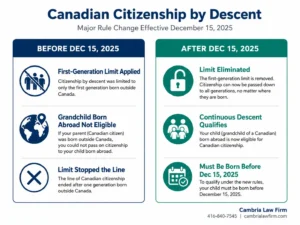
The eligibility test is simpler than most people expect. To be a Canadian citizen by descent under Bill C-3, three conditions must be met:
1. You were born before December 15, 2025. The change is not retroactive for those born after the bill came into force. If you were born on or after December 15, 2025, the previous rules apply — citizenship by descent is still limited to the first generation born outside Canada.
2. You can trace a continuous line of descent to a Canadian ancestor. There must be an unbroken chain connecting you to someone who was a Canadian citizen. The ancestor does not need to have been born in Canada — they need to have held Canadian citizenship at the time each subsequent person in the chain was born.
3. Each person in the chain was a Canadian citizen at the time the next person was born. If anyone in the chain lost citizenship, renounced it, or was not a citizen at the relevant time, the chain breaks at that point.
The documentation required to prove this chain is where most applications become complex. Birth certificates, naturalization records, and historical immigration documents spanning multiple decades — and sometimes multiple countries — all need to be assembled and presented to IRCC in a way that clearly establishes the unbroken descent.
Important: A family belief that “we have Canadian roots” is not the same as documented proof of citizenship by descent. Many applications are returned or refused because the chain of documentation has gaps — a missing birth certificate, a naturalization record that was never obtained, or a name discrepancy across historical documents. Getting the documentation right before submitting is the entire job.
This is the question most families are asking once they realize they may qualify. The answer depends on whether you plan to move to Canada or simply hold the status. Both have genuine value.
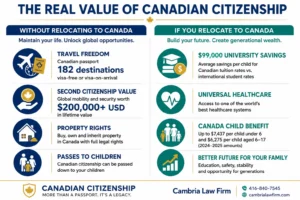
A Canadian passport. Canada’s passport currently grants visa-free or visa-on-arrival access to 182 destinations worldwide — ranking among the ten most powerful passports globally. For dual citizens, the Canadian passport can open doors that their other passport cannot. The practical value in avoided visa costs and processing time adds up quickly for frequent international travellers.
A second citizenship without the cost. Purchased second citizenships through investment programs in other countries typically cost USD $200,000 or more. Canadian citizenship by descent, if you qualify, costs the price of the application and the documentation to prove it.
The right passes to your children. Once you hold Canadian citizenship, your children born after you receive citizenship are eligible for citizenship by descent as well — extending the benefit to the next generation.
The right to buy Canadian property. Canadian citizens are not subject to the same foreign buyer restrictions that apply to non-residents. In markets like Toronto and the GTA, where real estate values remain significant, this has practical financial implications for families considering investment properties or eventual relocation.
University tuition. International students in Ontario pay significantly higher tuition than domestic students. A child enrolled as a domestic student at an Ontario university can save approximately USD $99,000 over a four-year degree compared to international student rates. For families with multiple children, this figure multiplies accordingly.
Universal healthcare. Provincial health insurance — OHIP in Ontario — covers most medically necessary services for residents. The financial value of this coverage compared to private US health insurance premiums is significant, though it requires actual residency in Ontario to access.
Canada Child Benefit. Qualifying families in Canada receive up to CAD $7,997 per year for children under 6, and up to CAD $6,748 per year for children aged 6 to 17, subject to income thresholds.
Applying for proof of Canadian citizenship by descent is an IRCC application process — not a court proceeding, not a PR application, and not a naturalization test. You are not applying to become a citizen. You are applying for IRCC to confirm and document citizenship you already hold.
The application requires:
The complexity scales directly with how many generations are in the chain and how many countries are involved. A grandchild of a Canadian-born grandparent will have a simpler documentation challenge than someone tracing six generations across three countries. For many South Asian and South American families in the GTA whose ancestors immigrated through Canada before settling elsewhere, the documentation challenge is real — records from the relevant decades can be incomplete, held in foreign archives, or require translation.
Processing times vary. IRCC has not published specific targets for citizenship by descent applications under the new Bill C-3 rules, and the volume of applications has increased significantly since January 2026.
| Item | Detail |
|---|---|
| Bill C-3 in force | December 15, 2025 |
| What changed | First-generation limit on citizenship by descent eliminated for those born before December 15, 2025 |
| Who qualifies | Anyone born before December 15, 2025 who can trace a continuous line of descent to a Canadian citizen ancestor |
| Application type | Proof of Canadian citizenship — not a new citizenship application |
| Canadian passport access | 182 visa-free or visa-on-arrival destinations |
| Comparable second citizenship cost elsewhere | USD $200,000+ through investment programs |
| University tuition saving (per child) | ~USD $99,000 over four years vs international student rates (if studying in Canada) |
| Applications filed — January 2026 | ~2,500 from Americans alone |
Under the old rules, yes — this was always the first-generation exemption that existed before Bill C-3. You would have qualified even before December 15, 2025. What Bill C-3 changed is the second generation and beyond. If your Canadian-born parent had you abroad, and you had a child abroad, that grandchild of the original Canadian citizen would previously not have qualified — but may now, provided the entire chain meets the requirements and the grandchild was born before December 15, 2025.
Yes. If you are a PR in Canada and you can trace a line of descent to a Canadian ancestor meeting the Bill C-3 criteria, you may already be a citizen by descent — which is a fundamentally different status than PR. Citizenship cannot be revoked for not meeting residency requirements, whereas PR status can lapse. If you believe you qualify, a citizenship by descent assessment is worth pursuing alongside your existing PR status.
Possibly. The key question is whether an ancestor in your family tree held Canadian citizenship — not just Canadian residency or PR status — at the time the next generation was born. A grandparent who lived in Canada as a permanent resident but never naturalized would not create the chain. A grandparent who naturalized as a Canadian citizen before having children outside Canada would. The documentation required to establish this is often the hardest part of the application for South Asian families with multi-country migration histories.
The first step is assembling the basic facts of your family tree — names, dates of birth, countries of birth, and any Canadian immigration or citizenship records you know about. Bring that to a consultation. Nav Aujla and Vick Sidhu will assess whether the chain of descent appears to be present and advise you on what documentation will be needed to prove it to IRCC. Do not submit an application without that assessment — incomplete applications take significantly longer to process and may be returned.
Based on your situation, read these next:
Our immigration team can help with applications, refusals, appeals, and next steps. Contact us today for a consultation.