Need help with your Canadian immigration matter?
Our immigration team can help with applications, refusals, appeals, and next steps. Contact us today for a consultation.


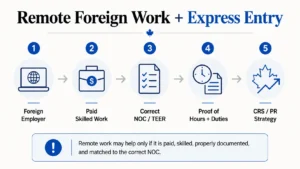
Yes, remote work for a foreign employer may help an international student in Canada build foreign skilled work experience, improve their Express Entry profile, and possibly strengthen their permanent residence strategy.
But it only helps if the work is properly documented, paid, skilled, and matched to the correct National Occupational Classification code.
For international students in Ontario, especially in Mississauga, Brampton, Toronto, and the GTA, this can be important. Many students focus only on part-time Canadian jobs while studying. That is not always enough for a strong PR pathway.
IRCC allows eligible international students to work up to 24 hours per week off campus during regular academic terms. However, remote work for an employer outside Canada generally does not count toward that 24-hour off-campus limit, as long as the student continues to meet their study permit conditions.
That distinction matters.
A student working remotely for a foreign employer may be able to build foreign skilled work experience while studying in Canada. If that experience fits Express Entry requirements, it may help later when building a permanent residence pathway.
This is not a shortcut. It is a strategy that needs to be handled carefully.
International students in the GTA face a competitive immigration environment.
Many students graduate with Canadian education but still struggle with CRS scores, work permit timing, employer support, or category-based Express Entry eligibility. A student in Mississauga or Brampton may be working part-time in Canada while studying, but that work may not always give them the CRS advantage they expect.
The issue is simple: work experience gained while studying in Canada is not always treated the same way as post-graduation skilled Canadian work experience under Express Entry.
That is where foreign remote work can become relevant.
If the work is for a foreign employer, paid by wages or commission, and falls under a skilled TEER category, it may support foreign work experience points under Express Entry.
Not all remote work helps.
To be useful for Express Entry, the remote work should generally be:
A job title alone is not enough. If the actual job duties do not match the NOC, the work may not help your PR profile.
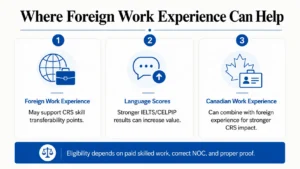
Remote foreign work can matter because Express Entry gives CRS value for foreign skilled work experience, especially when combined with strong language scores or Canadian work experience.
Foreign work experience may become more valuable when paired with:
This is why students should not wait until after graduation to think about PR.
A student who plans early may be able to build a cleaner long-term immigration profile than someone who waits until their Post-Graduation Work Permit is already running out.
This is where students need to be realistic.
One year of full-time skilled work experience under Express Entry generally means 1,560 hours, based on 30 hours per week.
So if a student works remotely for a foreign employer for 15 hours per week, it may take about two years to build the equivalent of one year of full-time work.
That is not bad. But it is not fast.
Students who think they can “stack” excessive hours and claim experience faster are misunderstanding the rule. IRCC does not allow applicants to compress one year of work experience into a few months by working extreme hours.
Potentially, yes.
Remote foreign work may help students build eligibility for occupational category-based Express Entry selection if the experience is in an eligible occupation and meets the required work experience threshold.
This matters for students in Ontario because category-based eligibility can sometimes create a pathway even when a general CRS score is not competitive enough.
But this is not automatic.
A student working remotely in a random administrative, sales, marketing, support, or freelance role should not assume it qualifies. The NOC must be correct. The duties must match. The employer evidence must be strong. The timeline must fit.
It does not. Unpaid work, informal work, cash work, vague freelance projects, or weakly documented work may not help.
This is one of the most damaging mistakes. If the NOC does not match the actual duties, the application may be questioned.
Students should keep:
Trying to rebuild this evidence two years later is a weak strategy.
Remote work performed in Canada for a foreign employer may not fit the same way as Canadian work experience. The classification must be handled carefully.
Remote foreign work may not count toward the 24-hour off-campus work limit, but that does not mean students can ignore full-time study requirements or other study permit conditions.
International students in Mississauga, Brampton, and the GTA should review their PR strategy before assuming remote work will help.
The key questions are:
Remote work should not be treated as a loophole.
It should be treated as one part of a larger immigration strategy.
The risk is not that remote work is impossible.
The risk is that students misunderstand how IRCC will assess it.
A poorly documented remote job can create false confidence. A student may enter the Express Entry pool assuming they have eligible foreign work experience, only to face problems later when asked to prove it.
For Ontario students, the consequences can be serious. A weak strategy can affect CRS planning, PGWP timing, category-based draw eligibility, and future permanent residence options.
If you are an international student in Ontario and you are doing remote work for an employer outside Canada, do not assume it will automatically help your PR application.
Contact Nav Aujla, Lawyer, and Vick Sidhu, RCIC, at Cambria Law Firm to review whether your remote work experience can support your Express Entry or permanent residence strategy.
A proper review can help determine your NOC, CRS impact, documentation gaps, and whether your work experience fits within a realistic PR pathway.
Our immigration team can help with applications, refusals, appeals, and next steps. Contact us today for a consultation.