Need help with your Canadian immigration matter?
Our immigration team can help with applications, refusals, appeals, and next steps. Contact us today for a consultation.

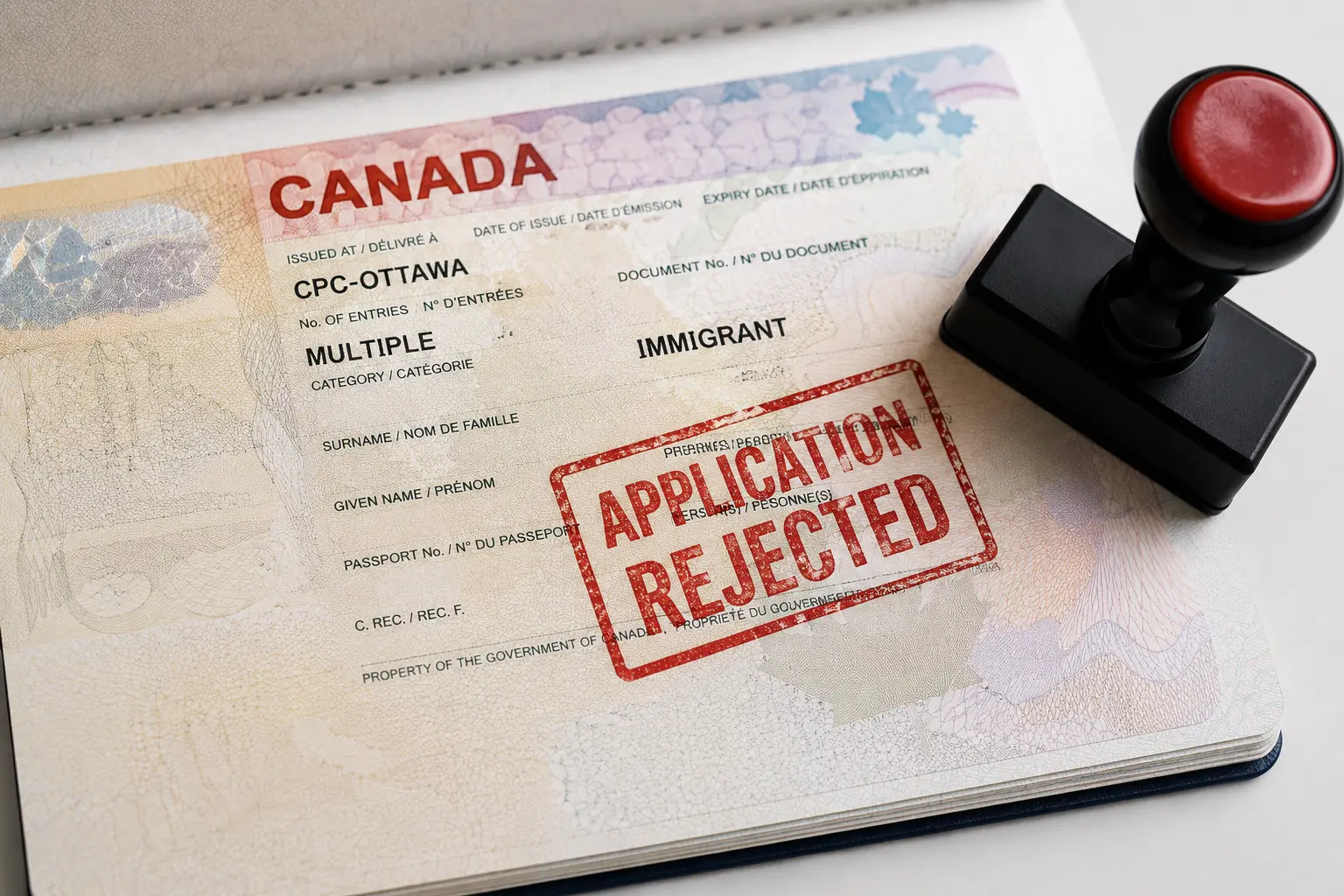
Most permanent residence refusals are not random. They follow predictable patterns. The same documentation errors, the same misrepresentation findings, the same inadmissibility issues appear in IRCC refusal letters year after year — for applicants who believed their applications were complete.
This guide covers the most common reasons Canada permanent residence applications are refused in 2026, what IRCC is actually looking for in each category, what the consequences of each refusal type are, and the specific steps that prevent the most avoidable refusals before submission.
Jump to the section most relevant to your situation:
| Refusal Reason | Consequence | Can You Reapply? | Appeal Available? | Professional Help? |
|---|---|---|---|---|
| Misrepresentation | 5-year ban from Canada | After ban expires | Judicial Review only | Essential |
| Incomplete documents | File returned or refused | Usually yes | Sometimes | Recommended |
| NOC misclassification | Experience eligibility refusal | Yes, with correction | Sometimes | Recommended |
| Criminal inadmissibility | Inadmissibility finding | Depends on offence | Rehabilitation or TRP | Essential |
| Medical inadmissibility | Excessive demand finding | With medical response | Procedural fairness response | Recommended |
| Genuineness of relationship | Section 4 refusal | Yes, with stronger evidence | IAD available | Recommended |
| Proof of funds failure | Eligibility refusal | Yes | Sometimes | Optional |
| 60-day ITA deadline missed | ITA withdrawn, re-enter pool | Re-enter pool | No | Recommended |
Misrepresentation under Section 40 of the Immigration and Refugee Protection Act (IRPA) is the refusal reason with the most severe consequences. A finding of misrepresentation results in a five-year ban from Canada, affecting any application you file during that period — PR, visitor visa, work permit, or study permit.
What IRCC considers misrepresentation:
External resource: Section 40 of IRPA — Misrepresentation (Government of Canada)
Inadmissibility means you are legally barred from becoming a permanent resident regardless of how strong the rest of your application is. Unlike documentation errors that can be corrected, inadmissibility requires a separate legal process.
Canada assesses foreign criminal records by comparing the offence to an equivalent Canadian offence. Common examples that trigger criminal inadmissibility include DUI convictions, assault charges, drug-related offences, and financial crimes. Criminal inadmissibility does not automatically mean you cannot ever obtain Canadian PR — Criminal Rehabilitation, a Temporary Resident Permit (TRP), or a Record Suspension may be available depending on how much time has passed and the nature of the offence.
External resource: Overcoming criminal inadmissibility — Government of Canada
Canada may refuse PR if an applicant’s medical condition is expected to cause excessive demand on health or social services. Since 2018, excessive demand assessments focus narrowly on cases where projected service costs exceed a defined threshold over five years. Medical inadmissibility refusals have decreased significantly since the 2018 reforms, but they still occur and require a formal medical inadmissibility process including an opportunity to respond.
The single most common preventable reason for PR delays and refusals is documentation failure — either missing required documents or submitting documents that contradict each other.
Employer reference letters are among the most frequently cited documentation failures in CEC and Express Entry refusals. A letter that does not clearly state job duties, hours worked per week, annual salary, employment dates, and the employer’s contact details — on company letterhead and signed by a named supervisor — is treated as insufficient proof of work experience.
IELTS and CELPIP results are valid for two years from the test date. A language test that expires before you submit your application cannot be used, even if it appeared valid when you received your ITA. CLB conversion errors are also common — confirm your calculated CLB levels against IRCC’s official conversion charts before submitting.
Many PR applicants must demonstrate adequate settlement funds. The required amount increases annually. For 2026, confirm the current threshold at canada.ca. Funds transferred into an account specifically for the application — without a paper trail explaining the source — can trigger a misrepresentation concern.
IRCC requires a complete ten-year travel and address history. Gaps, overlaps, or inconsistencies between your travel history, employment dates, and address history raise officer concerns and can result in credibility issues that support a refusal.
Your National Occupational Classification (NOC) code determines whether your work experience qualifies under the program you applied to and how many points you receive. Selecting the wrong NOC code — even unintentionally — can result in refusal for ineligibility.
NOC codes are classified by duties, not job titles. An “Administrative Manager” might be NOC 13100 (administrative officer) or NOC 10019 (senior manager) depending on what you actually do. The difference can be 50+ CRS points and program eligibility.
Common NOC misclassification patterns:
Prior immigration violations — whether to Canada or to other countries — can affect your PR application in ways many applicants do not anticipate.
For spousal sponsorship and family class applications, the most common refusal ground is a finding that the relationship is not genuine under Section 4 of the Immigration and Refugee Protection Regulations. Officers assess genuineness based on communication history, financial interdependence, in-person meetings, and consistency of statements between sponsor and sponsored person.
Read our complete spousal sponsorship guide for what a strong relationship file looks like in 2026.
For Express Entry applications, eligibility refusals occur when the submitted evidence fails to demonstrate that the applicant met the minimum requirements for the program they applied under at the time of their ITA.
External resource: CEC eligibility requirements — Government of Canada
Express Entry applicants have 60 days from the date of their ITA to submit a complete PR application. Missing this deadline results in automatic withdrawal of the ITA — no extensions are granted. The 60-day clock counts calendar days and begins from the ITA issuance date regardless of when you first saw the notification.
| Refusal Type | Preventable Before Submission? | Notes |
|---|---|---|
| Incomplete documentation | ✅ Yes — almost always | Pre-submission review catches this every time |
| NOC misclassification | ✅ Yes — with occupational assessment | Most common Express Entry error |
| Language test expiry | ✅ Yes — simple calendar check | Often missed when ITA comes quickly |
| Proof of funds issues | ✅ Yes — with documentation review | Source of funds needs paper trail |
| Misrepresentation (unintentional) | ✅ Yes — with professional review | RCIC catches omissions before submission |
| Criminal inadmissibility | ⚠️ Partially — requires separate process | Criminal Rehabilitation must precede or accompany PR |
| Medical inadmissibility | ⚠️ Partially — response opportunity exists | Can respond to excessive demand finding |
| Misrepresentation (intentional fraud) | ❌ No — and consequences are severe | 5-year ban; avoid unlicensed preparers |
You should consider working with a licensed RCIC or immigration lawyer if any of the following apply:
A pre-submission review costs a fraction of what a refusal costs — in fees, time, and in some cases, your legal right to remain in Canada.
Run through this before your 60-day ITA window closes:
A refusal is not necessarily the end. The available options depend on the specific reason for refusal, the program you applied under, and how much time has passed:
Full detail on both pathways is in our guide to refused PR applications and your appeal options.
Incomplete or inconsistent documentation — particularly insufficient reference letters, NOC misclassification, and language test issues — is the most common preventable refusal ground. Misrepresentation is the most serious, resulting in a five-year ban.
Options depend on the refusal reason. Judicial Review must be filed within 15 days (in Canada) or 60 days (outside Canada). Some family class refusals can be appealed to the IAD. Inadmissibility refusals may require Criminal Rehabilitation or a TRP as a separate process. Getting legal advice immediately after a refusal is critical — most deadlines are strict and non-extendable.
Yes, in most cases — unless the refusal involved misrepresentation (five-year ban) or permanent inadmissibility. Reapplying without addressing the reason for the original refusal typically results in the same outcome. A legal review of the refusal letter is the most effective first step.
A PFL is sent by IRCC when an officer intends to make a negative decision and is giving you a chance to respond — most commonly for misrepresentation concerns. The window is typically 30 days and is strictly enforced. Getting legal advice before responding is strongly advisable — a poorly worded response can confirm the officer’s concerns rather than address them.
A misrepresentation finding under Section 40 of IRPA results in a five-year ban from Canada, applying to all types of applications — PR, visitor visa, work permit, and study permit.
An H&C application under Section 25 of IRPA is a separate application — not a direct appeal of a PR refusal. It can be an option for applicants who do not qualify under standard programs but have significant establishment in Canada, family ties, or compelling circumstances. Legal advice is strongly recommended before pursuing this route.
Our immigration team can help with applications, refusals, appeals, and next steps. Contact us today for a consultation.