Who is at Fault in a Wide Left Turn Truck Crash?
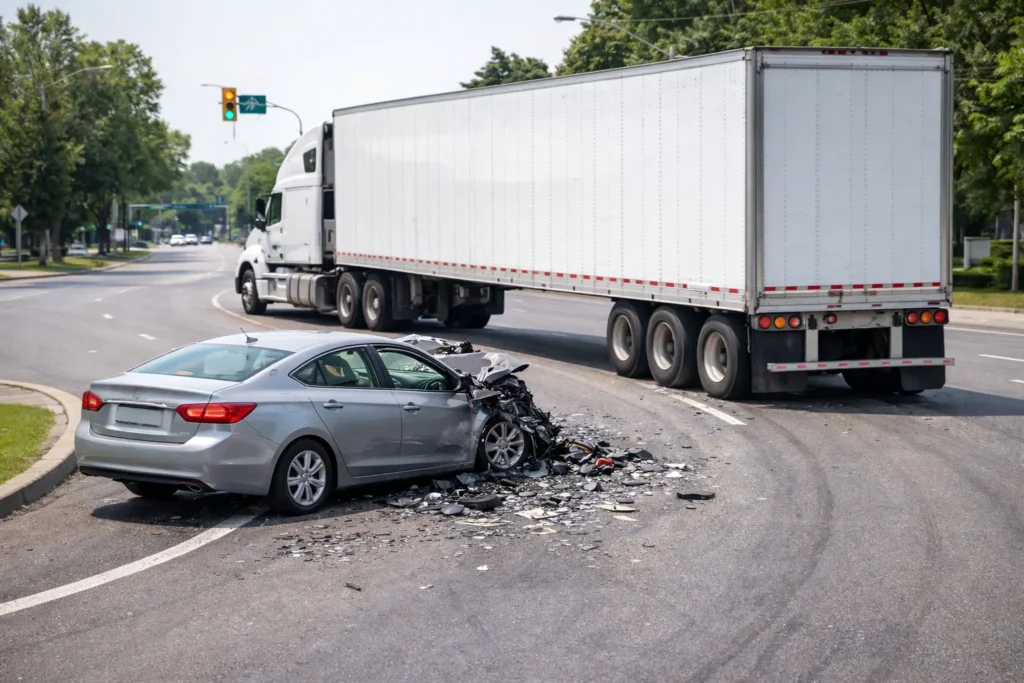
When a passenger vehicle is crushed between a turning commercial transport truck and the median, the immediate assumption is often that the truck driver is entirely to blame. While commercial drivers are held to a strict professional standard, determining legal liability in a wide left turn collision—often called a “squeeze play” crash—is rarely simple.
In Ontario, fault in these severe accidents is determined by examining the specific duty of care each driver owed on the road at the moment of the crash. Both the truck driver and the passenger vehicle driver have distinct legal obligations.
Here is a breakdown of how insurance companies and legal teams determine liability in a wide turn truck crash.
The Truck Driver’s Legal Liability
Commercial truck drivers operate heavy machinery that requires a wider turning radius, which forces them to swing into the right-hand lane before turning left. However, the need for space does not excuse a driver from their legal duty to execute the turn safely.
A truck driver or their trucking company may be found legally negligent if the driver:
-
Failed to Signal Promptly: Under the Highway Traffic Act, drivers must signal their intentions well in advance. If the truck driver swung right without signaling a left turn, other drivers would reasonably assume the truck was pulling over or changing lanes.
-
Abandoned the Turn Lane: If the driver swung excessively far into the right lane—leaving the left turning lane completely open—they create a dangerous and deceptive gap.
-
Failed to Check Blind Spots: Before cutting back to the left to execute the turn, the driver has a legal obligation to check their mirrors and ensure no smaller vehicles have entered their “No-Zone” (blind spot).
The Passenger Vehicle Driver’s Liability (Contributory Negligence)
Ontario operates under a system of contributory negligence. This means that even if the truck driver made an error, the driver of the passenger vehicle can be found partially at fault for the collision. If a court determines you are 25% at fault, your final compensation will be reduced by 25%.
A passenger vehicle driver may share liability if they:
-
Attempted an Illegal Pass: It is generally illegal and highly dangerous to pass a vehicle on the left at an intersection, especially if that vehicle has an active left-turn signal.
-
Ignored Active Signals and Warnings: If the truck’s left blinker was on, accelerating to squeeze past the truck on the left side constitutes reckless driving. Furthermore, ignoring the standard “Caution: Wide Turns” warning decals on the trailer can be used by the defense to argue you failed to exercise basic situational awareness.
-
Followed Too Closely: Tailgating a commercial truck reduces your visibility and reaction time, contributing to the poor decision to attempt a pass when the truck swings right.
How Fault is Proven After a Crash
Because liability is almost always contested in wide turn crashes, personal injury lawyers rely on hard evidence to reconstruct the timeline of negligence:
-
Electronic Logging Devices (ELDs) and Telematics: Modern trucks are equipped with computers that record speed, braking, and whether the turn signal was active at the exact moment of impact.
-
Dashcam Footage: Video from the truck, the victim’s car, or surrounding businesses provides objective proof of lane positioning and signaling.
-
Accident Reconstruction Experts: Engineers can analyze the debris field, skid marks, and final resting positions of the vehicles to prove exactly where the passenger car was when the truck initiated the turn.
Protect Your Rights After a Commercial Truck Crash
Trucking companies are backed by aggressive corporate insurers whose primary goal is to shift liability onto the driver of the passenger vehicle. If you are involved in a wide turn collision, never admit fault or apologize at the scene, as you likely do not have the full picture of the truck driver’s actions leading up to the crash.
Ensure you apply for your Statutory Accident Benefits (SABS) within seven days, and contact experienced legal counsel to ensure the proper evidence is preserved before it can be destroyed by the trucking firm.
Client Testimonials
Professional Representation and Support