Need help with your Canadian immigration matter?
Our immigration team can help with applications, refusals, appeals, and next steps. Contact us today for a consultation.

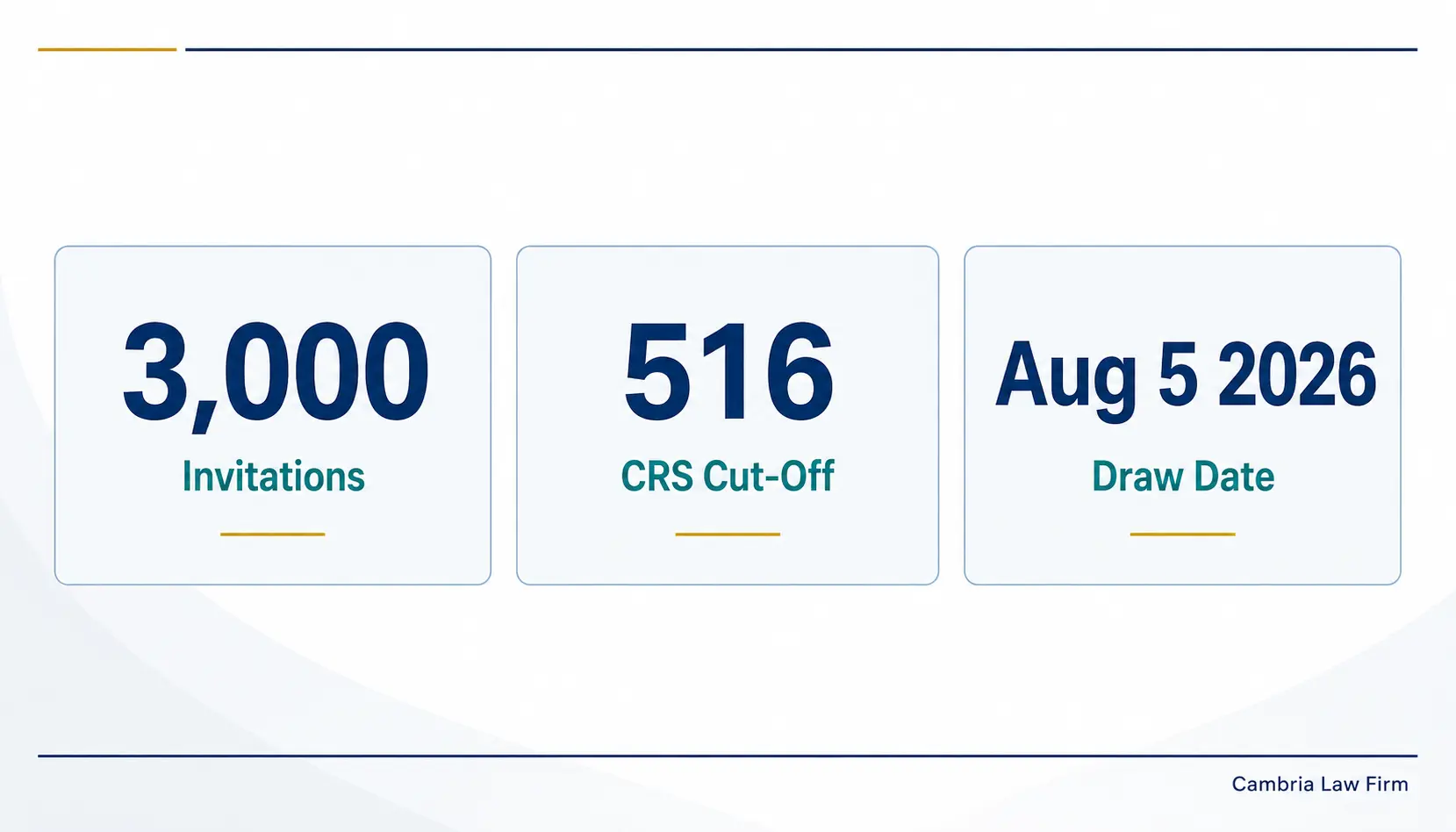
At a Glance
| Draw Detail | Result |
|---|---|
| Draw date | August 5, 2026 |
| Draw type | Canadian Experience Class (CEC) |
| Invitations issued | 3,000 |
| Minimum CRS score | 516 |
| Tie-breaking date | July 3, 2026 |
| Tie-breaking time | 9:35 p.m. UTC |
Source: IRCC Express Entry rounds of invitations — Government of Canada
The CRS cutoff of 516 means that eligible CEC candidates with scores above 516 were generally invited. The tie-breaking rule determines outcomes only for candidates at exactly the cutoff score.
The tie-breaking rule does not affect candidates whose scores are above the cutoff — it applies only where multiple candidates share the minimum qualifying score and the draw must select among them.
The August 5 draw continues a pattern of stable CEC cutoffs in the 507–518 range that has held throughout 2026. The cutoff was unchanged from July 21, but draw volume increased from 2,000 to 3,000.
| Draw Date | CRS | ITAs |
|---|---|---|
| August 5, 2026 | 516 | 3,000 |
| July 21, 2026 | 516 | 2,000 |
| July 7, 2026 | 517 | 2,000 |
| June 23, 2026 | 516 | 4,000 |
| May 27, 2026 | 518 | 3,000 |
| April 28, 2026 | 514 | 2,000 |
| April 14, 2026 | 515 | 2,000 |
| March 31, 2026 | 509 | 2,250 |
| March 17, 2026 | 507 | 4,000 |
| March 3, 2026 | 508 | 4,000 |
| February 17, 2026 | 508 | 6,000 |
| January 21, 2026 | 509 | 6,000 |
| January 7, 2026 | 511 | 8,000 |
The 2026 CEC cutoff has ranged from 507 to 518 — a remarkably narrow band. The cutoff in the second half of 2026 has settled in the 516–517 range, reflecting the current pool composition. Future draws depend on pool size, candidate scores, IRCC’s immigration targets, and the volume of profiles expiring or being updated.
| Draw Type | 2026 ITAs |
|---|---|
| Canadian Experience Class | 45,250 |
| French-language proficiency | 40,500 |
| Healthcare and social services | 8,000 |
| Provincial Nominee Program | 6,957 |
| Trades | 3,000 |
| Senior managers with Canadian work experience | 750 |
| Physicians with Canadian work experience | 662 |
| Skilled military recruits | 4 |
| Total — all draw types | 108,123 |
CEC draws account for 42% of all 2026 Express Entry ITAs across 13 draws — the dominant pathway by volume. The CEC remains the primary route for skilled workers already in Canada who have accumulated qualifying Canadian work experience.
The CEC is designed for skilled workers who have qualifying Canadian work experience and want to become permanent residents. The work experience must generally:
Applicants must also meet the applicable language requirements and intend to reside outside Quebec. IRCC counts a maximum of 30 hours per week toward the minimum work-experience requirement.
Receiving an ITA begins the document-intensive stage. The 60-day deadline runs from the date of the invitation — not from when the candidate starts preparing. Begin immediately.
Confirm the score is still accurate based on current age, language results, education, Canadian and foreign work experience, marital status, spouse information, provincial nomination, sibling points, and French-language points. A candidate must still meet the cutoff after any score-affecting changes.
The invitation is issued under the CEC category — the candidate must prove the underlying work experience qualifies. Review work authorization, employment dates, weekly hours, NOC code and duties, pay records, physical presence in Canada, periods of leave, and whether any work was completed during full-time studies.
A strong employment letter states the job title, exact employment dates, hours worked per week, salary or hourly wage and benefits, detailed job duties matching the selected NOC, and employer contact information with a name and authorized signature. An incomplete letter that confirms only dates and title is one of the most common post-ITA problems.
The application must be consistent with all previous study permit, work permit, visitor, and immigration applications. Any visa refusals, profile changes, or employment history discrepancies should be addressed before submission — not left for the officer to identify.
Police certificates, medical examination documentation, education records, civil-status documents, passport copies, and certified translations all take time to obtain. Start immediately — do not wait until the final week of the 60-day window.
| Mistake | Why It Causes Problems | What to Do Instead |
|---|---|---|
| Assuming the profile no longer matters | IRCC compares every supporting document with profile declarations made before the invitation | Review every profile field against your supporting documents before submitting |
| Uploading an incomplete employer letter | A letter confirming only title and dates may not prove CEC eligibility — duties must match the NOC | Obtain a complete letter including detailed duties, hours, wage, and authorized signature |
| Ignoring a reduced CRS score | Marriage, birthdays, expired language tests, or incorrect education claims can lower the score below the cutoff | Recalculate the score using current information and confirm it remains at or above 516 |
| Not disclosing previous refusals | Immigration history questions must be answered accurately — omissions are a misrepresentation risk | Disclose all previous applications, refusals, and immigration history accurately |
| Using the wrong NOC code | A familiar job title does not prove the selected NOC matches actual duties | Verify NOC by comparing actual duties to the lead statement and main duties of the NOC — not just the title |
| Waiting until the deadline | Police certificates, employer letters and translations take time — rushing produces errors | Begin all document collection the day the ITA is received |
| Counting unauthorized work | Only qualifying authorized work counts toward the CEC minimum — unauthorized work cannot be claimed | Verify work authorization for every employment period included in the CEC claim |
Candidates who were not invited remain in the Express Entry pool while their profiles are valid. Waiting alone is unlikely to produce an invitation if the score remains below the active cutoff range.
Practical score-improvement strategies include:
The minimum CRS score was 516. Candidates with scores above 516 were generally invited. Candidates with exactly 516 were invited only if their Express Entry profile was created before 9:35 p.m. UTC on July 3, 2026.
IRCC issued 3,000 Invitations to Apply — an increase from the 2,000 ITAs issued in the previous CEC draw on July 21, 2026, which also had a CRS cutoff of 516.
No. The July 21 CEC draw also had a CRS cutoff of 516. The cutoff was unchanged but the draw volume increased from 2,000 to 3,000 invitations. The 2026 CEC cutoff has ranged from 507 to 518 across 13 draws.
Invited candidates have 60 days from the date of the Invitation to Apply to submit a complete permanent residence application through their IRCC account. The deadline is strict — there are no extensions. Begin collecting documents immediately after receiving the ITA.
No. An ITA gives the candidate the opportunity to submit a permanent residence application. The candidate must prove that all information in their Express Entry profile was accurate, that they meet all CEC eligibility requirements, and that they are admissible to Canada. An incomplete or inconsistent application can result in a refusal even after an ITA is received.
Yes. Declining returns the candidate to the Express Entry pool, provided the profile remains valid. However, there is no guarantee of a future invitation, and the candidate’s score and pool ranking will be reassessed at the time of any future draw.
No. As of March 25, 2025, IRCC no longer awards CRS points for arranged employment or qualifying job offers. The previous 50 or 200 CRS points for job offers were removed. Candidates should ensure their CRS score calculations do not include job offer points.
It may count where the applicant was physically present in Canada, worked for a Canadian employer, and met all other CEC requirements. Physical presence in Canada is a requirement — remote work performed from outside Canada does not qualify.
Work completed while the applicant was a full-time student generally does not count toward the minimum CEC work requirement. Part-time work during full-time studies is typically excluded from the qualifying experience calculation.
Self-employment generally does not count toward the CEC minimum work experience requirement, subject to limited exceptions under specific public policies. Candidates relying on self-employed periods should seek legal advice to confirm whether those periods qualify before submitting an application.
Our immigration team can help with applications, refusals, appeals, and next steps. Contact us today for a consultation.