Need help with your Canadian immigration matter?
Our immigration team can help with applications, refusals, appeals, and next steps. Contact us today for a consultation.

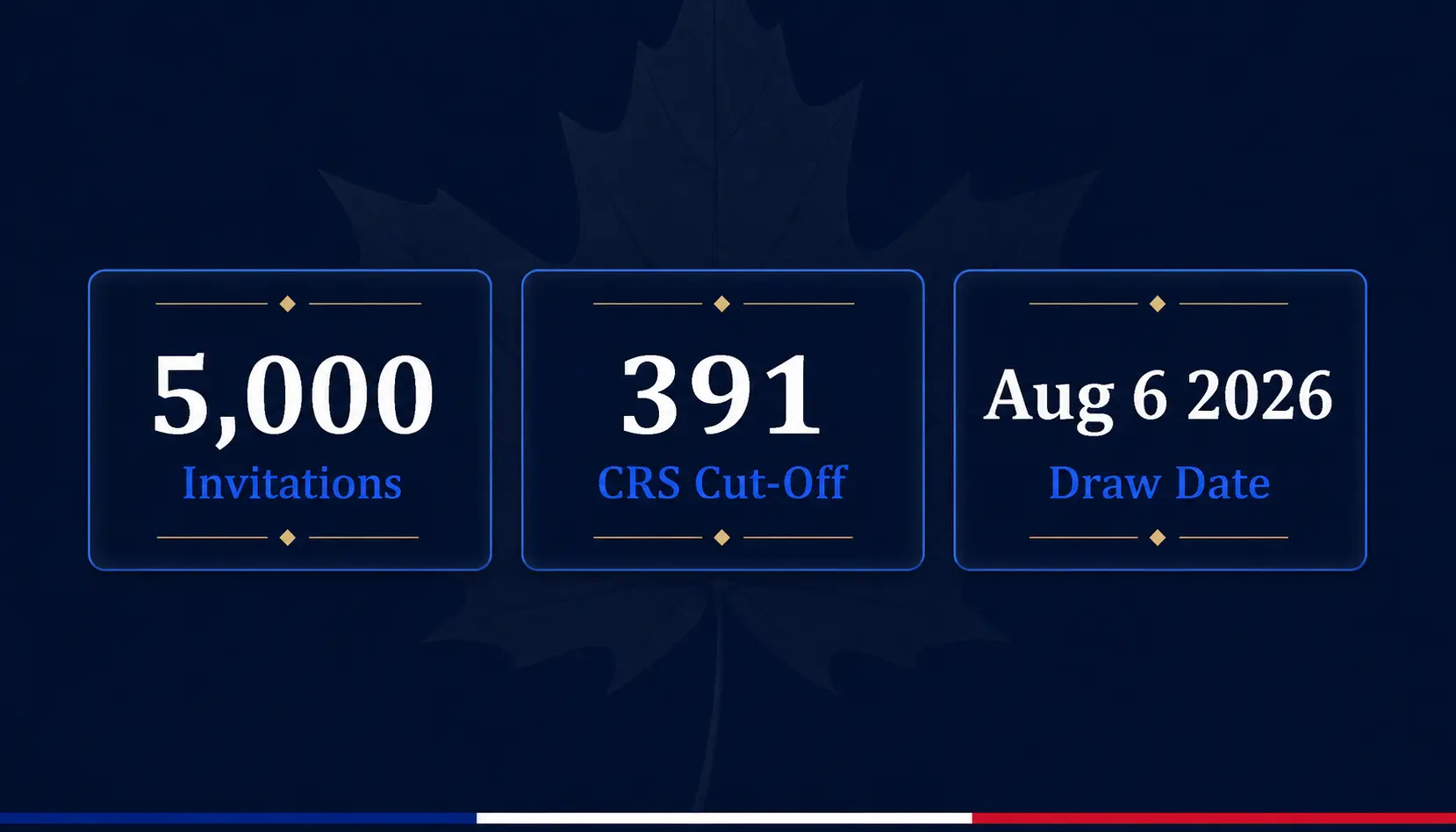
At a Glance
| Draw Detail | Result |
|---|---|
| Draw date | August 6, 2026 |
| Draw category | French-language proficiency |
| Invitations issued | 5,000 |
| Minimum CRS score | 391 |
| Tie-breaking date | March 18, 2026 |
| Tie-breaking time | 11:32 p.m. UTC |
| Significance | Lowest French-category cut-off since March 2025 |
Source: IRCC Express Entry rounds of invitations — Government of Canada
The CRS 391 cutoff is the key number. The August 5 CEC draw issued invitations at CRS 516 — a gap of 125 points separating the two draws held on consecutive days. A candidate with a CRS score of 400 would not have been invited in yesterday’s CEC draw but would have been invited today under the French-language category.
This gap illustrates why French proficiency is increasingly valuable in the current Express Entry environment. The CEC cutoff has held in the 514–518 range for most of the second half of 2026. The French-language cutoff dropped from 420 in July 9’s draw to 399 on July 22, and now to 391 on August 6 — a declining trend that significantly broadens the pool of candidates who can receive invitations.
Today’s two draws side by side:
| Feature | French-Language (Aug 6) | CEC (Aug 5) |
|---|---|---|
| CRS cut-off | 391 | 516 |
| ITAs issued | 5,000 | 3,000 |
| Main requirement | French-language category eligibility | Qualifying Canadian work experience |
| Outside Quebec intent | Yes | Yes |
| Draw Date | CRS | ITAs |
|---|---|---|
| August 6, 2026 | 391 | 5,000 |
| July 22, 2026 | 399 | 5,000 |
| July 9, 2026 | 420 | 5,000 |
| May 28, 2026 | 409 | 4,500 |
| April 29, 2026 | 400 | 4,000 |
| April 15, 2026 | 419 | 4,000 |
| March 18, 2026 | 393 | 4,000 |
| March 4, 2026 | 397 | 5,500 |
| February 6, 2026 | 400 | 8,500 |
The August 6 cutoff of 391 is the second-lowest in 2026 — only the March 18 draw (393) came close. The trend across the last three draws (420 → 399 → 391) shows a consistent decline in the cutoff, though draw sizes and cutoffs can change direction at any time depending on pool composition and IRCC’s immigration targets.
| Draw Type | 2026 ITAs |
|---|---|
| Canadian Experience Class | 48,250 |
| French-language proficiency | 45,500 |
| Healthcare and social services | 8,000 |
| Provincial Nominee Program | 6,957 |
| Trades | 3,000 |
| Senior managers with Canadian work experience | 750 |
| Physicians with Canadian work experience | 662 |
| Skilled military recruits | 4 |
| Total — all draw types | 113,123 |
French-language draws have now issued 45,500 ITAs across nine draws in 2026 — nearly matching the CEC total of 48,250. Together, CEC and French-language draws account for 83% of all Express Entry invitations issued so far in 2026.
French-language category-based selection does not replace the requirements of the underlying Express Entry program. Candidates must satisfy two sets of conditions simultaneously.
Step 1 — Be eligible for an Express Entry program:
Step 2 — Meet the French-language category requirements:
Candidates intending to live in Quebec after receiving permanent residence are not eligible for federal Express Entry programs — these programs require an intention to reside outside Quebec.
The 125-point gap between yesterday’s CEC draw (CRS 516) and today’s French-language draw (CRS 391) makes the practical case more clearly than any explanation could. A candidate with CRS 400 who also meets French-language category requirements received an invitation today. The same candidate would need to improve their CRS by more than 115 points to receive a CEC invitation at current cutoff levels.
French proficiency affects CRS scores in two ways beyond category eligibility:
Review all CRS-contributing factors with current information: age, education, language scores (confirm French test results are not expired), Canadian and foreign work experience, spouse information, French-language points, and any provincial nomination. A reduced CRS score after the ITA — from a birthday, expired test, or corrected information — can affect whether the invitation remains valid.
Verify that French test results are from an approved testing organization, are valid, cover all four abilities at the required minimum level, and are correctly entered in the Express Entry profile. Expired language results are one of the most common post-ITA problems in French-language draws.
A French-language category invitation was issued — but the permanent residence application must also prove eligibility under the Canadian Experience Class, Federal Skilled Worker Program, or Federal Skilled Trades Program. Gather employment letters, pay records, education credentials, and work permits as applicable to the specific program.
French-language test results, employment letters with detailed duties, work permits, pay stubs, T4 slips, Notices of Assessment, education records, Educational Credential Assessments, police certificates, passport copies, civil-status documents, and medical documentation. Begin all document collection immediately — the 60-day deadline is strict with no extensions.
Compare the permanent residence application against all previous visa, work permit, study permit, and Express Entry applications. Refusal history must be disclosed accurately. Differences in employment dates, addresses, or immigration history between the PR application and prior applications must be addressed with explanation — not left for the officer to identify.
| Mistake | Risk | Action |
|---|---|---|
| Expired French test results | Category eligibility fails — ITA may be invalid | Confirm test validity before submitting any document |
| Incorrect test scores in profile | CRS recalculated — may fall below cut-off | Compare profile scores with official test result documents |
| Assuming category eligibility alone is sufficient | Underlying Express Entry program requirements must also be met | Confirm eligibility under CEC, FSWP, or FSTP separately |
| Weak or incomplete employment letters | Underlying program eligibility fails if work experience is not proven | Letters must include dates, hours, duties, pay, and authorized signature |
| Not disclosing previous refusals | Misrepresentation risk if immigration history is incomplete | Disclose all prior applications and refusals accurately |
| Delaying police certificates | 60-day deadline is firm — incomplete applications are refused | Begin obtaining police certificates the day the ITA is received |
| Ignoring CRS score changes after ITA | Candidate may fall below the draw cut-off if score changes | Recalculate CRS with current information before filing |
Candidates who were not invited remain in the Express Entry pool while their profiles are valid. The most practical strategies depend on why the score falls below the current French-language cutoff.
The minimum CRS score was 391 — the lowest reported French-language category cut-off since March 2025. Candidates with scores above 391 who met French-language category requirements were generally invited. Candidates with exactly 391 were invited only if their Express Entry profile was created before 11:32 p.m. UTC on March 18, 2026.
IRCC issued 5,000 Invitations to Apply — the same volume as the July 22, 2026 French-language draw. The CRS cut-off dropped from 399 to 391 between those two draws.
Candidates with exactly 391 CRS points were invited only if their Express Entry profile was created before 11:32 p.m. UTC on March 18, 2026. The tie-breaking rule applies only at the exact cut-off score — candidates above 391 were not affected by it.
CRS 391 is the lowest reported French-language category cut-off since March 2025. It was also eight points lower than the July 22 draw, continuing a declining trend across the last three French-language draws (420 → 399 → 391). The 125-point gap between today’s French draw (CRS 391) and yesterday’s CEC draw (CRS 516) illustrates the advantage French proficiency provides in the current Express Entry environment.
IRCC has held nine French-language proficiency draws in 2026, issuing 45,500 invitations as of August 6. French-language draws are the second-largest source of Express Entry invitations in 2026, behind only the Canadian Experience Class.
No. Candidates must hold a valid Express Entry profile, be eligible under one of the underlying programs (CEC, FSWP, or FSTP), and meet all French-language category requirements. Meeting the category requirements determines eligibility for French-language draws — it does not override the requirements of the underlying Express Entry program, which must also be fully satisfied in the permanent residence application.
Yes. A candidate who is eligible under both the CEC and the French-language category can potentially receive invitations through either draw type. The August 6 draw shows why this matters — a candidate with CRS 400 who is eligible for both would not have been invited in the August 5 CEC draw (cutoff 516) but qualifies for today’s French-language draw (cutoff 391).
Yes. French-language Express Entry draws are available to eligible candidates regardless of where they currently live in Canada, provided they intend to reside outside Quebec after becoming permanent residents. Candidates in Mississauga, Brampton, Toronto, and across the GTA who hold valid profiles and meet French-language category requirements can qualify.
No. Federal Express Entry programs — including French-language category draws — require candidates to intend to reside outside Quebec. Candidates who intend to settle in Quebec should explore Quebec’s own immigration programs instead.
An expired language test can affect both category eligibility and CRS points. If a French test expires after the ITA is issued but before the permanent residence application is submitted, the candidate should seek advice immediately about whether the application can be submitted with valid results or whether the ITA remains valid. Do not submit a permanent residence application relying on expired language results.
Invited candidates have 60 days from the date of the Invitation to Apply to submit a complete permanent residence application through their IRCC account. The deadline is strict — there are no extensions. Begin all document collection immediately after receiving the ITA.
Future cut-offs cannot be predicted with certainty. The recent trend has been declining (420 → 399 → 391 across three consecutive draws), but draw sizes, pool composition, and IRCC’s immigration priorities can change direction at any time. Candidates who qualify should focus on maintaining a strong, accurate Express Entry profile rather than waiting for predicted cut-off changes.
Key Takeaways:
Our immigration team can help with applications, refusals, appeals, and next steps. Contact us today for a consultation.