Need help with your Canadian immigration matter?
Our immigration team can help with applications, refusals, appeals, and next steps. Contact us today for a consultation.

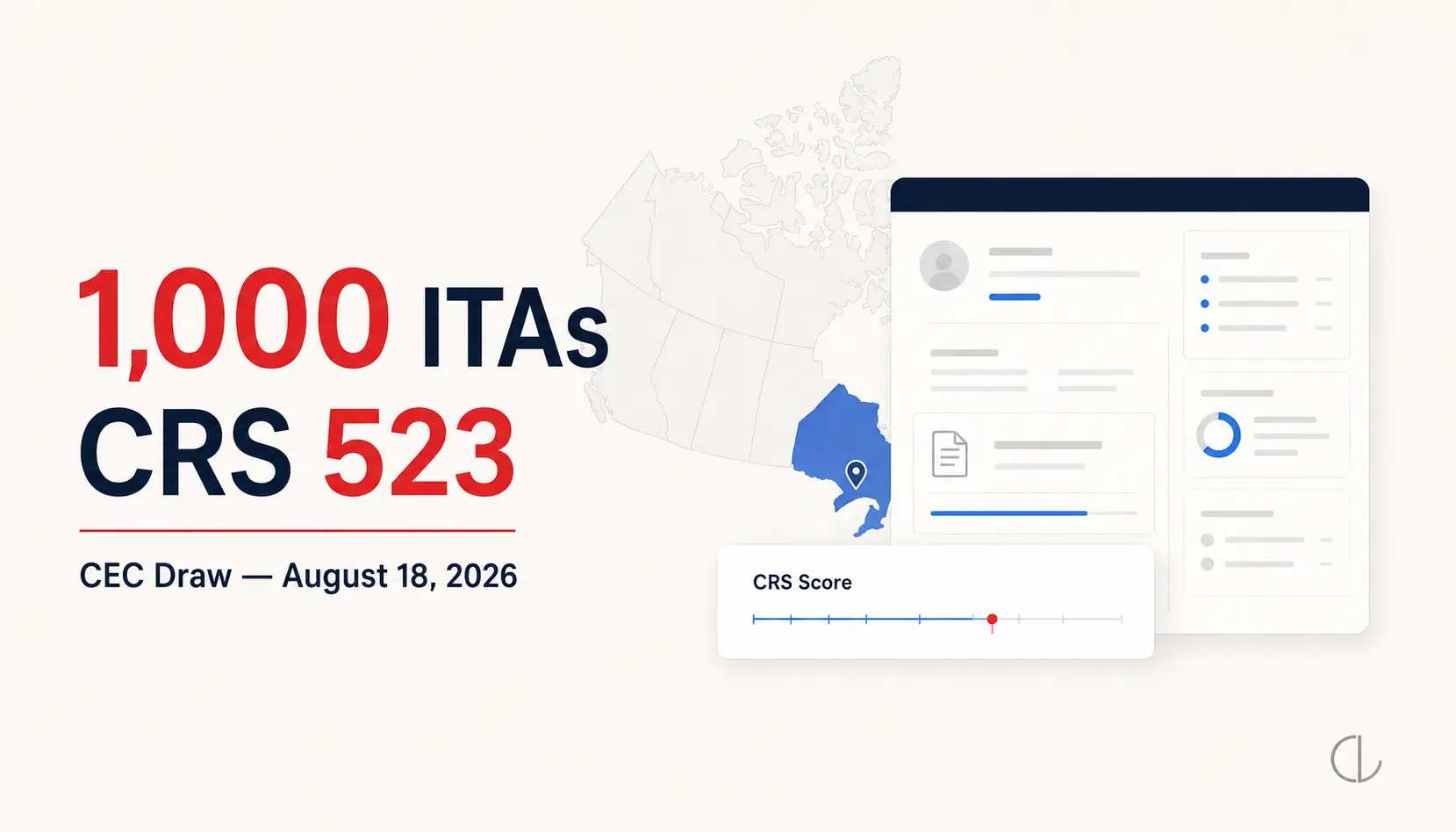
Candidates also needed to have created their Express Entry profile before 10:13 a.m. UTC on August 17, 2026 to be considered under the tie-breaking rule.
The August 18 draw is notable for two reasons: it issued the smallest number of CEC invitations in a single 2026 draw so far, while the CRS cut-off rose to 523, the highest CEC cut-off reported this year.
For candidates in Mississauga, Brampton and across Ontario, the result reinforces an important point: Canadian work experience alone does not guarantee an Invitation to Apply. Eligible CEC candidates are still ranked against other eligible candidates in the Express Entry pool.
| Draw Detail | Result |
|---|---|
| Date | August 18, 2026 |
| Draw Type | Canadian Experience Class |
| ITAs Issued | 1,000 |
| Minimum CRS Score | 523 |
| Tie-Breaking Rule | Profile created before 10:13 a.m. UTC on August 17, 2026 |
The previous CEC draw on August 5 invited 3,000 candidates with a CRS cut-off of 516.
In the August 18 round:
The combination of fewer invitations and a higher cut-off shows why candidates should not assume that CRS scores will move steadily downward from one CEC draw to the next.
| Date | ITAs | CRS |
|---|---|---|
| August 18 | 1,000 | 523 |
| August 5 | 3,000 | 516 |
| July 21 | 2,000 | 516 |
| July 7 | 2,000 | 517 |
| June 23 | 4,000 | 516 |
| May 27 | 3,000 | 518 |
The latest CRS of 523 is 5 points higher than the previous 2026 CEC high of 518 shown in the supplied draw history.
IRCC does not establish CEC cut-offs independently of the pool. In a program-specific round, IRCC identifies the highest-ranking candidates who are eligible for that particular Express Entry program.
This means the final cut-off can be influenced by factors such as:
Because only 1,000 candidates were invited in this round, fewer candidates could be reached before the ranking cut-off was established.
A CRS score below 523 did not qualify for the August 18 CEC draw, but that does not mean a candidate has no viable Express Entry strategy.
For candidates in Ontario, the key question is whether there are realistic ways to improve ranking or qualify for another type of selection.
Potential areas to review include:
Candidates can review our Express Entry strategy services for help assessing their profile beyond the headline CRS score.
The Canadian Experience Class is designed for skilled workers with qualifying Canadian work experience who want to become permanent residents.
IRCC currently requires the qualifying Canadian work experience to be:
CEC applicants must also meet the applicable language requirements and be admissible to Canada.
IRCC requires at least one year of qualifying Canadian skilled work experience, or 1,560 hours, accumulated during the three years before applying.
IRCC explains that candidates can satisfy this requirement through:
Work experience gained through self-employment or while the person was a full-time student generally does not count toward the CEC minimum, subject to specific exceptions identified by IRCC.
IRCC does not impose a minimum education requirement for the Canadian Experience Class.
However, education can still increase a candidate’s CRS ranking.
Canadian educational credentials may provide CRS points, while qualifying foreign education can contribute points where the candidate has an appropriate Educational Credential Assessment.
This distinction matters: a candidate can be eligible for CEC without post-secondary education while still competing against candidates who receive additional CRS points for education.
The strongest response is not simply waiting for the next CEC draw.
Review the profile systematically.
| Area | What to Review |
|---|---|
| Language | Determine whether improved English or French results could materially increase CRS. |
| Canadian Experience | Check whether additional qualifying Canadian work experience will increase CRS or strengthen eligibility. |
| Education | Confirm Canadian education points or whether an ECA for foreign education could increase ranking. |
| Category Eligibility | Determine whether French or another current category-based selection pathway applies. |
| Provincial Nomination | Review Ontario and other applicable provincial nomination options where appropriate. |
The day before this CEC round, IRCC invited 442 provincial nominees with a CRS cut-off of 760.
That does not mean every Ontario candidate should pursue a provincial nomination. Provincial programs have their own eligibility requirements and selection priorities.
But candidates with CRS scores below recent CEC levels should assess provincial options rather than relying on only one Express Entry pathway.
Read our Ontario provincial nomination services and our Ontario Workforce Priority Stream guide.
The minimum CRS score was 523.
IRCC issued 1,000 Invitations to Apply.
Based on the 2026 draw history reported with this update, yes. The previous highest CEC cut-off was 518 on May 27.
IRCC invited only 1,000 candidates in this round. Cut-offs depend on the number of invitations and the ranking of eligible CEC candidates in the pool, so a smaller round can result in a higher minimum score.
It was not sufficient for the August 18 draw, which required 523. Future rounds may have different cut-offs, so one draw should not be treated as a prediction.
IRCC generally requires at least one year or 1,560 hours of qualifying Canadian skilled work experience in the three years before applying.
No. There is no minimum education requirement for CEC, although education can increase a candidate’s CRS score.
No. Eligibility for CEC allows a candidate to enter or remain eligible within the Express Entry system, but an ITA depends on ranking and the cut-off in an applicable invitation round.
A CRS score should be reviewed together with Canadian work experience, language results, education, category-based eligibility and provincial nomination options.
Contact Nav Aujla and Vick Sidhu at Cambria Law Firm to discuss a Canadian Experience Class or Express Entry strategy in Mississauga or elsewhere in Ontario. Nav Aujla is a Lawyer and Vick Sidhu is a Regulated Canadian Immigration Consultant (RCIC).
Immigration Disclaimer: This article provides general immigration information only and does not constitute legal or immigration advice. Express Entry draw types, CRS cut-offs, program requirements and invitation volumes can change. Past draws do not predict or guarantee future invitations.
Our immigration team can help with applications, refusals, appeals, and next steps. Contact us today for a consultation.