Need help with your Canadian immigration matter?
Our immigration team can help with applications, refusals, appeals, and next steps. Contact us today for a consultation.

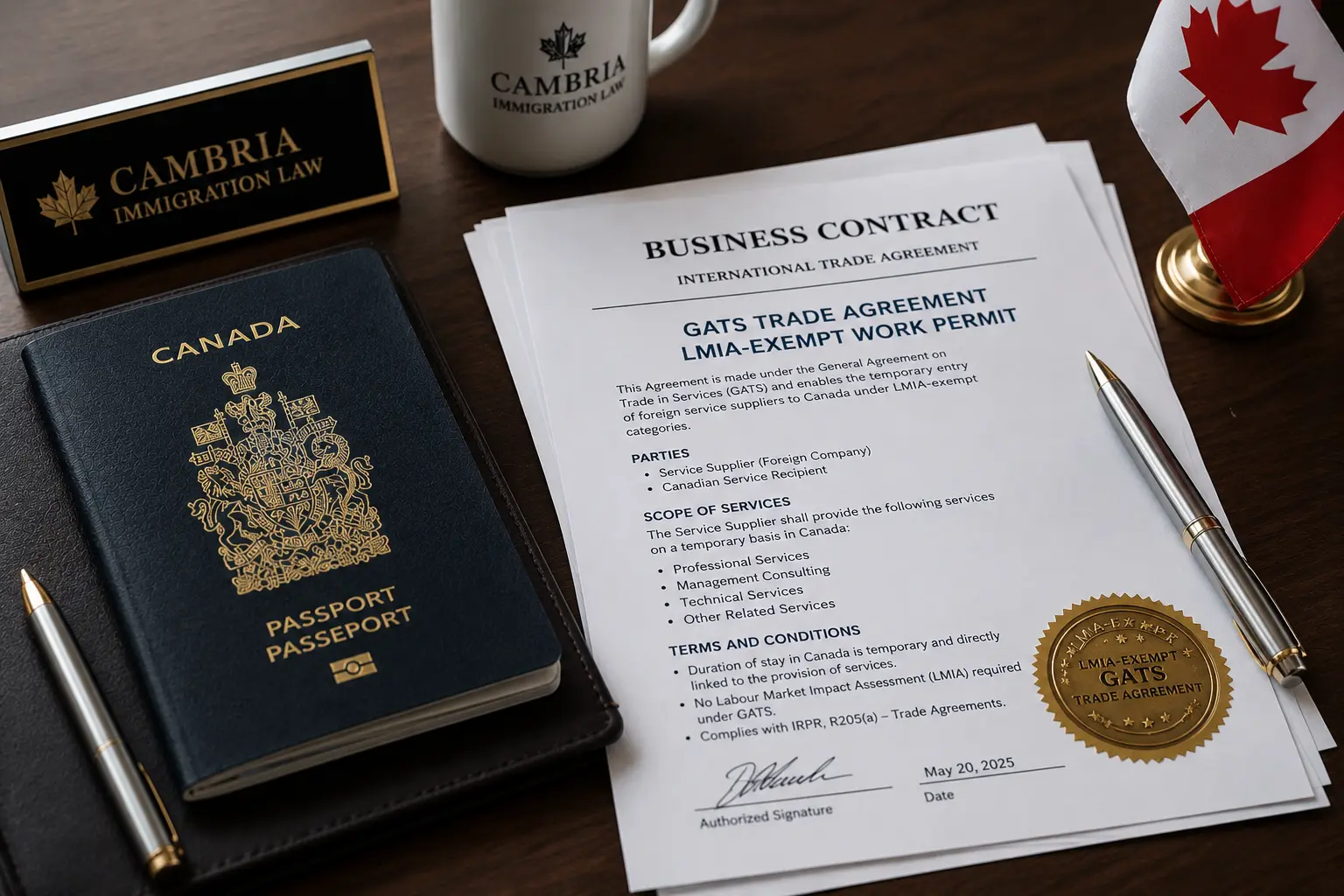
Bringing international talent into Canada can be a slow process, mostly because employers usually have to prove they could not find a Canadian to do the job first. However, certain international trade agreements allow professionals to skip this step entirely.
On May 15, 2026, the Canadian government released new guidance on a specific LMIA-exempt work permit program tied to the World Trade Organization. This program allows professionals to enter Canada quickly for short-term projects.
While the program is fast, the government has just made the application process much stricter. Here is exactly what changed on May 15, 2026, and what documents you now need to provide to avoid a refusal.
This specific work permit is designed for highly skilled workers who are coming to Canada for a short time to provide a service. Because it falls under a global trade agreement, the Canadian employer does not need to get a Labour Market Impact Assessment (LMIA).
This makes the process incredibly fast, but it comes with strict limits:
Before May 15, 2026, applicants only needed basic documents like a signed contract, a job description, and proof of their education to get approved.
The new guidance changes this. To stop people from misusing the program, immigration officers will now expect a much larger pile of evidence. If you do not include these new documents, your application will likely be rejected.
| Old Requirements (Before May 2026) | New Mandatory Requirements (Added May 15, 2026) |
|---|---|
| Signed service contract | Reference letters from previous employers |
| Basic job description | Detailed job description showing exact training required |
| Proof of education / degrees | Formal letter of support from the hiring company |
| Proof of citizenship | Exact proof of years of experience in that specific field |
The government has also clarified which jobs actually qualify for this fast-track system. They have separated the approved jobs into different groups.
Group 1 (Highly Eligible): This group includes engineers, architects, land surveyors, and specialized scientists who work with forestry and agriculture.
Strictly Excluded Sectors: You absolutely cannot use this LMIA-exempt work permit if you work in education, healthcare, sports, recreation, or cultural services. Those industries are fully blocked from this program.
Yes. Depending on your current status, you can apply at a Canadian visa office in your home country, directly at the airport or border (Port of Entry) if you are from an eligible country, or from inside Canada.
Yes. If your job (like an engineer or an architect) requires a specific license to work legally in the province of Ontario, you must still meet all of those licensing requirements before you can start working, even if you have the work permit.
No. The government was very clear on May 15, 2026, that no extensions are allowed. The maximum stay is 90 days within a full 12-month period.
We believe in clear communication. Here is the technical breakdown of the legal terms referenced in this article.
| Legal Term | Simple Definition | Context in Immigration |
|---|---|---|
| LMIA (Labour Market Impact Assessment) | A document an employer usually needs to prove they tried to hire a Canadian first. An “LMIA-exempt” permit lets you skip this step. | Immigration and Refugee Protection Regulations (IRPR), Part 11. |
| GATS (General Agreement on Trade in Services) | A World Trade Organization (WTO) treaty that makes it easier for member countries to trade services and move professionals across borders. | International treaty managed by the WTO. |
| Port of Entry (POE) | A physical border crossing, such as an international airport (like Toronto Pearson) or a land border with the United States. | Where some eligible applicants can receive their work permit instantly. |
The rules for bringing international professionals to Canada just became much stricter. A simple mistake on your job description or a missing reference letter will result in an immediate refusal.
At Cambria Law Firm, our business immigration lawyers ensure your contracts, support letters, and evidence are perfectly aligned with the new May 15, 2026 government standards so your professionals can get to work without delay.
Cambria Law Firm serves clients across Ontario, including Mississauga, Toronto, Brampton, Oakville, Hamilton, and the Greater Toronto Area. Law Society Number: 74895I.
Our immigration team can help with applications, refusals, appeals, and next steps. Contact us today for a consultation.