Need help with your Canadian immigration matter?
Our immigration team can help with applications, refusals, appeals, and next steps. Contact us today for a consultation.

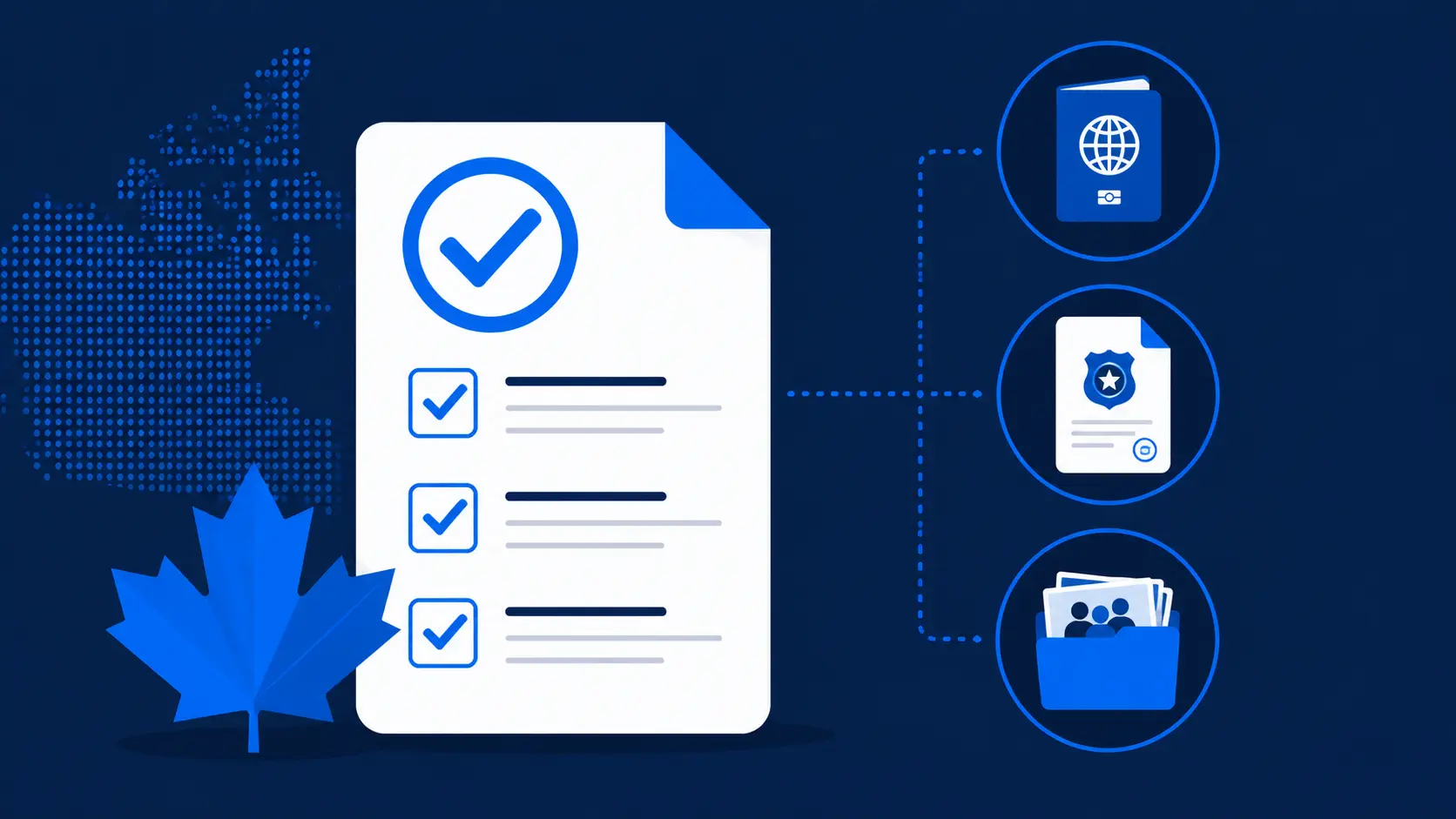
If you are sponsoring your spouse or common-law partner for permanent residence in Canada, your documents determine how quickly — and whether — the application gets approved.
IRCC looks for a complete application, clear sponsor eligibility, valid applicant documents, and strong relationship evidence that proves the relationship is genuine.
If you are sponsoring your spouse or common-law partner for permanent residence in Canada, the documents you submit with your application will determine how quickly — and whether — it gets approved. IRCC does not give you a second chance to fix a weak application without losing months in the process.
This checklist has been updated to reflect IRCC’s processing times and document requirements as of July 2026. If you filed before reading this, check each section against your application to identify any gaps before IRCC does.
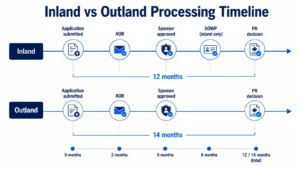
The most significant update since we published this checklist in June is the shift in IRCC’s published processing times. As of July 2026, spousal sponsorship is processing at approximately 12 months for inland applications and 14 months for outland applications. This is a material improvement from the figures cited earlier in 2026, when inland timelines were running as long as 25 months in some data sources.
What this means for you:
If your application is complete and well-documented, 2026 is a better time to file than it has been in recent years. Incomplete applications, however, are being returned — and the clock resets when that happens.
A returned application in July 2026 could easily push your timeline into 2028.
The two processing stages remain the same. Sponsor eligibility is assessed first, typically within one to three months. The applicant’s permanent residence file is then processed separately, which is where the bulk of that 12-to-14 month window is spent. Inland applicants can apply for a Spousal Open Work Permit (SOWP) simultaneously, which typically processes in four to six months, allowing your spouse to work in Canada while the main file is decided.
The sponsor is the Canadian citizen or permanent resident. IRCC assesses your eligibility before it reviews your spouse’s application. Missing or incomplete sponsor documents are one of the most common reasons files are delayed at the first stage.
You must provide proof of your Canadian citizenship or permanent residence. For citizens, this means a Canadian passport, birth certificate, or citizenship certificate. For permanent residents, include your PR card (both sides) or your Confirmation of Permanent Residence (COPR). If you were born outside Canada and naturalized, include your citizenship certificate.
IRCC requires confirmation that you are physically residing in Canada. A utility bill, bank statement, or government-issued correspondence dated within the last three months works for this purpose. A driver’s licence alone is not sufficient.
Unlike the Parent and Grandparent Program, spousal sponsorship does not have a minimum income requirement. You are not required to prove you meet a specific income threshold. However, you must demonstrate that you are not receiving social assistance (other than for a disability) and that you can provide basic necessities for your spouse after they arrive. A recent notice of assessment from the CRA or recent pay stubs are appropriate supporting documents.
If you have any criminal convictions in Canada or abroad, you must disclose these. Certain offences — particularly those involving violence, sexual offences, or offences against family members — will make you ineligible to sponsor. This is a legal determination, not a discretionary one. If you have any history in this area, speak with a regulated immigration consultant before filing.
Your spouse must provide a valid passport with at least six months of remaining validity beyond your intended travel date to Canada. Include all pages — blank and stamped — not just the biographical page. If your spouse has held multiple passports in the past ten years, include copies of the relevant pages from prior passports.
Your spouse must obtain a police certificate from every country where they have lived for six or more months since the age of 18. This includes their country of birth, regardless of how long ago they left. Police certificates have expiry windows — IRCC requires them to be issued within a specific period of your application date. Check IRCC’s country-specific instructions before requesting certificates, as processing times for police documents vary significantly by country.
Your spouse must complete a medical examination with an IRCC-designated panel physician. Medical exams are valid for 12 months from the date of the examination. Do not book the medical examination too early — if processing takes longer than expected, an expired medical will require a repeat examination before IRCC can approve the file.
Two identical photos meeting IRCC’s technical specifications. These must be recent (taken within the last six months) and must meet specific size, background, and quality requirements as outlined in the application instructions.
This is the part most applicants underestimate. IRCC is not simply checking whether you are legally married. They are assessing whether your relationship is genuine. A marriage certificate alone proves almost nothing. What IRCC actually scrutinizes is the evidence that your relationship exists as a lived reality — before and after marriage.
The strongest applications contain evidence across multiple categories. No single document is sufficient on its own. IRCC looks for consistency and volume across the following:
Every application should include a written narrative explaining how you met, how your relationship developed, why you are applying from inside or outside Canada, and what your plans are after your spouse receives permanent residence. This document gives IRCC context for the evidence package. It should be honest, specific, and detailed.
Generic narrative statements — “we love each other and want to build a life together” — add nothing. Specific accounts of how you met, significant moments in the relationship, and how you have maintained the relationship across distance are what matter.
If you live in Quebec, the sponsorship process includes an additional step that applies only to Quebec residents. Quebec’s Ministère de l’Immigration, de la Francisation et de l’Intégration (MIFI) requires a separate undertaking application, and Quebec has its own rules and capacity limits.
As of mid-2026, MIFI reached its maximum number of undertaking applications for spouses, common-law partners, conjugal partners, and dependent children 18 or older until June 25, 2026. If you are sponsoring from Quebec, check MIFI’s current status before filing. An IRCC approval cannot be finalized without a valid Quebec undertaking for Quebec-resident sponsors.
Quebec filing reminder:
Do not submit your MIFI undertaking application until IRCC instructs you to do so. Submitting prematurely can cause your Quebec application to be refused.
This decision affects your timeline, your spouse’s rights during processing, and your risk exposure if the application is refused.
| Stream | When It Applies | Key Consideration |
|---|---|---|
| Inland sponsorship | When your spouse is already in Canada and you are filing together. | Your spouse can apply for a Spousal Open Work Permit at the same time, but travel outside Canada can create risk. |
| Outland sponsorship | When your spouse is outside Canada, or when an inland applicant chooses processing through a visa office abroad. | Allows more travel flexibility, but current outland timelines are approximately 14 months. |
Inland sponsorship applies when your spouse is already in Canada and you are filing together. The key advantage is that your spouse can apply for a Spousal Open Work Permit at the same time, allowing them to work legally in Canada within four to six months of filing. The significant limitation is that inland applicants generally cannot leave Canada and re-enter without an Advance Travel Authorization (ATA) while their application is in process. If your spouse leaves Canada without one, their application may be abandoned.
Outland sponsorship applies when your spouse is outside Canada, or when an inland applicant chooses to have their file processed through a visa office abroad. Outland applications allow your spouse to travel freely during processing. Processing timelines for outland applications are currently running at approximately 14 months — two months longer than inland on average. The gap between inland and outland timelines has narrowed considerably in 2026.
The right choice depends on your specific circumstances. If your spouse is already in Canada and needs to work, inland is typically the better option. If your spouse needs to travel freely, or if there are concerns about maintaining status in Canada during a lengthy processing period, outland may be more appropriate.
Understanding what IRCC flags as problematic is as important as knowing what to include.
Applications are commonly delayed or refused when:
IRCC does not call you to clarify issues. They send procedural fairness letters when they have concerns, and you have a limited window to respond. A weak initial application means you may receive one of these letters — and responding to them requires the same level of careful documentation as the original application.
If you have not yet filed and are assembling your application, start with the relationship evidence section. That is where most applications either succeed or fail. Work backwards from what you have — photographs, communication exports, travel records — and identify the gaps before you submit.
If you have already filed and are waiting for a decision, the current inland timeline of approximately 12 months means that applications filed in early 2026 should be approaching decision in the first quarter of 2027. Monitor your IRCC secure account for any correspondence requesting additional documents or a procedural fairness response.
If your application has been in process significantly longer than the posted timeline, IRCC’s web form can be used to make a case-specific inquiry. Calling the IRCC call centre will not speed up your application and will not provide meaningful status updates.
How Cambria Law Firm Can Help
Cambria Law’s immigration consulting services are handled by Vick Sidhu, a Regulated Canadian Immigration Consultant (RCIC, CICC R705820), based in Mississauga, Ontario.
If you have questions about your spousal sponsorship application or would like a review of your document package before filing, contact our office at 416-840-7545.
Related immigration services:
Our immigration team can help with applications, refusals, appeals, and next steps. Contact us today for a consultation.