Injured in Ontario? Get clear legal guidance today.
Our personal injury team can help with accident, disability, and injury claims. Contact us today for a free consultation.

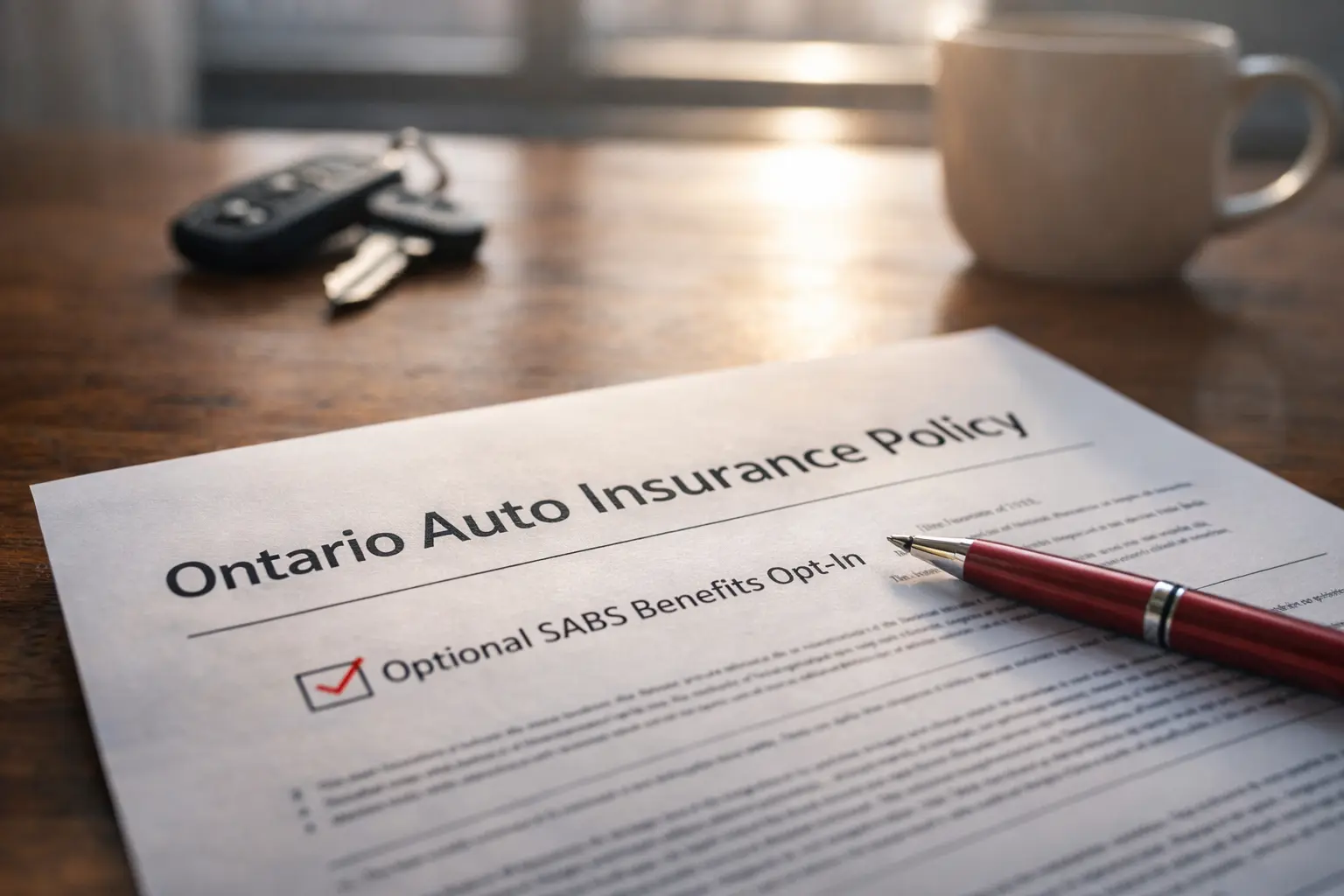
Since July 1, 2026, most Ontario statutory accident benefits are optional rather than automatically included as mandatory coverage. Medical, rehabilitation and attendant-care benefits remain mandatory, but benefits such as income replacement, non-earner, caregiver, housekeeping, death and funeral coverage now depend on the policy and optional coverage selected.
For Ontario drivers, the practical question is no longer simply “Do I have automobile insurance?” It is also “Which accident benefits does my policy actually provide?”
Ontario’s July 1, 2026 automobile insurance reforms changed the structure of the Statutory Accident Benefits Schedule (SABS).
Medical, rehabilitation and attendant-care benefits remain mandatory.
Other accident benefits are now generally optional, including:
Important: “Optional” does not mean that everyone lost these benefits on July 1, 2026. Whether a benefit applies depends on the policy, renewal or policy changes, optional coverage selections and the SABS rules.
For a complete explanation of the reforms, read our Ontario SABS Changes July 1, 2026 guide.
Income Replacement Benefits, commonly called IRBs, are now optional under the applicable post-July 1, 2026 framework.
Where income replacement coverage applies and the claimant satisfies the SABS eligibility requirements, the standard benefit is generally calculated at 70% of gross income, subject to a maximum of $400 per week.
Optional higher weekly limits can be purchased. FSRA currently identifies options of:
Coverage and entitlement are different. Purchasing income replacement coverage does not automatically mean an injured person will receive an IRB. The claimant must also satisfy the eligibility and disability requirements contained in the SABS.
Income replacement coverage may be especially important to review for:
This does not mean that every person should select the same coverage. Existing workplace benefits, private disability insurance and financial circumstances should also be considered.
The Non-Earner Benefit is also optional under the current framework.
It is designed for certain insured people who do not qualify for income replacement benefits and who satisfy the applicable SABS test following an accident.
Students, unemployed people and others without qualifying employment income should therefore not assume that a non-earner benefit is automatically included in their automobile policy.
Caregiver benefits are optional after July 1, 2026.
They may be relevant where an insured person was the primary caregiver for a person in need of care and the accident prevents the insured person from continuing those caregiving activities, subject to the requirements of the SABS and the coverage purchased.
The 2026 reforms also changed the structure of this coverage.
Under the current optional framework, the legislated standard caregiver coverage can apply to all impairments, rather than being restricted in the same way as the previous standard catastrophic-impairment framework.
This does not mean every injury qualifies. The coverage must apply under the policy and the claimant must still satisfy the legal conditions for payment.
Housekeeping and home-maintenance benefits are also optional.
These benefits can help reimburse qualifying expenses where an insured person’s accident-related impairment prevents them from performing housekeeping or home-maintenance services they normally performed before the collision.
As with caregiver coverage, the current optional framework may provide coverage for impairments beyond catastrophic impairment, subject to the policy and SABS requirements.
Death and funeral benefits are also part of the optional accident-benefits framework after July 1, 2026.
This is an important correction to older descriptions of Ontario automobile insurance that may still describe these benefits as automatically included standard coverage.
Where purchased and applicable, death benefits may provide payments to qualifying family members following a fatal automobile accident, while funeral benefits may help cover qualifying funeral expenses.
The amounts available depend on the optional coverage purchased and applicable policy terms.
Dependant-care and indexation benefits are also optional.
Dependant-care coverage may help with qualifying additional childcare or dependant-care expenses in circumstances permitted under the policy.
Indexation coverage can adjust certain benefits for inflation according to the applicable SABS provisions.
These options can be important in longer-term disability cases because inflation can materially affect the value of benefits paid over time.
The core mandatory SABS protection after July 1, 2026 consists of medical, rehabilitation and attendant-care benefits.
| Type of Impairment | Standard Combined Limit | Optional Increase |
|---|---|---|
| Non-Catastrophic Impairment | $65,000 | May be increased to $130,000 or $1,000,000 |
| Catastrophic Impairment | $1,000,000 | May be increased to $2,000,000 |
These figures concern combined medical, rehabilitation and attendant-care coverage and remain subject to the applicable SABS provisions and policy.
For serious injuries, see our catastrophic injury lawyer in Mississauga page.
One of the biggest misconceptions about the July 2026 changes is that all existing optional accident benefits automatically disappear at renewal.
That is not an accurate way to describe Ontario’s transition rules.
For applicable renewed policies, benefits held before the reforms may continue as optional benefits at their previous amounts unless the named insured and insurer agree in writing to decline or change the applicable coverage.
Review the actual renewal package. Do not assume that a benefit disappeared, continued unchanged or was added simply because the renewal occurred after July 1, 2026.
FSRA also expects insurers and intermediaries to communicate clearly with customers about the accident-benefit reforms and available options.
The current SABS places an important restriction on the new optional benefits.
Optional benefits such as income replacement, non-earner and caregiver coverage generally apply only to:
That makes accurate driver information on an automobile policy particularly important.
The reforms introduced OPCF 47R — Optional Accident Benefits Coverage & Priority of Payment.
This endorsement deals with optional accident-benefit coverage and priority-of-payment issues where a person may have access to more than one automobile insurance policy.
It is not a general waiver of legal liability.
FSRA states that insurers should provide customers access to the highest level of coverage available to them under a policy for which they are eligible and under which they elect to claim benefits.
Consider a worker in Mississauga who is injured in an automobile accident after July 1, 2026 and cannot return to work.
It would be incorrect to assume automatically that the worker either receives an income replacement benefit or receives nothing.
The correct analysis includes:
This is why the insurance policy should be reviewed before making assumptions about the benefits available after an accident.
Because July 1, 2026 has already passed, the priority is no longer preparing for the reform date. Drivers should review the coverage they actually have now.
If an accident has already occurred, adding or changing coverage afterward does not retroactively create benefits for that accident.
The focus should instead be on determining what coverage existed when the collision occurred and whether the injured person satisfies the applicable SABS requirements.
Relevant documents may include:
For information about the broader claims process, visit our car accident lawyer in Mississauga page.
No. Income replacement benefits remain available, but they are optional under the applicable post-July 1, 2026 framework. Whether they apply depends on the policy and coverage selections.
No. FSRA currently identifies optional weekly IRB maximums of $600, $800 or $1,000 above the standard $400 weekly maximum.
No. For policies subject to the post-July 1, 2026 framework, death and funeral benefits are among the accident benefits that are optional.
Not necessarily. Transition provisions can continue previously held benefits as optional coverage unless the insured and insurer agree in writing to change or decline the applicable benefits. Review your actual renewal documents.
Medical, rehabilitation and attendant-care benefits remain mandatory.
Optional benefits can be purchased for future coverage, but coverage added after an accident does not create entitlement for an accident that already occurred. The SABS states that relevant optional benefits may be purchased before the accident for which benefits are claimed.
The July 2026 reforms make the actual insurance policy increasingly important when determining which benefits may be available after an Ontario automobile accident.
Contact Nav Aujla at Cambria Law Firm to discuss a car accident claim in Mississauga or elsewhere in Ontario.
Personal Injury Disclaimer: This article provides general legal information only and does not constitute legal or insurance advice. Accident-benefit coverage and entitlement depend on the applicable insurance policy, endorsements, facts of the accident and Ontario law. Speak with your insurer, agent or broker regarding the purchase or modification of insurance coverage.
Our personal injury team can help with accident, disability, and injury claims. Contact us today for a free consultation.