Injured in Ontario? Get clear legal guidance today.
Our personal injury team can help with accident, disability, and injury claims. Contact us today for a free consultation.


Pain and suffering damages in Ontario are not calculated using a fixed formula.
The value depends on the severity and duration of the injury, the medical prognosis, the effect on daily life, and the strength of the evidence. In motor vehicle cases, Ontario’s statutory threshold and a 2026 deductible of $47,913.01 may also affect the amount recovered.
If you have been injured in Ontario, this question often arises before you have even spoken with a lawyer. You attended appointments, reported the accident, and followed the recommended treatment. You now want to understand what your pain and suffering may be worth.
The honest answer is that the value depends on the specific facts and evidence in your case. However, legal rules, monetary limits, and recurring factors shape pain and suffering awards throughout Ontario.
Understanding these rules is especially important before accepting a settlement offer from an insurer.
In Ontario personal injury law, pain and suffering is commonly described as non-pecuniary general damages.
These damages may compensate for:
Non-pecuniary damages are separate from:
In motor vehicle cases, statutory accident benefits operate separately from the civil claim. Read our guide to the 2026 SABS changes in Ontario.
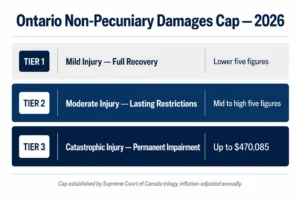
The Supreme Court of Canada established an upper limit for non-pecuniary damages in three 1978 decisions commonly called the trilogy.
The original cap was $100,000 in 1978 dollars. It has increased with inflation over time.
As of 2026, the inflation-adjusted upper limit is approximately $470,085.
Two points are important:
Ontario motor vehicle claims are subject to an additional statutory rule. A deductible may be subtracted from a pain and suffering award after the amount has been assessed.
| 2026 Amount | Value | Effect |
|---|---|---|
| Pain and suffering deductible | $47,913.01 | Generally deducted from an award below the monetary threshold. |
| Monetary threshold | $159,708.71 | The deductible no longer applies when the award exceeds this amount. |
Example
If a court assesses pain and suffering damages at $80,000 in a motor vehicle case, the statutory deductible may substantially reduce the amount payable. The gross assessment should not be confused with the final amount recovered after statutory deductions.
Read our detailed guide to the 2026 tort deductible in Ontario.
Before an injured person can recover pain and suffering damages from a protected automobile defendant, the claimant generally must establish:
The threshold test is separate from the statutory deductible.
A claimant may first need to establish that the injury satisfies the legal threshold. The court then assesses the value of the damages, after which the deductible may apply.
Chronic pain, post-concussion symptoms, PTSD, anxiety, and persistent soft-tissue injuries may satisfy the threshold in appropriate cases. The result depends on permanence, seriousness, functional impact, and medical evidence.
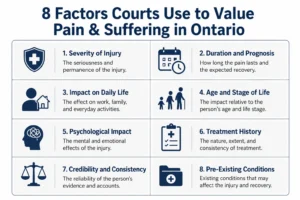
Ontario courts do not use a fixed formula. They compare the claimant’s injuries and life impact with previous decisions involving similar circumstances.
A fracture requiring surgery and causing permanent limitations will generally be assessed differently from a soft-tissue injury that resolves within several weeks.
However, the diagnosis alone does not determine value. Courts also examine how the injury affects the person’s function and quality of life.
A temporary injury with full recovery is assessed differently from chronic symptoms or permanent impairment.
The medical prognosis is therefore one of the most important parts of the claim.
Courts and insurers consider specific changes to daily functioning, including:
Specific and consistently documented limitations are more persuasive than general descriptions of pain.
The impact of a permanent injury is assessed in the context of the injured person’s expected lifestyle and remaining years.
A permanent restriction affecting a younger person may continue for decades. The assessment for an older claimant may involve different considerations, but age does not automatically reduce the value.
Non-pecuniary damages can include mental and emotional harm.
PTSD, depression, anxiety, driving phobia, and sleep disruption may increase the assessed impact when supported by consistent medical evidence and treatment records.
Courts and insurers consider whether the claimant followed reasonable treatment recommendations.
Long, unexplained gaps may be used to argue that symptoms were less serious than claimed. Where treatment is interrupted because of cost, access, family obligations, or another legitimate reason, that explanation should be documented.
Consistency across medical records, insurance forms, examinations, social media activity, and legal documents is essential.
Contradictory statements or exaggerated limitations can reduce the value of an otherwise legitimate claim.
A pre-existing condition does not automatically prevent recovery.
Ontario law recognizes that an accident may aggravate or accelerate an earlier condition. The evidence should clearly establish the claimant’s condition before the accident and what changed afterward.
The following ranges provide broad context only. They are not a settlement calculator and should not be applied without reviewing the facts and applicable legal rules.
| Injury Category | Broad Value Range |
|---|---|
| Mild injury with full recovery | Lower five figures or less, depending on recovery time and disruption. |
| Moderate injury with prolonged recovery | Mid five figures, sometimes higher depending on symptoms and lasting restrictions. |
| Chronic pain or permanent limitations | High five figures into six figures, depending on permanence and life impact. |
| Catastrophic and permanently disabling injury | May approach the national upper limit in exceptional circumstances. |
Two people with similar imaging results may receive very different assessments because the court considers how the injury affects the individual’s work, independence, relationships, and daily life.
Early settlement offers may be made before the medical prognosis is clear, before all treatment records are available, and before long-term income or care needs can be assessed.
Once a full and final settlement and release are signed, the claim usually cannot be reopened simply because symptoms later worsen.
Before accepting a settlement
Review the diagnosis, prognosis, future treatment needs, employment impact, statutory deductible, and all other categories of damages. A settlement should be assessed using the complete evidence, not only the insurer’s first calculation.
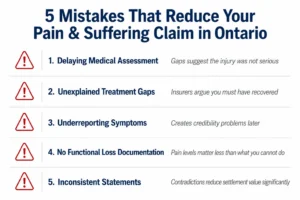
A delay can create questions about causation and severity. Seek appropriate medical attention promptly when symptoms arise.
Long interruptions may be used to argue that the injury was not as serious as claimed. Document practical reasons for any gap.
Medical providers can only record the information they receive. Describe symptoms and functional limitations accurately.
A brief diary recording sleep, work tolerance, driving, household tasks, recreation, and symptom flare-ups may help preserve relevant details.
Exaggeration can damage credibility. Accurate and consistent reporting is more persuasive than extreme language.
Slip and fall claims are not subject to the automobile threshold and deductible merely because they involve personal injury.
They do, however, involve separate liability requirements, notice obligations, and limitation periods.
Pedestrian claims must be classified carefully. If a pedestrian is injured through the use or operation of a motor vehicle, the automobile threshold and deductible rules may apply.
Read more about the Ontario notice rules for snow-and-ice claims.
How Cambria Law Firm Assesses Pain and Suffering Claims
The inflation-adjusted upper limit is approximately $470,085. It is generally reserved for the most catastrophic and permanently disabling injuries.
The 2026 deductible for non-pecuniary damages is $47,913.01. It does not apply when the assessed award exceeds the monetary threshold of $159,708.71.
In many motor vehicle claims, the claimant must establish a permanent serious impairment of an important physical, mental, or psychological function, or a permanent serious disfigurement.
Some claims resolve within months. Many take one to three years. Complex claims involving serious injuries, disputed liability, or trial may take longer.
No. An accident may aggravate or accelerate a prior condition. The pre-accident baseline and post-accident change should be supported by medical and functional evidence.
Obtain legal advice before accepting a full and final settlement. Early offers may be made before the prognosis and long-term financial impact are clear.
Our personal injury team can help with accident, disability, and injury claims. Contact us today for a free consultation.