Injured in Ontario? Get clear legal guidance today.
Our personal injury team can help with accident, disability, and injury claims. Contact us today for a free consultation.

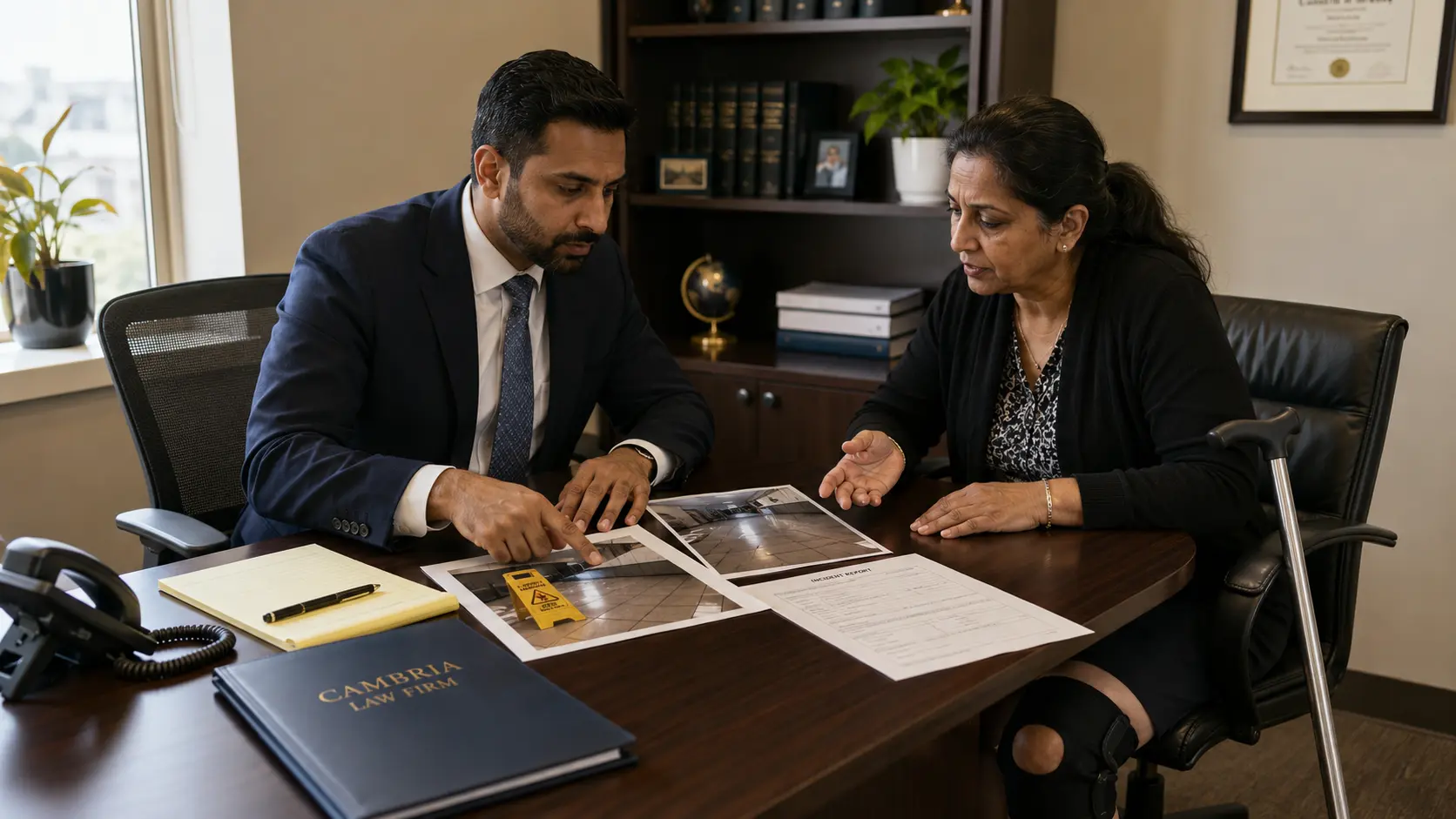
Slipping and falling inside a Mississauga store, mall, or building raises an immediate question: does it matter whether there was a wet floor sign?
Not by itself. Ontario law under the Occupiers’ Liability Act asks whether the property owner or occupier took reasonable steps to keep visitors safe. A warning sign is one factor among several. Its presence does not automatically defeat a claim, and its absence does not automatically prove one.
You are walking through a grocery store on Dundas Street, a mall near Square One, or an office lobby in Mississauga City Centre. The next moment, you are on the ground.
There is pain, confusion, and almost immediately one question: was there a wet floor sign?
Many people assume the answer settles everything. If there was a sign, there is no claim. If there was no sign, the business is automatically liable.
Neither assumption is correct under Ontario law.
The Occupiers’ Liability Act does not make liability depend on whether a sign was present. The real question is whether the property owner, tenant, property manager, or other occupier acted reasonably to keep visitors safe.
A warning sign is evidence relevant to that question. It is not the answer by itself.
Indoor slip and fall claims in Ontario are governed by the Occupiers’ Liability Act. The law applies to people and businesses that control property, including store owners, commercial tenants, landlords, property managers, and maintenance contractors.
Occupiers must take reasonable care to ensure that people entering the property are reasonably safe.
The important word is reasonable.
The law does not require a business to guarantee that no accident will ever happen. It requires the business to take reasonable precautions in response to foreseeable risks.
That standard applies to wet tile floors, recently mopped areas, spills near food courts, leaking refrigeration units, slippery entrances, and other indoor hazards.
This is why neither the presence nor the absence of a warning sign automatically resolves a claim. The same underlying question applies in both situations:
Did the occupier act reasonably based on what it knew, or should reasonably have known, about the hazard?
A common misconception is that placing a warning sign automatically protects a business from liability.
It does not.
A sign may warn visitors about a hazard, but it does not replace the need to manage the hazard itself.
For example, placing a sign beside a large spill in a busy aisle may not be enough if staff fail to:
A court may still find that the occupier failed to take reasonable care even though a sign was visible.
The adequacy of the warning also matters. Relevant questions may include:
The presence of a sign should therefore not cause an injured person to assume there is no claim.
The absence of a warning sign does not automatically make the occupier liable.
The injured person generally needs to establish that the occupier knew, or reasonably should have known, about the hazard and had enough time to address it.
This is sometimes described as the issue of notice.
Timing is critical.
If a customer spills a drink and another person slips only a few seconds later, staff may not have had a reasonable opportunity to discover and remove the spill.
By contrast, if a spill remained on the floor for a significant period, if employees walked past it, or if the area was known for recurring leaks, the occupier may have had actual or constructive notice of the danger.
Occupiers are not insurers against every possible accident. They must respond reasonably to hazards they knew about or should have discovered through an appropriate inspection system.
Ontario courts look beyond the warning-sign question and examine the occupier’s overall safety system.
Relevant factors may include:
Documentation can be especially important.
In claims involving grocery stores, malls, restaurants, fitness centres, and commercial buildings, maintenance logs and inspection records may show whether the business had a reasonable safety system and whether employees followed it.
Where a business cannot produce reliable inspection records, the court may question whether inspections actually took place.
Indoor hazards that are predictable may create a greater expectation of preventive action. Examples include:
Even if the occupier failed to meet the reasonable-care standard, the injured person’s conduct may still affect the outcome.
Ontario law allows responsibility to be divided between the parties under the principle of contributory negligence.
A court may consider:
If both parties contributed to the fall, compensation may be reduced according to the injured person’s share of responsibility.
Being partly responsible does not necessarily eliminate the claim.
The steps taken immediately after a fall can affect the strength of the evidence later.
Tell staff or management immediately. Ask that an incident report be completed and request a copy if one is available.
Take photographs of:
Take photographs from several angles and distances.
Ask for the names and contact information of anyone who saw the fall or observed the hazard beforehand.
Prompt medical assessment helps protect your health and creates a record connecting the injuries to the incident.
Do not throw away or continue heavily using the shoes you were wearing. They may become relevant evidence.
Many businesses overwrite surveillance recordings within days or weeks.
A preservation letter should be sent promptly to request that the footage, incident reports, inspection logs, and related records be retained.
How Cambria Law Firm Approaches Indoor Slip and Fall Claims

No. A warning sign is one factor the court considers. Liability may still be found if the business failed to clean the hazard promptly, block access, provide a safe route, dry the floor, or take other reasonable precautions.
No. You generally need to show that the occupier knew or reasonably should have known about the hazard and had enough time to address it.
Your compensation may be reduced if you are found partly responsible, but contributory negligence does not necessarily eliminate the claim.
It can be critical. Footage may show how long the hazard existed, whether staff saw it, where warning signs were placed, and how the fall occurred. Businesses may overwrite recordings quickly, so early preservation requests matter.
Responsibility depends on who controlled the area. A store may control the interior of its leased premises, while the mall owner or property manager may control common hallways, entrances, washrooms, and food-court areas. Maintenance contractors may also share responsibility.
The general limitation period for a civil claim is two years, although discoverability and other rules may affect the deadline.
Different and much shorter notice periods may apply if the incident occurred on municipal property or involved snow or ice maintenance. The location and circumstances should be reviewed promptly.
Our personal injury team can help with accident, disability, and injury claims. Contact us today for a free consultation.