Injured in Ontario? Get clear legal guidance today.
Our personal injury team can help with accident, disability, and injury claims. Contact us today for a no-obligation consultation.

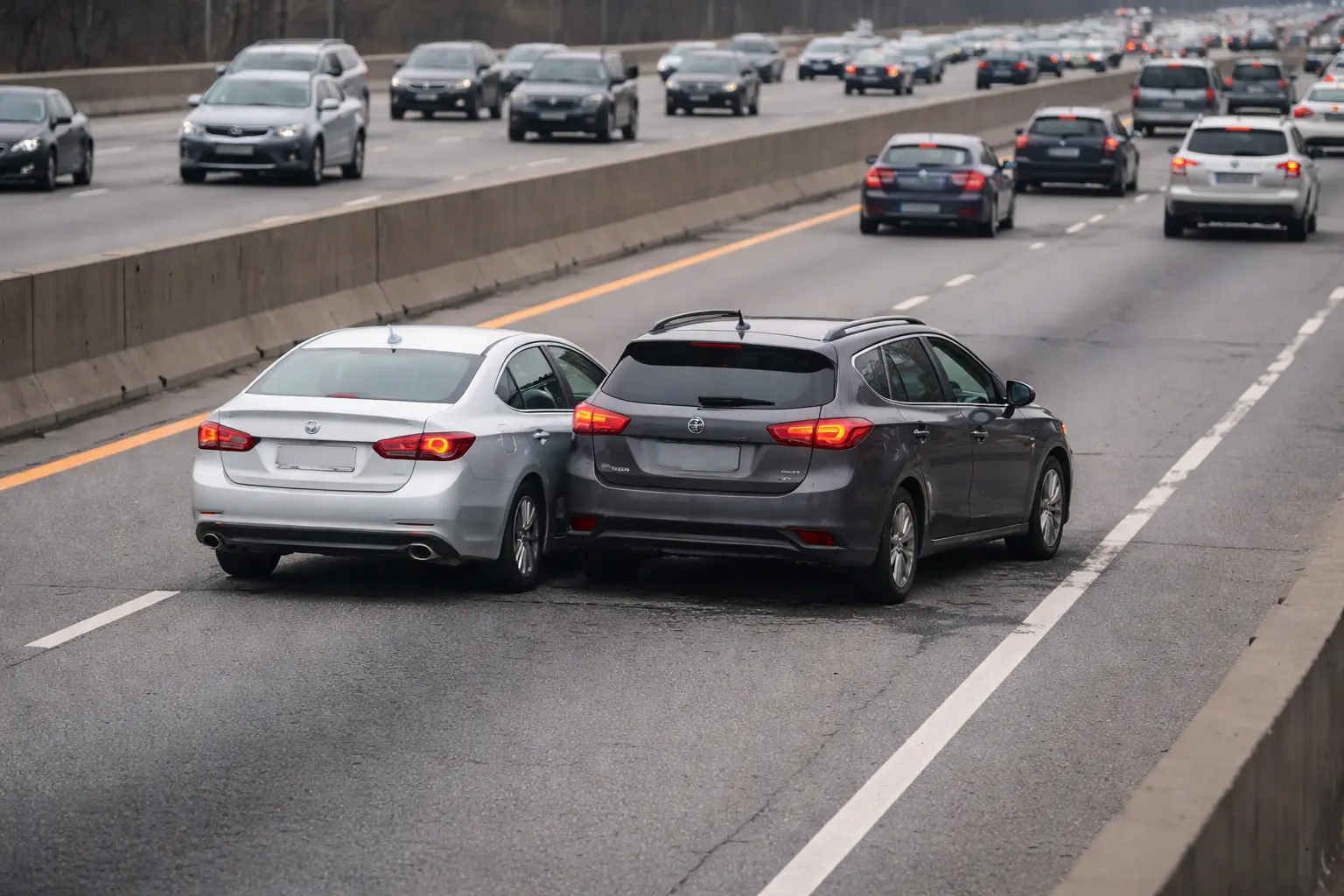
Traffic on the 401 stopped without warning. You hit the car ahead of you. Your insurer has already assigned you 100% fault. But is the fault determination always that simple?
The short answer is no. Ontario’s fault determination rules contain provisions that distribute liability in rear-end scenarios beyond the simple assumption that the following driver is always responsible. Understanding those provisions — and knowing what evidence can shift or share fault — is essential if you want to protect your claim or pursue compensation after a rear-end collision.
Ontario uses a standardized Fault Determination Rules (FDR) framework that insurance companies are required to apply when assigning fault for car accidents. Under the standard FDR for rear-end collisions, the following driver bears the majority of responsibility — typically 100% — on the basis that they failed to maintain a safe following distance.
This default allocation reflects the basic principle of highway driving: you are responsible for the space between your vehicle and the one ahead of you. If that space was insufficient to stop safely when the lead car braked, the following driver’s failure to maintain adequate distance is the proximate cause of the collision.
But the fault determination rules are not absolute, and real-world highway scenarios — particularly on a highway as congested and accident-prone as the 401 — frequently involve contributing factors that can shift or share liability.
The FDR provides for modified fault allocations when the lead vehicle’s conduct contributed to the collision. Scenarios where the leading driver may bear partial or full responsibility include:
Sudden brake check without cause. If the lead driver abruptly and aggressively braked in a situation where a reasonable driver would not — not in response to an obstacle or hazard, but as an aggressive driving maneuver — fault may be partially attributed to them.
Faulty or non-functioning brake lights. A following driver who could not see the lead vehicle braking because the brake lights were not working has a legitimate argument that the collision was contributed to by the lead vehicle’s equipment failure. This requires evidence — a post-accident vehicle inspection documenting the defect.
Unsafe lane change into a close following position. If the lead vehicle cut in front of the following driver from another lane, leaving insufficient braking distance, the fault allocation changes significantly. This is one of the most common disputed scenarios on the 401, where aggressive lane changes at speed are frequent.
Collision caused by third vehicle. In multi-vehicle highway pileups, the direct collision between two vehicles may be caused by the actions of a third vehicle that initiated the chain reaction. Assigning 100% fault to the following driver in that vehicle’s insurer’s face without accounting for the third party’s role is inappropriate.
Dashcam footage. Dashcam video from either vehicle, or from nearby vehicles, often captures the sequence of events in a way that the FDR standard allocation does not reflect. A dashcam showing a sudden brake check, an aggressive lane change, or a third vehicle’s role can fundamentally change the fault picture.
Witness accounts. Bystander witnesses to a highway collision — other drivers, passengers in nearby vehicles — can provide independent accounts of vehicle behaviour that support a different fault allocation.
Post-accident vehicle inspection. For brake light defect arguments, a formal vehicle inspection documenting the defect, conducted as close to the collision date as possible, is essential.
Cell phone records. If you have reason to believe the lead driver was on their phone immediately before the collision, cell phone records obtained through discovery can establish distraction as a contributing cause.
Police report. In serious collisions, the attending officer’s observations about road conditions, vehicle positions, and witness accounts are valuable supporting evidence.
In Ontario’s insurance system, fault allocation affects your accident benefits claim and your insurance premiums. A shift from 100% to 50% fault — or from 100% to 25% — can have significant consequences for what your insurer pays and what you can recover from the other driver’s insurer.
More importantly, if you were the victim in a rear-end collision and were seriously injured — and you believe the lead driver’s conduct contributed — pursuing a tort claim against that driver requires establishing their negligence. Building that case from the beginning, with the right evidence preserved and the right legal strategy in place, is the difference between a successful claim and an uncompensated injury.
Cambria Law represents car accident victims across Mississauga, Toronto, and the Greater Toronto Area. If you have been involved in a rear-end collision on the 401 or elsewhere in Ontario, we can review the fault allocation assigned by your insurer, identify evidence that may support a different result, and build your claim accordingly.
Call 416-840-7545 or contact us online for a free consultation. No fees unless we win.
Our personal injury team can help with accident, disability, and injury claims. Contact us today for a no-obligation consultation.