Need help with your Canadian immigration matter?
Our immigration team can help with applications, refusals, appeals, and next steps. Contact us today for a consultation.


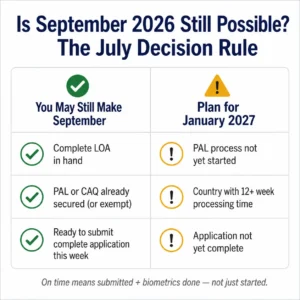
July 2026 reality check: if your program starts in September 2026, you may still be on time — but only if your file is already close to complete.
For most applicants, “on time” means having a complete study permit application submitted to IRCC, biometrics completed quickly, and a PAL or CAQ already in hand if one is required.
If you are reading this in July 2026 and your program starts in September 2026, you are at a real decision point.
September is still possible for some applicants, but the timeline is tight. Since Student Direct Stream (SDS) ended on November 8, 2024, all applicants are processed through the regular stream, which is commonly 8 to 16 weeks depending on your country and visa office. On top of that, peak season from May to July can add 2 to 4 weeks due to higher volumes and biometrics appointment pressure.
Here is what “on time” means in practical terms. It does not mean “I started my application.” It means you have submitted a complete application to IRCC, you have completed biometrics, and you already have your PAL, Provincial Attestation Letter, or CAQ, Québec Acceptance Certificate, if one is required for your category and province.
Your outcome in July 2026 depends mainly on four factors:
This article gives you a date-based timeline you can use today, explains who needs a PAL and who is exempt effective January 1, 2026, shows what to do if you miss September, and lays out a clean January 2027 plan.
Several 2026 rules and realities affect how early you should apply and how you should plan your September 2026 intake.

IRCC has published a 2026 study permit cap of 309,670 application spaces. When application volumes surge, provinces and schools can tighten their internal pacing, and IRCC queues can move more slowly. You should assume July files are being reviewed in a high-volume environment.
SDS ended on November 8, 2024. Many applicants still follow SDS-era advice from old videos and blogs. That is one of the biggest reasons people miss September.
In 2026, your planning assumption should be:
For a single applicant outside Québec, IRCC’s updated living expense baseline is $22,895 CAD, plus first-year tuition and travel costs.
Do not submit with only tuition and a low bank balance. In 2026, you should present funds in a way an officer can verify quickly and understand without guessing.
If you will study in Québec, you usually need a CAQ first, and Québec also applies its own financial capacity requirements alongside CAQ rules. Always confirm directly with the Québec government before applying.
Standard IRCC fees are $150 CAD for the study permit and $85 CAD for biometrics, for a total of $235 CAD payable to IRCC.
You may also face additional costs beyond IRCC fees, including:
In July 2026, your biggest enemy is not IRCC alone. It is preventable delays caused by missing basics.
Aim to have these ready before you start uploading:
When volumes are high, incomplete files can lose weeks because IRCC may issue a request letter or the officer may be unable to confirm key points quickly. A missing proof of funds detail or unclear tuition payment can push your decision past your program’s start date.
For many Ontario college and undergraduate applicants, a PAL is often required. Ontario PAL turnaround is commonly 2 to 3 weeks. If you are starting the PAL process in July, you must build that delay into your submission plan.
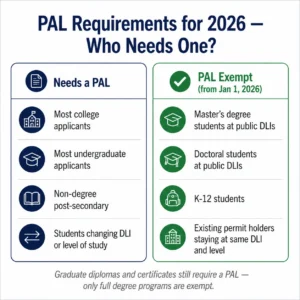
A PAL, or Provincial Attestation Letter, is a province-issued confirmation that supports Canada’s study permit cap system. In most provinces outside Québec, it is typically obtained through your school’s process and must be included in your study permit application if required by IRCC instructions for your category.
| Category | Do You Need a PAL? | Notes |
|---|---|---|
| Most college or undergraduate programs outside Québec | Usually yes | PAL must be included if required for your category. Confirm province and IRCC instructions. |
| Master’s or PhD at a public DLI | PAL exempt effective January 1, 2026 | Confirm the exemption on IRCC guidance before submitting. |
| Québec studies where CAQ is required | PAL not used | You typically need CAQ first, often 4 to 6 weeks, then apply to IRCC. |
As of January 1, 2026, master’s and doctoral students at public DLIs are expected to be exempt from PAL or TAL. Do not rely on screenshots or social media summaries. Confirm the exemption wording directly on IRCC’s page before you submit your application.
Québec has a separate step that many applicants underestimate. In many cases, you must secure the CAQ before applying for the federal study permit. Plan 4 to 6 weeks for CAQ processing, then add biometrics and IRCC processing time.
In 2026, the realistic baseline to plan around is 8 to 16 weeks in the regular stream, depending on where you apply. Some countries may show shorter times in the IRCC tool at certain points in the year, but for September planning you should use a conservative buffer.
If you apply in June or July 2026, assume your file is entering the system during peak season. Even if the tool shows a shorter estimate, real-world bottlenecks often include:
A practical planning number for July submissions is often 10 to 20 weeks total from submission to final outcome when you add peak pressure and pre-IRCC steps.
| Usually Included | Usually Not Included |
|---|---|
| Time after IRCC receives your complete application. | PAL issuance time, CAQ processing, biometrics appointment scheduling, medical exam scheduling, passport submission, and counterfoil stamping where applicable. |
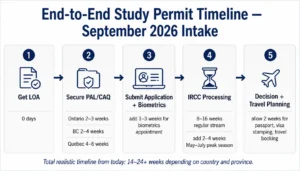
The timeline below is a planning tool for July 2026 applicants targeting a September 2026 start. Your actual dates depend on your province, school, and local biometrics availability.
| Step | What Happens | Typical Planning Time | What You Control |
|---|---|---|---|
| 1 | Get LOA from DLI | School-controlled | Respond fast to school requests and pay the deposit if required. |
| 2 | Get PAL, outside Québec if required | Ontario 2 to 3 weeks; BC 2 to 4 weeks | Start early, follow DLI instructions, and avoid missing information. |
| 3 | CAQ, Québec only if required | 4 to 6 weeks | Submit CAQ correctly and track requests. |
| 4 | Submit complete study permit application to IRCC | Same day once ready | Document completeness, consistent forms, clear funds, and clear LOE. |
| 5 | Biometrics after BIL | 3 to 21+ days to get an appointment in busy regions | Book immediately after BIL and consider travel to another VAC if possible. |
| 6 | IRCC processing, regular stream | 8 to 16 weeks, plus peak season pressure | Completeness reduces avoidable requests. |
| 7 | Final steps after approval | Passport request, counterfoil if applicable, and travel planning | Follow instructions quickly and do not delay passport submission. |
Best-case scenario
Conservative-case scenario
If your approval is late, your next step is not to argue with IRCC. It is to speak with your school immediately about:
Schools control registration and deferrals. IRCC controls the study permit decision.
Your LOA is not the end of school requirements. Many DLIs have tuition deposit deadlines, course registration deadlines, and a final date you are allowed to arrive and still start the term.
You should ask your school in writing by July 15, 2026:
If you need a PAL and you are only starting in July, your real IRCC submission date may become August.
Even after approval, some students need extra time for passport submission and counterfoil stamping, flight booking, housing arrangements, and tuition deadlines tied to enrollment.
| Risk Level | Submission Timing | Planning Note |
|---|---|---|
| Lower risk | Complete application submitted by May 31, 2026 | Best practical target for September intake planning. |
| Medium risk | Submitted by June 15, 2026 | Only reasonable if PAL/CAQ and documents are ready. |
| High risk | June 16 to July 31, 2026 | Especially risky if you still need PAL/CAQ or funds are not organized. |
| Very high risk | After August 1, 2026 | September start becomes difficult under regular-stream expectations. |
If PAL is required for your category and you submit without it, you risk delays, refusal, or being asked to provide it later.
Prevention: Confirm the PAL requirement on IRCC, then confirm your school’s PAL process by email.
Outside Québec, the living expense baseline is $22,895 CAD, plus first-year tuition and travel.
Common funding problems include:
Prevention: Provide clean bank statements, income proof, sponsor documents where applicable, and explanations for unusual transactions.
After you receive your Biometrics Instruction Letter, you still need an appointment. In high-demand regions, VAC slots can be limited during June to August.
Prevention: Book within 24 to 72 hours of receiving the BIL if possible. Be willing to travel to another VAC city if your country allows it.
The SDS era ended on November 8, 2024. By 2026, do not rely on SDS-style speed or document shortcuts.
Prevention: Refer to the IRCC document checklist generated for your application and read the current study permit instructions on Canada.ca.
A Québec applicant who starts their CAQ in July often finds themselves unable to submit a study permit until August or September.
Prevention: If you are planning to study in Québec, initiate your CAQ application early and adjust your intake plans accordingly.
If it is late July or early August 2026 and you still do not have your PAL or CAQ and have not submitted a complete application, aiming for a January 2027 intake is often more realistic under regular-stream timelines.
You may have missed the September intake if you are unable to submit your application to IRCC by July 31, 2026, your country’s processing time is nearing the upper limit of the range, you still require biometrics and possibly medicals, and your school has a strict cut-off date for late arrivals.
If your Ontario DLI requires a PAL for January 2027, coordinate early with admissions. PAL time, often 2 to 3 weeks, is still real, even for January.
| Item | Planning Number for 2026 | Official Source to Confirm |
|---|---|---|
| 2026 study permit cap | 309,670 application spaces | IRCC, Canada.ca |
| Regular stream processing | 8 to 16 weeks | IRCC processing time tool |
| Peak season impact | +2 to 4 weeks, May to July | Practical planning based on peak cycles |
| Ontario PAL turnaround | 2 to 3 weeks | Province/DLI process and IRCC PAL guidance |
| British Columbia PAL turnaround | 2 to 4 weeks | Province/DLI process and IRCC PAL guidance |
| Québec CAQ | 4 to 6 weeks | Québec.ca, MIFI |
| IRCC fees | $150 + $85 = $235 CAD | IRCC fees, Canada.ca |
| Funds baseline, single applicant outside Québec | $22,895 CAD + first-year tuition + travel | IRCC proof of funds guidance |
| SDS | Ended November 8, 2024 | IRCC notice, Canada.ca |
| Master’s/PhD public DLI PAL exemption | Effective January 1, 2026 | IRCC PAL guidance, Canada.ca |
Before you submit, confirm each number and rule on the official IRCC and provincial websites, because policies and instructions can be updated.
A Regulated Canadian Immigration Consultant is not useful because they have a shortcut. They are useful because they reduce preventable mistakes that cause delays and refusals.
How Cambria Law Firm Can Help
Immigration consulting services at Cambria Law Firm are provided by Vick Sidhu, Regulated Canadian Immigration Consultant, RCIC R705820.
Yes, it is still possible for some applicants, but July submissions are high-risk. To have a realistic chance, you should submit a complete application quickly, complete biometrics as soon as you receive the BIL, and ideally already have your PAL or CAQ in hand if required. Plan using 8 to 16 weeks regular processing plus 2 to 4 weeks peak season pressure.
No. SDS ended on November 8, 2024. In 2026, applicants should plan for regular stream timelines and requirements.
For a single applicant outside Québec, IRCC’s living expense baseline is $22,895 CAD, plus first-year tuition and travel costs. Québec applicants should follow IRCC rules plus Québec’s CAQ-related financial requirements.
Effective January 1, 2026, master’s and doctoral students at public DLIs are expected to be exempt from PAL or TAL. Confirm directly on IRCC’s official PAL guidance before you submit.
Sometimes, but only if your school allows late arrival or issues a deferral. Ask your DLI for its last arrival date and deferral policy. If late arrival is not allowed, you should pivot to January 2027 with a new LOA and updated planning.
No. Do not book non-refundable flights before you receive your approval and understand your school’s registration and arrival rules.
Our immigration team can help with applications, refusals, appeals, and next steps. Contact us today for a consultation.