Injured in Ontario? Get clear legal guidance today.
Our personal injury team can help with accident, disability, and injury claims. Contact us today for a free consultation.

Ontario dog bite claims are usually based on the Dog Owners’ Liability Act, which can make an owner responsible for injuries caused by their dog.
Compensation may include treatment costs, lost income, pain and suffering, scarring, psychological harm, and out-of-pocket expenses.
Dog bites are more common than most people expect — and more consequential than they initially appear. It is not just the bite itself. It is the infection risk, the scar that does not fade, the child who develops fear responses, the time off work, and the awkwardness when the dog belongs to a neighbour or someone you know.
Ontario has a clear legal framework for dog bite claims. This guide covers what the law says, what an owner is responsible for, what compensation can include, and what steps matter most early on.
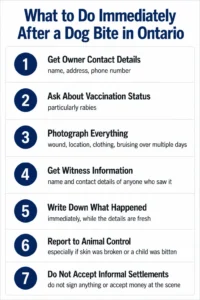
Many bites look manageable initially and worsen within hours — swelling, infection, or a wound that is deeper than it appeared. Medical records also matter significantly later. Not because you are being dramatic, but because documentation is how you establish that the injury occurred and what it caused.
If skin is broken, see a doctor or go to urgent care the same day. Ask about tetanus and whether antibiotics are needed. If the dog’s vaccination status is unknown, ask about rabies risk and follow public health guidance. If it is an emergency, call 911.
See our guide on how doctor notes affect your injury claim for why early and specific documentation matters in any Ontario personal injury claim.
You generally do not have to prove the owner was negligent.
Ontario’s Dog Owners’ Liability Act creates a liability framework for damages caused by a dog biting or attacking a person or another animal.
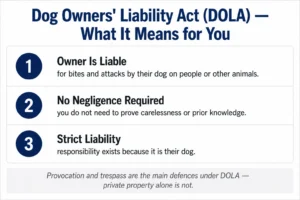
Dog bite claims in Ontario are most commonly based on the Dog Owners’ Liability Act (DOLA). In plain language, DOLA says the owner is liable for damages caused by their dog biting or attacking a person or another animal.
The part that surprises most people: you generally do not have to prove the owner was negligent. You do not need to show they were careless, that they failed to control the dog, or that they knew the dog was dangerous. DOLA imposes liability because the animal is theirs. This is meaningfully different from what many people expect injury law to require.
There are nuances and defences — provocation and trespass being the primary ones — but as a starting point, Ontario law does not require you to jump through the same evidentiary hoops you might expect.
It is not limited to the person on the vet paperwork. An “owner” under DOLA can include someone who harbours the dog — meaning someone who keeps or is responsible for the dog, even temporarily.
Depending on the facts, more than one person may be considered an owner:
This matters because insurance coverage and legal responsibility can become complex quickly, particularly when the bite happened away from where the dog normally lives.
Being on someone’s private property does not automatically eliminate your claim. People often assume it does, but private property alone is not the deciding factor.
Claims regularly arise from situations where the person was invited as a guest, was a delivery worker performing their job duties, was a neighbour or friend dropping by, or was a contractor, caregiver, or cleaner working on the property. The defences most relevant to dog bite liability under DOLA are provocation and trespass — not simply being on private land.
A prior bite history can support an argument that the owner should have taken stronger precautions, and it may affect how seriously a court or bylaw enforcement views the situation. But prior history is generally not required to establish liability under DOLA. The strict liability framework means the absence of a prior incident does not protect an owner from responsibility.
Ontario uses contributory negligence. If you contributed to what happened — provoking the dog, ignoring warnings from the owner, behaving in a way that reasonably led to the bite — your compensation can be reduced proportionally to your degree of fault. It does not necessarily eliminate the claim, but it affects the amount recoverable.
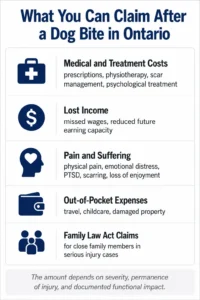
Not everything is covered by OHIP. Common out-of-pocket expenses include prescriptions, wound care supplies, physiotherapy or massage therapy for lasting tissue damage, psychological treatment for trauma or anxiety, and scar management or cosmetic treatments. Our post on OHIP coverage after an accident covers what falls outside public coverage and what other funding sources may apply.
If you missed work or could not perform your regular duties, you may have a claim for lost wages, reduced earning ability if the injury affects future work capacity, and related out-of-pocket expenses connected to your recovery.
Pain and suffering in an Ontario personal injury claim can include physical pain, emotional distress, anxiety or PTSD related to dogs following the incident, loss of enjoyment of life, and permanent scarring or disfigurement. Scarring on visible areas — the face, hands, arms, or legs — affects confidence, social functioning, and mental health in ways that are often underestimated initially. Our guide on how much pain and suffering is worth in Ontario covers how courts assess non-pecuniary damages.
Travel to medical appointments, childcare needed during recovery, and replacing clothing or belongings damaged in the attack can all form part of a claim.
In cases involving serious injury, close family members may have a separate claim for losses they suffer as a result of your injury under the Family Law Act. This is more technical and situation-specific — worth asking about if the injury is significant.
Most dog bite claims are resolved through insurance rather than from an owner’s personal funds. Common sources include home insurance, which often includes liability coverage for injuries caused by a dog, sometimes even away from the property, and tenant insurance. This is one reason people should not feel as though making a claim will financially devastate a neighbour or friend — the insurance that covers exactly this situation is typically what responds.
That said, insurers do not voluntarily pay fair compensation. They investigate, minimize, dispute fault, and argue about severity. Understanding why not to accept the first insurance offer applies in dog bite claims just as it does in other personal injury contexts.
Bites involving children carry additional clinical and psychological considerations. Beyond the physical wound, watch for sleep disruption and nightmares, new fear responses to dogs, avoidance of parks and outdoor play, regression behaviours, and ongoing sensitivity about scarring.
Psychological harm is legitimate harm and is compensable. Counselling is not an optional extra — it is part of appropriate treatment and part of a claim. Face or hand injuries in children may also require specialist review, plastic surgery consultations, and long-term scar care. Early documentation and appropriate specialist referrals matter significantly.
Note that limitation periods for minors operate differently from the general two-year period. Legal advice early in these cases protects the child’s rights.
A workplace dog bite may involve WSIB in addition to a potential third-party claim. Examples include a personal support worker bitten at a client’s home, a delivery worker bitten at a residence, or a contractor bitten on a job site. The interaction between WSIB entitlements and a separate DOLA claim can be complex, and there are timing considerations. See our overview of Ontario accident benefits for broader context on how workplace and non-fault injury systems interact.
In most cases, the general limitation period in Ontario is two years from the date of the incident. However, there are exceptions — including special rules for minors and situations where the limitation runs differently depending on when the injury or its consequences became known. Our post on Ontario’s two-year limitation period explains the framework in detail.
Waiting also weakens your case independently of the limitation period — memories fade, photographs get lost, witnesses become unavailable, and medical records become harder to obtain. Even if you are unsure whether you want to pursue a claim, getting legal advice early costs nothing and preserves your options.
A civil injury claim and animal control or bylaw enforcement are separate processes. What happens to the dog depends on the municipality, the severity of the attack, the animal’s history, and decisions made by animal services — not on whether you file a compensation claim. Your claim is about your injuries and losses. Concerns about the animal’s safety are handled through a separate public health or enforcement channel.
The following situations warrant legal advice sooner rather than later:
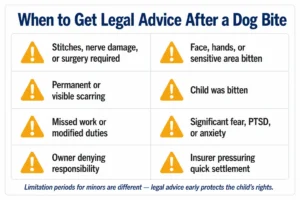
Our personal injury services cover dog bite claims alongside other injury types across Mississauga and the Greater Toronto Area.
Related reading:
Not under the Dog Owners’ Liability Act (DOLA). Ontario’s dog bite law imposes liability on the owner based on ownership or custody of the dog, without requiring you to prove carelessness, a failure to control the dog, or prior knowledge that the dog was dangerous. This strict liability framework makes Ontario law more accessible for dog bite victims than many people expect.
Being on private property does not automatically eliminate your claim. The relevant defences under DOLA are provocation by the victim and trespass — not simply being on someone’s property. Guests, invited visitors, delivery workers, caregivers, and contractors who are bitten on private property can still have valid claims.
Compensation can include medical and treatment costs not covered by OHIP, lost wages and future earning capacity, pain and suffering, including emotional distress, scarring, and PTSD-type symptoms, out-of-pocket expenses, and in serious cases, Family Law Act claims for affected family members. The amount depends on the severity and permanence of the injury, functional impact, and documented losses.
A prior bite history can support an argument that stronger precautions were warranted, but it is not generally required under DOLA to establish liability. The absence of a prior incident does not protect a dog owner from responsibility under Ontario’s strict liability framework.
In most cases the general limitation period is two years from the date of the incident. Special rules apply for minors, and in some circumstances the limitation runs differently depending on when the injury or its full consequences became known. Waiting also weakens a claim independently of the limitation deadline — medical records, photographs, and witness availability all diminish over time. Getting legal advice early preserves your options.
A civil injury claim and animal control or bylaw enforcement are separate processes. What happens to the dog depends on municipal animal services decisions based on the severity of the attack and the animal’s history — not on whether you pursue a compensation claim. Your claim is about your injuries and losses, not about the animal.
Our personal injury team can help with accident, disability, and injury claims. Contact us today for a free consultation.