Injured in Ontario? Get clear legal guidance today.
Our personal injury team can help with accident, disability, and injury claims. Contact us today for a free consultation.


If you have been told OHIP will not cover your treatment after an accident in Ontario, that is not necessarily the end of the road.
You need to identify why coverage was denied, determine which payer is responsible, and act quickly to protect access to treatment and benefits.
Getting hurt is one thing. Finding out your medical coverage has been denied makes it harder. If you have been told OHIP will not cover your treatment after an accident in Ontario, that is not necessarily the end of the road — but it does mean you need to move quickly, get organized, and understand which system is actually responsible for your care.
A lot of OHIP denials after accidents are not really about you doing something wrong. They are about which payer is supposed to cover your treatment first. Understanding that distinction is the first step.
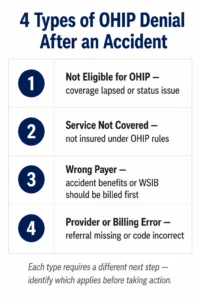
People say “OHIP denied me” but it can mean several different things:
These are different problems with different solutions. Before taking any further steps, ask the clinic, hospital, or billing office for the denial reason in writing, the specific billing code or service that was denied, who actually issued the denial—OHIP, the hospital billing department, your insurer, or WSIB—and whether the issue is about your eligibility or the specific service.
A written explanation of the denial becomes the foundation of whatever you do next.
This surprises many people. In Ontario, if you were injured in a car accident—whether as a driver, passenger, pedestrian, or cyclist—you may have access to Statutory Accident Benefits through auto insurance. Even without your own car insurance, you may still have coverage through the insurance policy of the vehicle you were in, a spouse’s or parent’s auto policy in some circumstances, the insurer of the at-fault vehicle, or the Motor Vehicle Accident Claims Fund as a last resort.
Treatments like physiotherapy, chiropractic, massage therapy, attendant care, in-home support, and certain rehabilitation services are generally not funded by OHIP in accident contexts. These are typically handled through accident benefits. So if OHIP “denied” coverage for those services after a crash, it may not be a true denial—it may be that those services were never insured by OHIP to begin with, and the right claim was never opened.
If your accident involved a motor vehicle, the immediate priority is to report the accident to an insurer and open an Accident Benefits claim. Ask for the OCF-1 (Application for Accident Benefits) and the OCF-3 (Disability Certificate, completed with your healthcare provider). There are strict deadlines in the accident benefits system—missing them can significantly affect your ability to access treatment funding. Our post on 2026 SABS changes in Ontario covers the accident benefits framework in more detail.
If your accident benefits claim is subsequently denied or delayed, that is a separate dispute process. Our post on what to do when an insurance claim is denied in Ontario covers that process step by step.
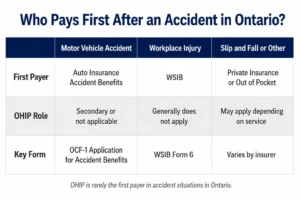
If you were injured at work or during a work-related activity, WSIB is generally the first payer. OHIP does not typically step in when WSIB coverage applies.
If your injury happened at work, the immediate steps are to notify your employer and create an incident report, ensure your healthcare provider documents that the injury was work-related, file the appropriate WSIB forms or confirm your employer has done so, and keep copies of everything submitted.
If WSIB subsequently denies your claim, that triggers a separate appeal process that can become technically complex quickly.
Sometimes the accident is not the issue—your OHIP status is. Common reasons OHIP eligibility lapses include moving without updating your address, an expired OHIP card, extended time outside Ontario, immigration status changes, or a waiting period following a return to Ontario.
If your OHIP eligibility is the problem, confirm your current eligibility status through ServiceOntario, ask specifically what document or requirement is missing, and address it immediately while keeping proof of every submission. If your OHIP eligibility is tied to an immigration status issue, getting legal guidance before you proceed is worth doing—not every denial is final, but the approach matters.
Even with full OHIP eligibility, OHIP does not cover everything. In personal injury situations, people commonly find OHIP does not cover physiotherapy in many outpatient contexts, psychotherapy and counselling outside certain hospital programs, massage therapy, chiropractic, medical devices not on the covered list, certain assessments and reports requested for legal or insurance purposes, and some out-of-province services.
When a service is not covered by OHIP, the question becomes which other system covers it. In accident situations, the possible payers include auto insurance accident benefits, WSIB, private extended health benefits through your employer or a spouse’s plan, long-term disability insurance, or out-of-pocket payment with later reimbursement sought as part of a legal claim depending on the circumstances.
People lose money by paying out of pocket without tracking expenses, then being unable to prove or connect those costs to the accident later. Start tracking everything from day one.
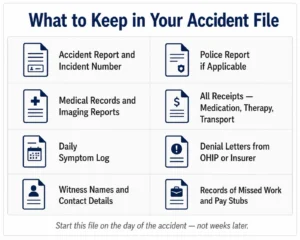
You do not need a complicated system. You need one folder—physical or digital—that contains:
This is not just for a lawsuit. Clean documentation makes every insurer interaction easier and ensures nothing is lost if your situation escalates.
Front-line staff at clinics, billing offices, and sometimes insurer call centres can oversimplify. “OHIP doesn’t cover this” sometimes means the referral was missing, the billing code was wrong, the provider billed the wrong payer, there is a coordination of benefits issue between multiple insurers, or the treatment plan requires pre-authorization that was not obtained.
After any important call, write down who you spoke with, what they said, what they told you to do next, and any reference number. Keep these notes with your accident file. This habit becomes valuable quickly.
OHIP is only one payer. Accident benefits, WSIB, and private insurance can all still apply. In some situations, out-of-pocket expenses paid after a denial may also be recoverable later through a legal claim.
Passengers, pedestrians, and cyclists can all qualify for accident benefits in Ontario depending on the circumstances. Do not assume coverage does not apply without checking.
Injury severity is not always apparent in the first week. Concussions, soft tissue injuries, chronic pain, and psychological impacts can take time to fully present. Early legal advice is usually about process and deadlines—not about deciding whether to sue anyone.
Insurers have their own assessment processes and their own reasons for approving or limiting treatment. Understanding your rights within that system independently is worth doing.
The worst outcomes in accident benefit and personal injury claims are often connected to delay—waiting weeks, then months, while deadlines pass and medical evidence becomes harder to establish. If you have received an OHIP denial after an accident, treat it as a signal to act now, not a final verdict to accept.
In Ontario, personal injury claims are generally subject to a two-year limitation period from the date the claim was discovered, which is another reason early action matters.
Our post on what to do after a car accident in Ontario covers the early steps in more detail for motor vehicle accident situations specifically.

Early legal advice in accident situations is usually about avoiding mistakes—not about deciding whether to sue. A personal injury lawyer can help you understand accident benefits deadlines and required forms, identify which treatment can be funded and how to get it approved, respond if an insurer sends you for an independent medical examination, document income loss correctly, and understand what you should and should not sign.
If you are managing an OHIP denial alongside an insurer denial and a clinic requesting upfront payment, you are running a bureaucratic process while injured. That is when having someone explain your options clearly makes a practical difference. See our pages on car accident legal services and slip and fall claims for more information on how Cambria Law Firm approaches these cases.
Related reading:
In motor vehicle accident situations, many treatments—including physiotherapy, chiropractic, massage therapy, and attendant care—are not insured by OHIP. They are funded through Statutory Accident Benefits available through your auto insurer. A denial of OHIP coverage does not mean you have no access to treatment funding; it may mean the claim needs to be opened through the correct payer.
The OCF-1 is the Application for Accident Benefits—the form you submit to your auto insurer to open an accident benefits claim after a motor vehicle accident. It is one of the first forms you should request after a car accident in Ontario. There are deadlines for submitting accident benefits documentation, so opening this claim promptly matters.
Yes. Passengers, pedestrians, and cyclists injured in motor vehicle accidents in Ontario may qualify for accident benefits depending on the circumstances of the accident and available insurance coverage. Do not assume benefits are unavailable without confirming through an insurer or a personal injury lawyer.
Generally yes—WSIB is the first payer for workplace injuries in Ontario, and OHIP does not typically step in when WSIB coverage applies. If you were injured at work or during a work-related activity, a WSIB claim should be opened promptly. If WSIB denies your claim, a separate appeal process applies.
There are strict statutory deadlines for submitting accident benefits applications and documentation. Deadlines vary by form type and circumstance. Missing a deadline can affect your ability to access benefits. Contact a personal injury lawyer promptly after an accident to confirm the specific deadlines that apply to your situation.
Our personal injury team can help with accident, disability, and injury claims. Contact us today for a free consultation.