Injured in Ontario? Get clear legal guidance today.
Our personal injury team can help with accident, disability, and injury claims. Contact us today for a free consultation.


Concussions after car accidents are often difficult to see, difficult to document, and easy for insurers to minimize.
Early medical assessment, consistent symptom reporting, treatment follow-through, and careful documentation can make a significant difference to both recovery and the strength of your claim.
Most people think a concussion looks like a movie moment — someone hits their head, blacks out, wakes up confused. Real concussions are often far less dramatic, and that is part of the problem.
After a car accident in Ontario, you can be walking, talking, and exchanging insurance information while sustaining a brain injury that doesn’t fully reveal itself until days later. The symptoms that emerge — the ones that affect your ability to work, drive, sleep, read, or sit in a bright room — are often the exact symptoms insurers downplay, delay, or argue are unrelated to the crash.
This guide covers what those symptoms look like, why insurers routinely minimize them, what you should be documenting, and when to get legal advice before someone else starts defining your injury for you.
A concussion is a mild traumatic brain injury. “Mild” refers to the fact that it is not immediately life-threatening — it does not mean the injury is minor or that the impact on your daily life will be small.
In a motor vehicle accident, you do not need to hit your head on the steering wheel or dashboard to sustain a concussion. The brain can move inside the skull from the force of impact alone. Sudden deceleration, whiplash-style movement, or a side impact at what appears to be a low speed can all cause the brain to sustain injury.
What makes concussions particularly difficult in an insurance claim context is that they frequently do not appear on CT scans or MRI imaging. Imaging is often completely normal, which gives insurers the opening to argue there is “no objective proof.” This is a well-documented pattern in motor vehicle accident claims in Ontario.
Adrenaline can also mask symptoms immediately after a crash. Many people feel relatively functional at the scene and do not notice anything significant until the next day, several days later, or even two to three weeks after the accident.
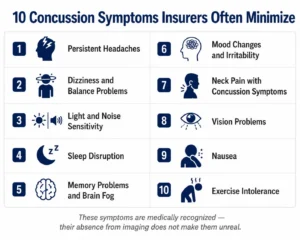
Post-concussion headaches are common and are often described differently from typical tension or stress headaches — pressure behind the eyes, a tight band sensation around the head, throbbing after screen time, head pain that spikes with noise or light, and headaches that worsen as the day progresses.
Insurers frequently label persistent headaches as “non-specific,” suggesting they could be caused by stress, dehydration, or poor sleep rather than the crash. When headaches were not present before the accident and appear immediately after, that distinction matters in your claim and needs to be clearly documented in your medical records.
Post-concussion dizziness is not always dramatic. It can present as feeling slightly off-balance while walking, unsteadiness in busy spaces like grocery stores, dizziness when standing up quickly, a sense that your surroundings are slightly tilted, or motion sensitivity in vehicles or on escalators.
These symptoms are often connected to vestibular dysfunction, which is well-recognized as a consequence of concussion and typically requires specific vestibular rehabilitation. If a proper vestibular assessment has not been completed, you may remain in this cycle for months without the right treatment — and without the documentation that supports your claim.
Photophobia and phonophobia — sensitivity to light and sound — are recognized neurological symptoms of concussion, not preferences or exaggeration. Fluorescent lighting causing discomfort, needing sunglasses indoors, being unable to tolerate busy public spaces, or finding that children’s voices trigger nausea are real functional limitations.
The documentation challenge is that these symptoms can be mischaracterized in insurer assessments as anxiety, social withdrawal, or a pre-existing psychological condition rather than a neurological response to injury.
Sleep changes after a concussion are among the most common post-injury complaints. These can include difficulty falling asleep, frequent nighttime waking, vivid or disturbing dreams, sleeping ten or more hours and still feeling exhausted, pronounced afternoon fatigue, and a reversed sleep-wake cycle. Some individuals experience hypersomnia; others develop insomnia.
Sleep disruption has downstream effects on pain tolerance, mood, memory, reaction time, and healing. Insurers may characterize sleep problems as general stress or a pre-existing condition — another pattern worth anticipating and preparing documentation against.
Cognitive symptoms — forgetting why you walked into a room, losing your train of thought mid-sentence, re-reading the same passage repeatedly without retaining it, missing appointments, mixing up words, or forgetting passwords you have known for years — are among the most functionally disabling post-concussion symptoms and among the most difficult to demonstrate to an insurer.
Because these symptoms are not visible and may not be apparent in a brief assessment or conversation, they are routinely undervalued in claims. The functional impact often becomes most apparent at the end of a cognitive workday, when the brain has exhausted its capacity to compensate.
Emotional and behavioural changes after a concussion — irritability without clear cause, feeling overwhelmed by routine tasks, increased anxiety, depression, emotional flatness, or a low threshold for sensory stimulation — can stem from neurological injury, from the disruption to daily life that follows an accident, or from both simultaneously.
Insurers commonly attempt to reframe these symptoms as pre-existing psychological conditions, general accident-related stress, or a personality characteristic rather than a documented consequence of the injury. Proper documentation from a treating healthcare professional, with a clear timeline relative to the accident, is essential.
Whiplash and concussion frequently co-occur in motor vehicle accidents, and their symptoms overlap significantly. Cervicogenic headaches, dizziness, visual disturbances, nausea, and concentration difficulties can originate from a neck injury, a concussion, or both simultaneously — which creates disputes in claims over causation.
A thorough multidisciplinary assessment matters here, both for appropriate treatment and for building a medical record that accurately reflects the full picture of your injury. See our post on whiplash and soft tissue injuries in Ontario for more on how these claims are valued and disputed.
A standard optometry exam testing visual acuity may return a normal result while significant post-concussion visual dysfunction remains undetected. Convergence insufficiency, difficulties tracking moving objects, blurred vision when transitioning between near and far focal distances, double vision, and eye strain leading to headaches are all recognized post-concussion visual complications that require a neuro-optometric assessment to identify properly.
Nausea is a recognized concussion symptom and can present continuously or intermittently, often connected to dizziness, sensory overload, motion sensitivity, or headache. It may be most pronounced in specific environments — busy retail spaces, traffic, or high-stimulation settings. Documenting the context in which nausea occurs helps connect it to the injury rather than allowing it to be attributed to an unrelated cause.
A characteristic feature of ongoing concussion symptoms is that physical activity — walking, gym exercise, or even normal daily movement — produces a spike in symptoms including headache, dizziness, nausea, or cognitive fog, followed by a period of significant fatigue that can last hours or the remainder of the day. This post-exertional worsening is a recognized clinical marker and is addressable through a graduated return-to-activity protocol — but it must first be properly identified and documented.
Concussion claims face a particular set of insurer tactics that differ from claims involving more visible injuries:
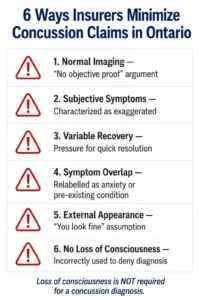
Loss of consciousness is not required
Many concussions occur without a blackout. The absence of loss of consciousness does not mean the injury is less real or less significant.
Understanding these tactics before they are used on your claim is one of the practical reasons to seek legal advice early. Our post on why you should not accept the first insurance offer covers related insurer patterns in more detail.
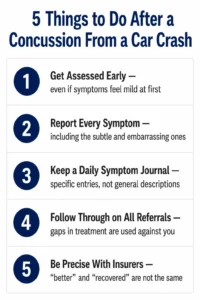
Seek medical assessment as soon as possible after the accident if you have any symptoms that could indicate a concussion. An emergency department, your family doctor, a walk-in clinic, or a concussion clinic can all document your initial presentation. If symptoms evolve or new symptoms appear in the days and weeks that follow, return for reassessment — one initial visit is rarely sufficient.
People routinely minimize their own symptoms in medical settings. If you are experiencing light sensitivity, irritability, memory difficulties, nausea in certain environments, or trouble with reading, say so specifically. The medical record is built from what you report. What is not documented does not exist from a claims perspective.
A simple daily log — not elaborate, just consistent — documenting what symptoms occurred, their intensity, what triggered or worsened them, and how they affected your daily activity creates a contemporaneous record that is significantly more persuasive than trying to recall details months later. Specific entries like “headache 7/10 after 30 minutes of screen time, had to stop working” are more useful than general statements about not feeling well.
If you are referred to physiotherapy, vestibular rehabilitation, occupational therapy, neuropsychology, or vision therapy, attend and continue treatment consistently. Gaps in treatment without a documented reason are regularly used in insurer assessments to argue that symptoms were not severe or that you have recovered. If cost, transportation, or symptom severity interrupts treatment, document that with your healthcare provider.
Describing yourself as “doing better” in a conversation with an adjuster when you mean you had one slightly more functional day can be used later to argue that your claim for ongoing benefits is inconsistent with your own reported status. Accurate and consistent reporting matters throughout the claim process. “Better” and “recovered” are different things.
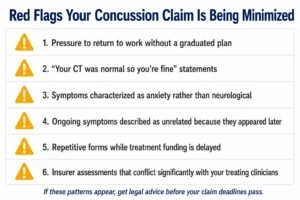
If these patterns are present, you have a deadline to be aware of. In Ontario, personal injury claims are generally subject to a two-year limitation period, and accident benefits disputes have their own separate timelines. Getting legal advice before those deadlines arrive is significantly better than after.
A concussion claim requires more than describing symptoms to an insurer. It requires organized medical documentation, consistent clinical records, and a legal framing that explains how the injury affects your actual daily functioning — not just what shows up in imaging.
A personal injury lawyer can assist with gathering and organizing the right medical evidence, managing insurer communication to avoid careless wording that undermines your claim, pursuing accident benefits for treatment, income replacement, and attendant care, building a claim around documented functional impact rather than diagnosis alone, and properly valuing the long-term consequences of an injury that may not be visible to others but significantly affects your life. In serious cases involving permanent impairment, the claim may also engage catastrophic injury designations that unlock higher benefit levels.
A fractured bone generates visible evidence and social recognition. A concussion generates skepticism — from employers, from family members who don’t see the impact, sometimes from the healthcare system, and routinely from insurers.
The job performance, the patience, the relationships, the confidence, the sense of being yourself — these are real losses. And because you can still hold a conversation, still appear functional in public, you end up explaining it over and over to people who cannot see what you are managing.
If you are experiencing symptoms after a crash, document everything. Seek proper assessments. Follow through on referrals. And get legal advice before the deadlines in your claim pass.
Related reading:
No. Loss of consciousness is not required for a concussion diagnosis. Many concussions occur without any loss of consciousness. The absence of a blackout does not affect whether a concussion occurred or whether your symptoms are compensable in a personal injury claim.
Concussions are a functional brain injury — they affect how the brain works, not the brain’s physical structure in a way that standard imaging captures. Normal CT and MRI results are expected in most concussion cases and do not mean there is no injury. The clinical diagnosis is based on your reported symptoms, mechanism of injury, and assessment findings — not on imaging alone.
Recovery varies significantly by individual. Many people recover within four to six weeks. Others experience post-concussion syndrome, where symptoms persist for months. Factors including the severity of the initial injury, how quickly appropriate treatment was started, the presence of whiplash, and individual health history all affect recovery timelines. A proper clinical assessment and graduated treatment plan are important for both recovery and documentation purposes.
Document your symptoms in a daily log as specifically as possible — what you experienced, its intensity, what triggered or worsened it, and how it affected your ability to function that day. Keep all medical records, receipts, and correspondence. Report every symptom to your healthcare provider. Obtain copies of referrals and treatment notes. This documentation forms the foundation of both your treatment plan and your insurance claim.
Insurers may attempt to minimize or deny concussion claims on the basis that symptoms are self-reported rather than visible on imaging. This is a common insurer tactic and does not mean your claim lacks merit. Post-concussion symptoms are recognized in medical literature, consistent clinical documentation strengthens your position significantly, and a personal injury lawyer can challenge insurer assessments that mischaracterize your symptoms.
As early as possible. Early legal advice is about protecting your claim — understanding which deadlines apply, ensuring you are pursuing the right benefits, and avoiding errors in communication with your insurer that can be used against you later. Ontario’s two-year limitation period for personal injury claims applies, and accident benefits have their own separate deadlines. Waiting does not help your position.
Our personal injury team can help with accident, disability, and injury claims. Contact us today for a free consultation.