Injured in Ontario? Get clear legal guidance today.
Our personal injury team can help with accident, disability, and injury claims. Contact us today for a free consultation.

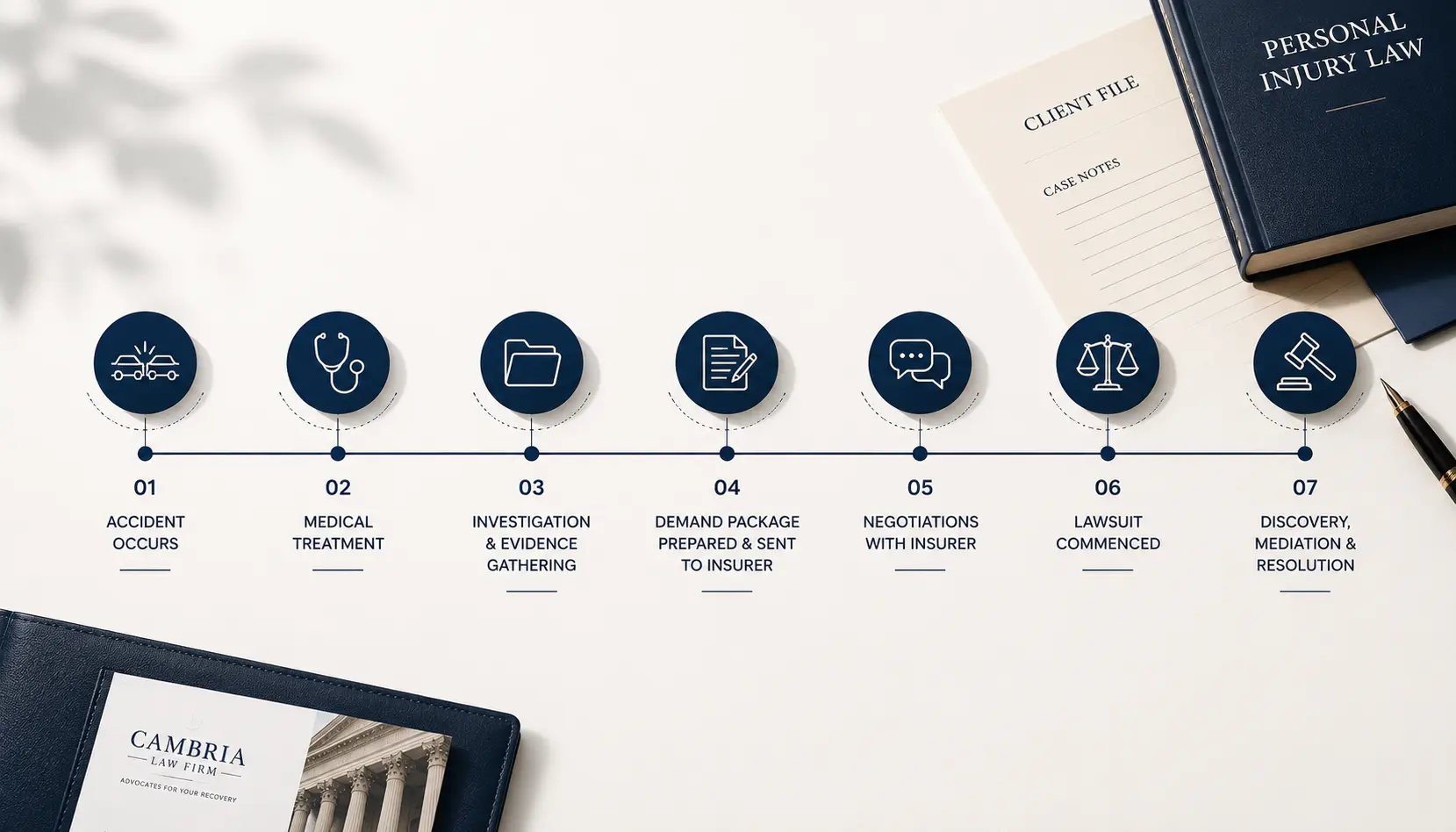
At a Glance
One of the biggest concerns after an accident is not just whether you can recover compensation, but how long the legal process will take. While every case is different, understanding the stages of a personal injury lawsuit can help you make informed decisions and set realistic expectations.
One of the first questions an injured person asks a personal injury lawyer is: how long will this take? The honest answer is that it depends — but not in a vague or unhelpful way. The timeline of an Ontario personal injury lawsuit follows a predictable series of stages, and understanding those stages gives you a realistic picture of what to expect and why.
This guide walks through every stage of the Ontario personal injury litigation process in order, with realistic timelines for each.
| Stage | Typical Timing | What Happens |
|---|---|---|
| 1. Accident and emergency care | Day 0 | Medical treatment, evidence collection, incident reporting |
| 2. Medical treatment and stabilization | Month 1 – 18 | Ongoing treatment, specialist referrals, prognosis development |
| 3. Retaining a lawyer | Month 1 – 12 | Legal consultation, case assessment, retainer signed |
| 4. Accident benefits / insurance claims | Month 1 – 24 | SABS claims, treatment approvals, income replacement |
| 5. Statement of Claim filed | Month 6 – 24 | Formal lawsuit commenced in Superior Court |
| 6. Defence and pleadings | Month 8 – 30 | Statement of Defence, documentary discovery, undertakings |
| 7. Examinations for discovery | Month 12 – 36 | Oral examination of plaintiff and defendant under oath |
| 8. Independent medical examinations | Month 12 – 36 | Defence-retained medical experts assess the plaintiff |
| 9. Mandatory mediation | Month 18 – 42 | Structured settlement negotiation with a mediator |
| 10. Pre-trial conference | Month 30 – 54 | Judge reviews case, identifies issues, encourages settlement |
| 11. Trial | Month 36 – 72+ | Full hearing before a judge (and sometimes jury) |
Timing: Day 0 — the day of the accident
The personal injury timeline starts the moment the accident occurs. What you do — and do not do — in the first hours affects everything that follows.
Immediate priorities at the scene: get medical care first, report the incident to the property owner or police as applicable, photograph the scene and hazardous condition, and collect witness information. If the fall occurred on municipal property — a public sidewalk, road, or park — the 10-day written notice requirement under Ontario’s Municipal Act, 2001 starts running immediately. See our complete guide on what to do after a slip and fall accident in Ontario for the full step-by-step.
The evidence that exists on day one — photographs, witness contact information, surveillance footage, the physical scene itself — is often the most valuable evidence in the claim. Much of it disappears within 24–72 hours.
Timing: Month 1 through Month 6–18 (varies widely by injury)
The medical treatment phase is not just about recovery — it is about building the evidentiary foundation of your claim. Every medical encounter creates a record. The consistency, specificity, and completeness of that record is one of the most important factors in determining what your pain and suffering and other damages are worth.
Key milestones in this stage:
Why this stage determines the timeline more than any other: a personal injury claim cannot be properly valued until the injured person’s prognosis is clear. Settling while still in active treatment — before knowing whether symptoms are temporary or permanent — almost always undervalues the claim. The cost of patience at this stage is real, but so is the cost of settling too soon. See our guide on how medical records affect your personal injury claim.
Timing: Ideally Month 1–3; no later than Month 12
Most Ontario personal injury lawyers offer an initial consultation at no charge and handle cases on a contingency fee basis — meaning legal fees are paid as a percentage of the settlement or award, not upfront. Retaining a lawyer early preserves evidence, stops the limitation period clock concerns, and ensures the claim is built correctly from the start.
Early retainer tasks your lawyer handles: preservation requests for surveillance footage, gathering accident reports and scene evidence, coordinating with treating practitioners to ensure records are complete, and assessing whether the claim has sufficient merit and value to pursue litigation. The limitation period — generally two years from the date the claim was discovered — runs regardless of your state of health or treatment progress. See our full guide to Ontario’s two-year limitation period.
Timing: Month 1 through Month 24 (runs concurrently with other stages)
For motor vehicle accident claims, this stage runs parallel to the tort lawsuit and involves a separate process with your own insurer under Ontario’s Statutory Accident Benefits Schedule (SABS). Accident benefits may include income replacement, medical and rehabilitation benefits, attendant care, and other statutory entitlements — regardless of who was at fault.
The accident benefits process and the tort lawsuit are legally distinct. Both run simultaneously. A resolution in one does not automatically resolve the other, though settlements may involve releases that address both. Your lawyer manages both streams on your behalf.
For slip and fall and other non-MVC claims, this stage involves communications with the occupier’s insurer — typically through your lawyer — rather than a SABS process. Be cautious: do not give recorded statements or sign any documents from the other party’s insurer without first consulting your lawyer. See our guide on insurance recorded statements in Ontario.
Timing: Month 6 to Month 24 after the accident
A personal injury lawsuit formally begins when the plaintiff’s lawyer files a Statement of Claim in the Ontario Superior Court of Justice. The Statement of Claim is a formal legal document that identifies the parties, describes the circumstances of the accident, sets out the allegations of negligence, and lists the categories of damages being claimed.
The Statement of Claim must be served on the defendant within six months of being issued. For motor vehicle accident cases, the defendant is typically the at-fault driver and their insurer. For slip and fall cases, the defendant is the property owner or occupier.
Filing the Statement of Claim does not mean the case immediately proceeds to trial. In most cases, it triggers the formal litigation process — pleadings, documentary discovery, examinations, mediation — that typically takes one to four more years before resolution.
Why lawyers sometimes file early: filing stops the limitation period and preserves the right to sue even if the case is not yet fully valued. A lawyer may file the Statement of Claim before the medical prognosis is fully clear to protect the client’s rights, while continuing to build the damages case.
Timing: Month 8 to Month 30
After service of the Statement of Claim, the defendant has 20 days (if served in Ontario) to deliver a Statement of Defence. The Statement of Defence responds to the plaintiff’s allegations, may deny liability, and may raise contributory negligence or other defences.
The pleadings stage also involves:
The documentary discovery process can itself take months, particularly in complex cases involving multiple defendants, significant income loss claims, or extensive medical histories.
Timing: Month 12 to Month 36
An examination for discovery is a formal oral examination conducted under oath before a court reporter. The plaintiff is examined by the defendant’s lawyer; the defendant (or their representative) is examined by the plaintiff’s lawyer. Everything said is transcribed and can be used at trial.
For the plaintiff, the examination typically covers: the circumstances of the accident, the injuries sustained, the medical treatment received, the impact on employment and daily life, pre-existing conditions, and any prior accidents or injuries. The purpose is for the defendant’s lawyer to understand and test the plaintiff’s case.
Preparation for examination for discovery is one of the most important things your lawyer does. Inconsistencies between what is said at discovery and what appears in the medical records — or what is said at trial — can significantly damage credibility and reduce the value of the claim. See our complete guide on examination for discovery in Ontario personal injury cases.
Timing: Month 12 to Month 36
After the plaintiff has been examined at discovery, the defence typically requests one or more independent medical examinations (IMEs) — also called defence medical examinations. The plaintiff attends an appointment with a physician, psychologist, occupational therapist, or other specialist retained by the defence to provide an independent opinion on the injuries, causation, prognosis, and functional limitations.
IME reports are used by the defence to challenge the plaintiff’s medical evidence. An unfavourable IME report does not end the case — it is evidence that must be weighed against the plaintiff’s own treating practitioners’ opinions. Courts regularly prefer treating practitioners’ evidence over IME reports where the treating evidence is consistent and well-documented.
See our complete guide to independent medical examinations in Ontario for what to expect and how to prepare.
Timing: Month 18 to Month 42
Ontario requires mandatory mediation for civil cases in Toronto, Ottawa, and Windsor before they can proceed to trial. In other jurisdictions, mediation is strongly encouraged and almost universally used in personal injury litigation even where not formally required.
Mediation is a structured negotiation session — typically one full day — conducted with the assistance of a neutral mediator. Both parties and their lawyers attend. The mediator does not make a binding decision but facilitates discussion and helps the parties find a negotiated resolution. Mediation is confidential — what is said in mediation cannot be used at trial.
The mediation stage is where a significant proportion of Ontario personal injury cases resolve. Cases that settle at mediation do so because both parties reach a number they can accept — the defendant avoids the cost and uncertainty of trial; the plaintiff gets certainty and finality without waiting years for a trial date.
Mediation requires thorough preparation: a comprehensive mediation brief, current medical and expert reports, income loss calculations, and a realistic assessment of the range of outcomes at trial. The quality of mediation preparation directly influences the settlement range a plaintiff can achieve.
Timing: Month 30 to Month 54
If mediation does not resolve the case, the parties attend a pre-trial conference before a Superior Court judge. The pre-trial conference is an informal hearing at which the judge reviews the issues in dispute, identifies what is agreed and what remains contested, and often expresses a view about the likely outcome at trial. These judicial observations frequently bring the parties close enough to reach a negotiated settlement.
Cases that do not settle at the pre-trial conference proceed to a trial date, which is scheduled from the trial list. In Toronto and other major Ontario centres, trial scheduling adds significant additional time — it is not uncommon to wait 12–24 months from the pre-trial conference for a trial date.
Timing: Month 36 to Month 72 or beyond
Fewer than 2–5% of Ontario personal injury cases reach trial. Those that do are typically cases involving significant damages, strongly disputed liability, or a fundamental disagreement about the value of the claim that mediation could not bridge.
A personal injury trial in Ontario is heard before a Superior Court judge, with or without a jury (the plaintiff generally has the right to elect a jury trial in cases above certain thresholds). Trial length depends on complexity — simple cases may be heard in three to five days; catastrophic injury cases may take three to four weeks or longer.
The trial process involves: opening statements, examination-in-chief and cross-examination of witnesses (including the plaintiff, medical experts, accident reconstruction experts, and economic loss experts), closing submissions, and the judge’s decision. If a jury is empaneled, the jury delivers the verdict on liability and damages; the judge decides questions of law.
After judgment, either party may appeal to the Ontario Court of Appeal — adding further time if the outcome is appealed.
The vast majority of Ontario personal injury cases — estimated at 95–98% — settle before reaching a courtroom. Settlement can happen at any stage: during accident benefits proceedings, after the Statement of Claim is filed but before discovery, at mediation, or at the courthouse door on the first day of trial.
| Stage | Can the Case Settle Here? |
|---|---|
| Before lawsuit | Yes |
| After lawsuit | Yes |
| After discovery | Yes |
| During mediation | Yes — one of the most common settlement points |
| During trial | Yes |
| After judgment | No — subject to appeal rights |
The timing of a good settlement depends on one thing more than any other: knowing the full value of your claim. That requires knowing your prognosis — whether your injuries are permanent, what future care you will need, and what impact your injuries have on your long-term income. Settling too early, before your medical picture is clear, typically means settling for less than the claim is worth.
| Settlement Stage | Typical Timing | Who Settles Here |
|---|---|---|
| Pre-litigation negotiation | Month 6–18 | Clear liability, resolved injuries, modest damages |
| Post-discovery, pre-mediation | Month 18–30 | Cases where discovery clarifies value for both sides |
| Mediation | Month 24–42 | Most complex cases — the most common settlement point |
| Pre-trial conference | Month 36–54 | Cases brought closer by judicial observations |
| Courthouse / trial | Month 48+ | Highly disputed cases where all other efforts failed |
| Cause of Delay | Why It Happens | What Can Be Done |
|---|---|---|
| Medical prognosis not yet clear | Treating well until condition stabilizes before valuing the claim properly | Necessary delay — premature settlement costs more than waiting |
| Specialist reports not yet obtained | Referral wait times; multiple specialties needed for complex injuries | Pursue referrals aggressively early; do not wait until litigation begins |
| Documentary discovery disputes | One party refuses or delays producing records; undertakings not answered | Motions to compel production; case management orders |
| Scheduling delays for examinations | Both parties’ counsel availability; court reporter availability; expert availability | Book discovery dates early; use case management if significant delay |
| IME scheduling and reports | Defence IME doctors have limited appointment availability; report turnaround time | Your lawyer can challenge IME requests that appear improper or excessive |
| Court scheduling delays | Ontario civil courts, particularly in Toronto, have significant backlogs | Mediation is the most reliable way to avoid dependence on court scheduling |
| Multiple defendants | Each additional defendant adds pleadings, discoveries, and negotiation complexity | Early case management; focus on primary defendant where possible |
| Contributory negligence disputes | Defendant argues plaintiff was partly at fault; each side needs evidence on this | Evidence at the scene and expert reconstruction reports |
| Threshold disputes (MVC) | Defence argues the injury does not meet Ontario’s serious and permanent threshold | Specialist evidence on permanence; detailed functional documentation |
Every personal injury case follows its own timeline. Some claims resolve quickly because liability is clear and the medical picture is straightforward. Others take longer because the injuries are serious, the prognosis is uncertain, or the parties disagree about fault or value.
Understanding the litigation process can reduce uncertainty and help you make informed decisions. Early legal advice can also preserve evidence, protect limitation periods, and ensure the claim is built properly from the beginning.
Most Ontario personal injury cases that settle before trial take between one and four years from the date of the accident. Simple cases with clear liability and fully resolved injuries may settle within 12–18 months. Complex cases involving serious permanent injuries, disputed liability, or multiple defendants typically take three to five years. Cases that proceed to trial — fewer than 5% — can take five to seven years or longer from accident to verdict.
The fastest settlements occur when liability is clear, injuries have fully resolved with a documented prognosis, and both parties have a realistic assessment of the claim’s value. The most common mistake that delays settlement is accepting an early offer before the full extent of the injuries is known. A case that is properly documented and clearly valued typically settles at mediation — the stage designed for this purpose. Rushing to settle before your medical picture is clear produces a faster resolution but almost always produces a lower one.
Almost certainly not. Approximately 95–98% of Ontario personal injury cases settle before reaching a courtroom. If a Statement of Claim is filed, the process includes examinations for discovery, mediation, and possibly a pre-trial conference — but these are not court appearances in the trial sense. You attend these proceedings with your lawyer. The vast majority of clients never set foot in a courtroom during the resolution of their claim.
Under Ontario’s Limitations Act, 2002, you generally have two years from the date you discovered — or ought reasonably to have discovered — that you had a claim to start a lawsuit. For most accidents, this runs from the date of the accident itself. Missing the limitation period permanently eliminates your right to sue, regardless of how serious your injuries are. See our complete guide to Ontario’s two-year limitation period.
Mediation is a structured settlement negotiation session conducted with the assistance of a neutral mediator, typically lasting one full day. It is mandatory before trial in Toronto, Ottawa, and Windsor, and widely used elsewhere. Both parties attend with their lawyers. The mediator does not decide the case — they facilitate a negotiated resolution. What is said in mediation is confidential and cannot be used at trial. The majority of Ontario personal injury cases that do not settle pre-litigation resolve at mediation.
The examination itself typically takes one to three hours for the plaintiff’s discovery in moderately complex cases. Complex catastrophic injury cases may take a full day or longer. Scheduling the examination — coordinating both counsel’s availability, a court reporter, and the parties — is often what adds time. In Toronto, examination for discovery may be scheduled six to twelve months after the Statement of Claim is filed. See our guide on what happens at an examination for discovery in Ontario.
Within limits. Getting medical care immediately and consistently, retaining a lawyer early, responding promptly to all requests for documents and information, and keeping your records organized all help avoid unnecessary delays. What you cannot rush is your medical stabilization — the point at which your prognosis is known — because the value of your claim depends on it. Settling before your condition has stabilized to avoid waiting typically produces a lower outcome than the delay costs.
A personal injury trial is heard before a Superior Court judge, with or without a jury. Both parties call witnesses — including the plaintiff, medical experts, and other experts as needed — who are examined and cross-examined. After closing submissions, the judge (or jury) decides liability and damages. Trial in Ontario civil courts can take years to schedule from the trial list, particularly in Toronto. Because of this, most cases that survive the pre-trial conference ultimately settle on the courthouse steps or during the first days of trial rather than completing a full hearing.
Our personal injury team can help with accident, disability, and injury claims. Contact us today for a free consultation.