Injured in Ontario? Get clear legal guidance today.
Our personal injury team can help with accident, disability, and injury claims. Contact us today for a free consultation.

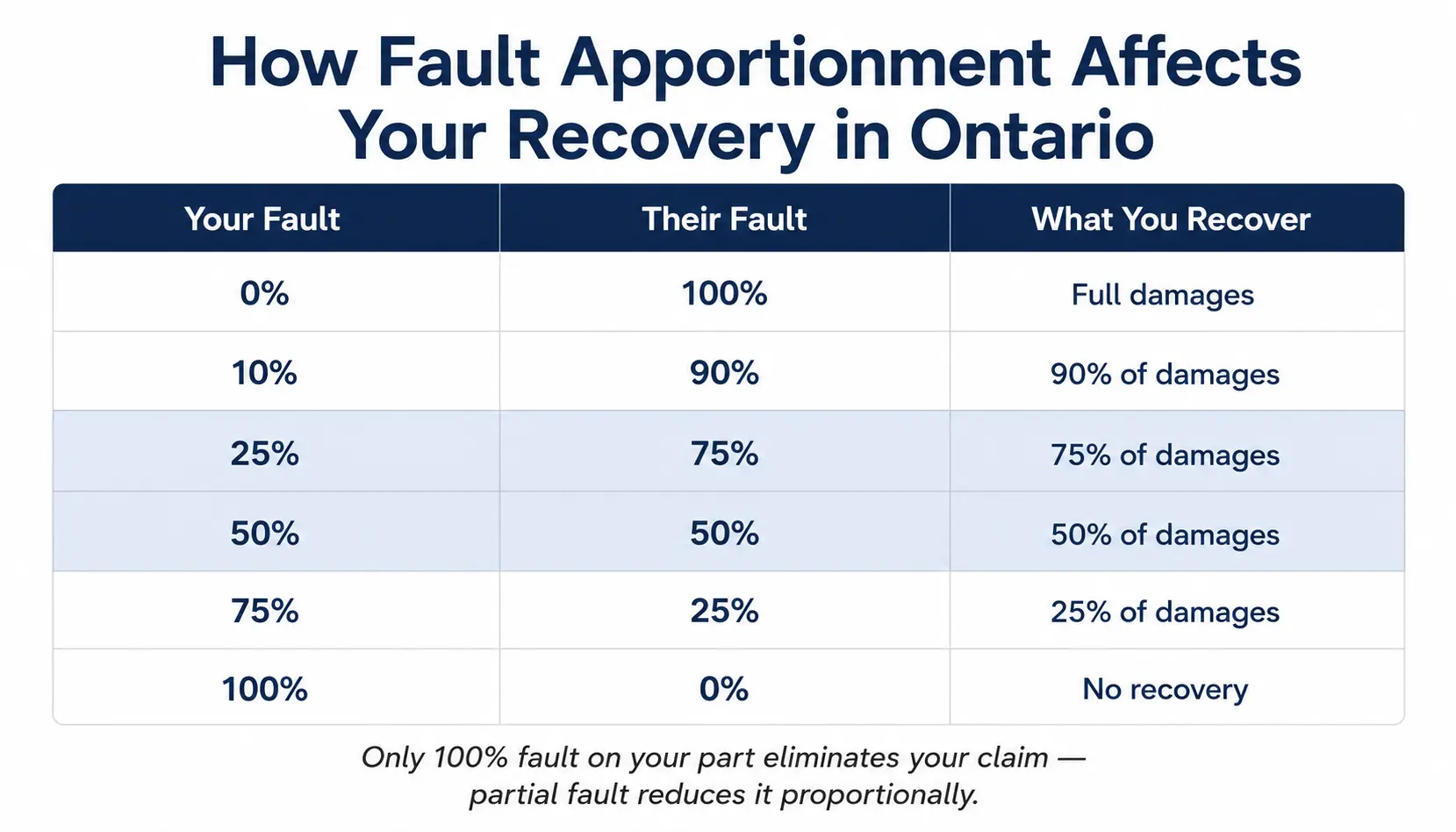
Being partly responsible for an accident does not automatically prevent you from recovering compensation in Ontario. The key question is how responsibility is divided—and whether the evidence supports the percentage of fault being alleged against you.
One of the most common reasons injured people do not pursue a personal injury claim in Ontario is the belief that partial fault disqualifies them entirely. An insurer tells them they were partly responsible. A police officer suggests they contributed to the accident. They assume the door is closed.
In most cases, it is not. Understanding how Ontario’s contributory negligence framework actually works — and how fault is determined, challenged, and apportioned — is essential before making any decision about whether to pursue a claim.
Ontario’s contributory negligence framework is governed by the Negligence Act, RSO 1990. The core principle is that where two or more parties each bear some responsibility for an accident, liability is apportioned among them in proportion to their respective degrees of fault. Each party is responsible for their own share — and compensated or reduced accordingly.
This is often described as a comparative fault approach — courts compare the conduct of all parties and assign each a percentage of the total fault.
The practical effect is significant: a plaintiff who contributed to an accident is not barred from recovering compensation. Their recovery is reduced by their own percentage of fault — but the remaining percentage is still recoverable from the defendant.
Yes — in almost all cases where the defendant also bears some fault. The framework works as follows:
| Your Share of Fault | Defendant’s Share of Fault | What You Recover |
|---|---|---|
| 0% | 100% | 100% of your total damages |
| 10% | 90% | 90% of your total damages |
| 25% | 75% | 75% of your total damages |
| 50% | 50% | 50% of your total damages |
| 75% | 25% | 25% of your total damages |
| 100% | 0% | Nothing — no claim against the defendant |
Whether a claim is worth pursuing at a given fault apportionment depends on the total value of the damages. A 50% fault finding on a claim worth $400,000 in total damages still produces a $200,000 recovery. A 50% fault finding on a claim worth $20,000 may not justify the cost and time of litigation. These are factual and strategic questions that a personal injury lawyer assesses at the outset.
Fault apportionment in Ontario personal injury litigation is not formulaic. Courts assess the conduct of all parties against the standard of what a reasonable person would have done in the same circumstances. Several established principles guide the analysis:
The baseline question for every party is: did they act as a reasonable person would in the circumstances? Departing from that standard — by driving distracted, failing to watch where you are walking, cycling without signalling, or failing to wear appropriate footwear in icy conditions — can support a finding of contributory negligence.
Contributory negligence must have contributed to the accident or the injuries — not just be a general failing. A driver who was mildly speeding but whose speed played no role in a collision caused by the other driver running a red light may not be found contributorily negligent at all. The conduct must have actually contributed to the outcome.
Where one party had the last clear opportunity to avoid the accident and failed to take it, courts may assign them a greater share of fault — even if the other party also contributed to putting the situation in motion.
Under the crumbling skull and thin skull doctrines, a defendant takes the plaintiff as they find them. A plaintiff with a pre-existing condition who is more severely injured than an average person would have been is not automatically contributorily negligent for that pre-existing vulnerability. The defendant is responsible for all the consequences of their negligence — including consequences amplified by the plaintiff’s pre-existing fragility.
MVC contributory negligence arises in many ways:
| Plaintiff’s Conduct | Potential Contributory Negligence Finding | Typical Range |
|---|---|---|
| Not wearing a seatbelt at the time of the collision | Yes — failure to mitigate injury | 5–25% reduction depending on injury type and evidence that seatbelt would have reduced harm |
| Speeding moderately but not the primary cause | Possible — depends on whether speed contributed to the collision or severity | 10–30% |
| Distracted pedestrian crossing outside crosswalk | Likely — pedestrian has a duty to exercise reasonable care | 20–50% depending on driver’s speed and the specific facts |
| Passenger who accepted a ride with a known impaired driver | Yes — voluntarily assuming known risk | 10–25% |
| Cyclist without helmet in a jurisdiction without mandatory helmet law (adults in Ontario) | Possible — where head injury resulted and helmet would likely have reduced it | 0–15% — courts are not consistent on this point |
For motor vehicle accident claims specifically, Ontario’s Insurance Act imposes additional rules around no-fault accident benefits through SABS that operate separately from fault. Accident benefits are available regardless of fault — the fault apportionment affects the tort lawsuit, not the accident benefits claim.
Contributory negligence in slip and fall claims frequently arises from arguments about the plaintiff’s footwear, their level of attention, or their familiarity with the premises.
| Defendant’s Argument | How Courts Treat It |
|---|---|
| Plaintiff was wearing inappropriate footwear for the conditions | Relevant if footwear was clearly unsuitable — but courts look at what was reasonable in the context, not an abstract footwear standard |
| The hazard was open and obvious | This is a factor in fault — but Ontario courts (following Waldick v. Malcolm) have held that open and obvious does not automatically negate the occupier’s duty or create full contributory negligence |
| Plaintiff was distracted by their phone | Relevant if distraction contributed to the fall — but distraction is weighed against how obvious the hazard was and how quickly it could have been avoided |
| Plaintiff was running or rushing | Possible contributing factor — depends on whether rushing was unreasonable in the context |
See our guides on what to do after a slip and fall accident in Ontario and grocery store slip and fall claims for how evidence affects these specific claim types.
Pedestrian accident contributory negligence is among the most contested areas. Pedestrians do not always have the right of way — crossing against a signal, jay walking, or stepping unexpectedly into traffic can all support a contributory negligence finding. However, drivers owe pedestrians a heightened duty of care, and courts are generally reluctant to assign pedestrians the majority of fault where a driver had the last clear opportunity to avoid the collision.
Cyclists face contributory negligence arguments around failure to signal, riding in an unsafe position on the road, riding without lights, or failing to wear a helmet. Ontario requires helmets only for cyclists under 18 — but where an adult cyclist suffers a head injury, courts may consider helmet use as a contributory negligence factor even without a statutory obligation.
Understanding the mechanics of the reduction is important for assessing whether a claim is worth pursuing at any given fault apportionment.
Assume a plaintiff suffers the following damages in an MVC:
| Head of Damage | Court’s Assessment |
|---|---|
| Pain and suffering (non-pecuniary) | $120,000 |
| Past income loss | $80,000 |
| Future income loss | $150,000 |
| Future care costs | $60,000 |
| Out-of-pocket expenses | $10,000 |
| Total assessed damages | $420,000 |
If the plaintiff is found 25% contributorily negligent:
At 25% contributory negligence, the claim still produces a substantial recovery. Even at 40% contributory negligence, the net result in a case of this size remains significant. Whether any fault level makes a claim uneconomical depends on the total damages and the cost and risk of litigation — questions that require legal analysis of the specific facts.
For a full explanation of how pain and suffering and other heads of damage are calculated, see our complete guide to pain and suffering compensation in Ontario.
Fault apportionment is determined by evidence. The quality, completeness, and consistency of the evidence on both sides directly determines the final fault percentages — and therefore the amount recovered.
| Evidence Type | How It Affects Fault | Why It Matters |
|---|---|---|
| Photographs from the scene | Documents road conditions, sightlines, signage, lighting, and the physical environment | Can contradict a defendant’s description of the hazard as “obvious” or the plaintiff’s conduct as unreasonable |
| Surveillance and dashcam footage | Shows exactly what happened in the moments before the accident | Often the most powerful evidence — preserving or obtaining it quickly is critical |
| Witness statements | Independent accounts of how the accident occurred and who did what | Independent witnesses who have no connection to either party carry significant weight |
| Police report and accident reconstruction | Official record of what officers observed; reconstruction experts can model vehicle speeds, braking, and sightlines | Accident reconstruction experts are frequently retained in seriously disputed MVC cases |
| Medical records | Establish the nature and severity of injuries; can address whether certain injuries are consistent with the plaintiff’s account | See our guide on how medical records affect your injury claim |
| Weather and road condition records | Confirm conditions at the time — relevant to whether the plaintiff’s conduct was reasonable in the circumstances | Government and municipal records of road conditions, salting, and maintenance are often obtainable |
| Employment and training records | In workplace accidents, documents what the plaintiff knew about the hazard and what training was provided | A plaintiff who was trained to avoid the exact hazard that injured them faces a more difficult contributory negligence argument |
Insurers have a direct financial interest in attributing as much fault to the plaintiff as possible. Every percentage point of fault attributed to you reduces their exposure. Understanding the tactics used is the first step to countering them.
Shortly after an accident, an insurer may tell you they have determined you were 40%, 50%, or 60% at fault — often before a full investigation has occurred. This early attribution is frequently a negotiating position, not a conclusion based on complete evidence. It is designed to anchor your expectations low and discourage you from pursuing a full claim.
Insurers routinely request recorded statements from claimants shortly after an accident — before the claimant has legal advice and before the full picture of injuries is known. Statements made in these calls may be used to establish contributory negligence, particularly if the claimant acknowledges any responsibility. See our guide on insurance recorded statements in Ontario before speaking with any insurer.
Insurers may conduct surveillance to capture footage of the plaintiff engaged in activities they claim to be unable to do. If captured, this footage may be used to argue that the plaintiff’s conduct — for example, exercising after claiming to be unable to walk — affects credibility on the fault question as well as the damages question. See our guide on insurance surveillance and injury claims in Ontario.
An early low settlement offer that bakes in a high contributory negligence finding — before medical prognosis is known, before expert evidence is obtained — is one of the most effective ways insurers reduce their exposure. An offer of $50,000 that reflects an assumed 60% contributory negligence is very different from what an independently assessed claim might be worth. See our guide on whether to accept an insurance settlement offer in Ontario before signing anything.
| Mistake | Why It Increases Your Fault | What to Do Instead |
|---|---|---|
| Apologizing at the scene | “I’m sorry” is routinely used as an admission of fault — even if said out of habit or shock | Do not apologize or admit responsibility at the scene — get medical care and report the accident |
| Giving a recorded statement without legal advice | Spontaneous statements about your own conduct, speed, or attention can establish contributory negligence | Obtain legal advice before giving any statement to an insurer |
| Delaying medical care | A delay between the accident and treatment allows the insurer to argue the injuries were not caused by the accident — and may suggest the plaintiff did not take reasonable steps to mitigate | Get medical care the same day, even if symptoms seem minor |
| Failing to preserve evidence | Without contemporaneous photographs, witness information, and surveillance footage, your version of events is harder to establish | Photograph the scene, collect witness information, and contact a lawyer before evidence disappears |
| Social media posts showing physical activity | A single photograph contradicting your claimed limitations is powerful contributory negligence and damages evidence | Avoid posting about physical activities; do not delete posts after litigation begins without legal advice |
| Accepting an early fault attribution | Agreeing with the insurer’s initial fault assessment — even informally — can anchor subsequent negotiations | Do not agree with or confirm any fault attribution before legal advice |
Partial fault is not the same as no claim. In Ontario, the outcome usually depends on how responsibility is divided, how strong the evidence is, and how much the claim is worth after the reduction is applied.
Because insurers have a financial incentive to assign more fault to an injured person, early legal advice can be especially important where liability is disputed.
Yes. Ontario’s Negligence Act uses proportional fault apportionment — if you were 30% at fault and the defendant was 70% at fault, you recover 70% of your total damages. Your compensation is reduced by your share of fault, not eliminated. Only if you are found 100% responsible for the accident is your claim against the other party extinguished. Never assume a partial fault finding ends your claim without first getting independent legal advice.
In Ontario’s current framework under the Negligence Act, fault is apportioned proportionally among all parties — each bears their share. This is sometimes called comparative fault or contributory negligence depending on the context. What matters practically is that a plaintiff who contributed to the accident recovers less — not nothing — unless they are found entirely responsible. The old common law rule that any contributory negligence completely barred a claim was abolished in Ontario decades ago.
If both parties are found 50% at fault, each recovers 50% of their own damages from the other. In a motor vehicle accident, this means the plaintiff recovers 50% of their total assessed damages (minus the MVC statutory deductible applied to the pain and suffering component). A 50/50 fault split does not make a claim worthless — it depends entirely on the total value of the damages involved.
Yes — failure to wear a seatbelt is one of the most commonly raised contributory negligence arguments in Ontario MVC claims. Courts typically reduce the plaintiff’s recovery by 5–25% where the failure to wear a seatbelt contributed to the severity of the injuries sustained. The reduction is applied only to the extent the seatbelt would have reduced the injuries — if the injuries would have been identical regardless of seatbelt use, no reduction is warranted. This requires medical expert evidence.
The fault determination for accident benefits purposes under Ontario’s SABS framework operates somewhat differently from the tort (lawsuit) fault analysis. In the accident benefits context, fault is determined under Regulation 668 using a set of Fault Determination Rules that are different from the contributory negligence principles that govern tort claims. Being found at fault for accident benefits purposes does not automatically mean you bear the same percentage of fault in a tort lawsuit — these are distinct analyses.
In slip and fall cases, fault is assessed under the Occupiers’ Liability Act. The court considers the occupier’s duty to take reasonable care and the plaintiff’s own conduct — footwear, awareness, familiarity with the premises, distractions. Following the Supreme Court of Canada’s decision in Waldick v. Malcolm [1991] 2 SCR 456, an open and obvious hazard does not automatically establish contributory negligence — it is one factor among many. See our full guide on slip and fall accidents in Ontario.
Yes — especially so. When contributory negligence is alleged, the fault apportionment question becomes central to the value of the claim. Every percentage point of fault attributed to you reduces your recovery. An experienced personal injury lawyer builds the evidence to challenge excessive fault attribution, identifies the strongest legal arguments for reducing your share, and negotiates or litigates the apportionment with the full picture of the evidence. The difference between a 40% and a 20% contributory negligence finding on a $400,000 claim is $80,000. Legal representation is most valuable precisely when liability is contested.
It does not change the limitation period. Ontario’s general two-year limitation period under the Limitations Act, 2002 applies regardless of whether contributory negligence is in play. The clock runs from when the claim was discovered — typically the date of the accident. A partial fault finding does not extend or pause the limitation period. See our complete guide to Ontario’s two-year limitation period.
Our personal injury team can help with accident, disability, and injury claims. Contact us today for a free consultation.